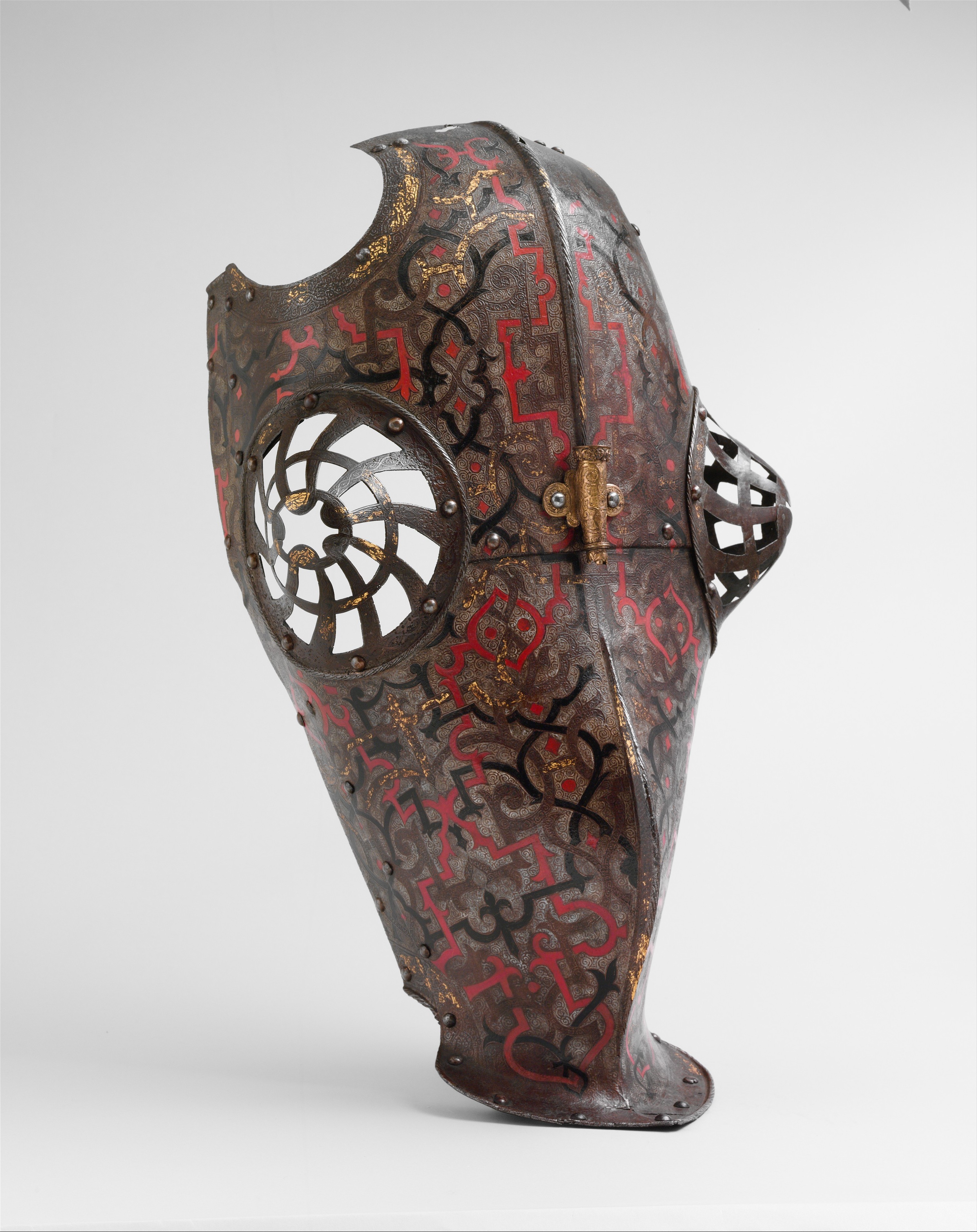
An Exegesis of Power: The Radziwill Armor as Couture Object
To analyze a 16th-century armor garniture through the lens of haute couture is to engage in a radical act of contextual translation. It demands we look beyond the artifact's martial purpose and perceive it as the ultimate bespoke garment—a complex, multi-layered construction engineered for a specific body and an exacting social performance. The Portions of an Armor for Duke Nikolaus "The Black" Radziwill, crafted in the renowned workshops of Nuremberg, represents not merely military equipment but a pinnacle of wearable technology and symbolic communication. Its creation parallels the modern couture house: a collaborative atelier of master artisans (armorers, etchers, gilders, leatherworkers) executing a singular commission for a client of immense stature, where every line, material, and decorative motif is imbued with intentional meaning.
The Silhouette of Sovereignty: Architecture and Articulation
The primary structure of the armor establishes its foundational silhouette—one of imposing, geometric authority. The fluted and ridged design, characteristic of the Maximilian style, serves a dual purpose. Functionally, these corrugations increase structural strength, deflecting blows and mitigating the need for excessively heavy plate. Aesthetically, they create a play of light and shadow, emulating the fashionable slashed fabrics of the period and adding a dynamic, vertical emphasis that elongates and empowers the wearer's form. This is tailoring at its most rigorous: the steel plates are precisely shaped and joined through articulated rivets and leather straps to facilitate the complex kinematics of mounted combat and tournament maneuvering. The articulation points—the pauldrons (shoulders), couters (elbows), and poleyns (knees)—are masterclasses in functional design, allowing for a prescribed range of motion while maintaining impervious protection. The ensemble is a second skeleton, one that externally dictates posture and movement, projecting an image of invulnerable, kinetic readiness.
Surface as Canvas: The Semiotics of Decoration
Beyond its formidable shell, the armor’s surface is a dense text of heraldic and political language. The application of gold against the steel—through techniques like mercury gilding—and the meticulous etched patterns transform defensive plate into a walking manifesto. The decorative program would have prominently featured the Radziwill trąby (trumpet) coat of arms, a visual declaration of lineage that is as crucial as any modern monogram. The etched bands and borders, often featuring foliate motifs, classical grotesques, or interlacing patterns, align the wearer with the Renaissance humanist ideals of the educated prince. This is not random ornamentation; it is a calculated integration of identity and ideology onto the three-dimensional form. The use of colored textiles, likely rich velvet, as linings and as backing for the plackart (lower breastplate) or tonlet (skirt of plates) introduces texture, color, and a tangible connection to the opulence of court dress. The contrast between the cold, hard brilliance of etched steel and the deep, tactile luxury of velvet creates a multisensory dialectic of war and civility, a sartorial expression of the duke’s dual role as marshal and chancellor.
The Garniture System: Modularity as the Ultimate Wardrobe
The concept of the garniture is where this analysis finds its most direct corollary to contemporary fashion systems. A full garniture was a set of interchangeable armor elements allowing one core harness to be configured for different purposes: the field (for war), the tournament (for jousting or foot combat), and the parade. This is the 16th-century equivalent of a capsule wardrobe built around a foundational silhouette. For the field, lighter, more pragmatic components would be used. For the tournament, specialized, reinforced plates—such as a heavier left-side pauldron for the joust or a grand guard for the chest—would be attached. This modularity speaks to a profound understanding of context-specific dressing. Duke Radziwill did not merely own "an armor"; he owned a system, a versatile toolkit for the performance of his various martial and ceremonial duties. Each configuration communicated a different facet of his persona: the efficient commander, the chivalric champion, the imposing sovereign. The couture house today operates on a similar principle of transformative pieces, though the battles are social rather than martial.
Katherine Fashion Lab: Deconstructing the Armored Body
At Katherine Fashion Lab, our interest in such an object lies in its foundational principles of bespoke architecture, context-driven transformation, and symbolic density. This armor was a data-driven garment, shaped from precise measurements of the Duke's body, perhaps even from a wooden mannequin made to his exact proportions—the antecedent of the couture house's dress form. Its production involved a supply chain spanning continents for iron, precious metals, and dyes. Its value resided equally in its material worth, its technical ingenuity, and its unparalleled capacity for identity projection. To study it is to understand that the most powerful garments are those that actively intervene in the world, that alter not only the perception of the wearer but their very capabilities. The Radziwill armor did not just clothe the man; it extended and amplified him into an icon of state power and martial virtue.
In conclusion, this Nuremberg masterpiece transcends its classification as arms and armor. It stands as a seminal work of applied art and elite craftsmanship, a testament to the era's highest achievements in metallurgy, design, and symbolic storytelling. It reminds us that true couture—whether in steel or silk—is an interdisciplinary endeavor. It is the meticulous fusion of engineering, aesthetics, and personal narrative, created for a singular individual to navigate the complex, performative stages of their life. The Duke’s armor is his legacy cast in a wearable, formidable form; it is the ultimate power suit, designed for the most high-stakes boardrooms imaginable—the battlefield and the tiltyard.