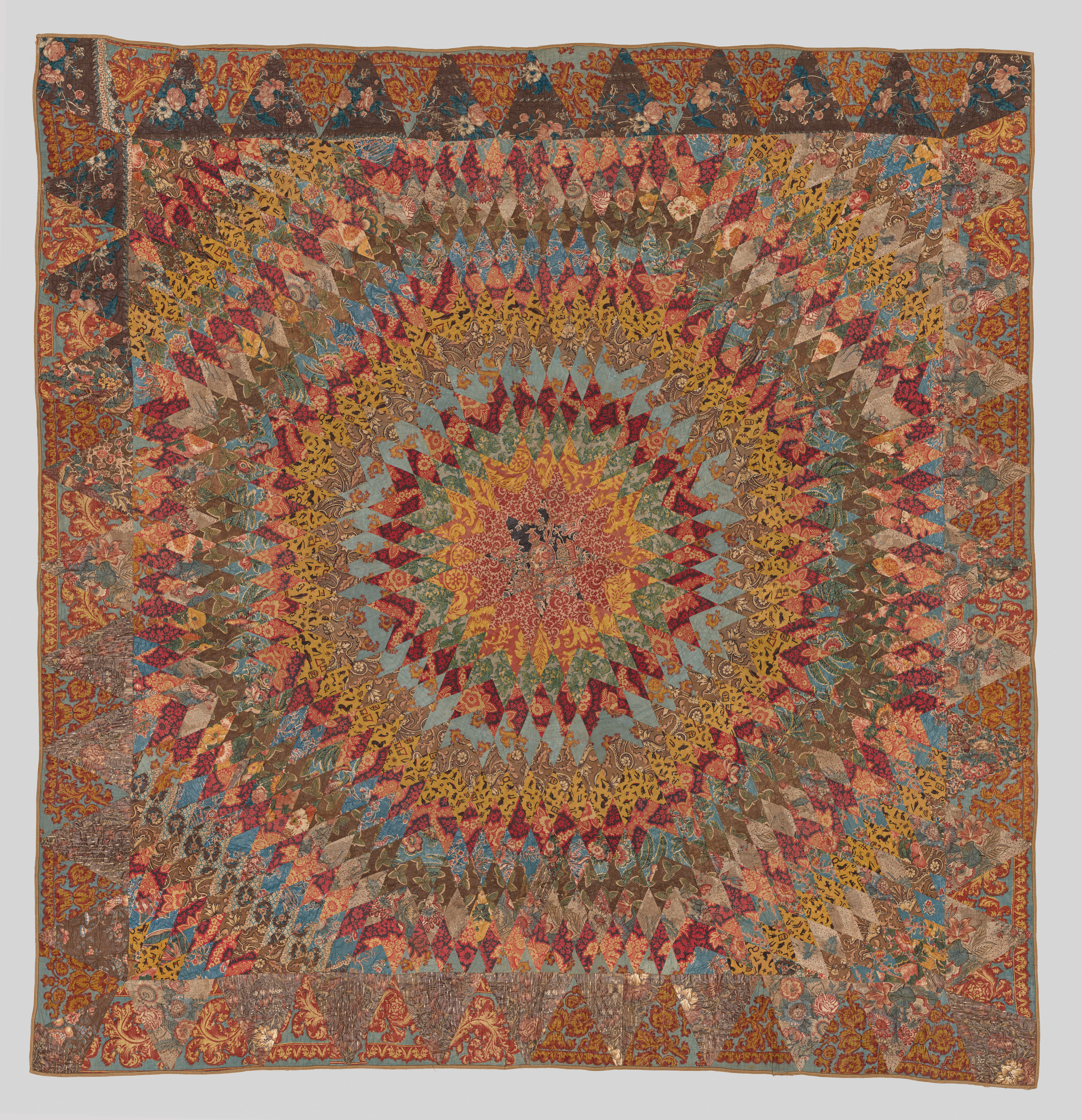
The Star of Jerusalem Quilt: A Cartography of Heritage in Cloth
In the rarefied air of haute couture, where innovation often masquerades as rupture, Katherine Fashion Lab presents a counter-narrative: the Star of Jerusalem Quilt. This is not a garment that shouts for attention through aggressive deconstruction or avant-garde silhouette. Instead, it whispers a profound, layered story through the most humble of mediums—printed and pieced cotton—elevated to a status of museum-grade contemplation. As a standalone study, this piece transcends its utilitarian quilt origins to become a masterclass in material storytelling, cultural synthesis, and the quiet power of geometric devotion.
Deconstructing the Celestial Cartography
At first glance, the quilt's composition is a study in disciplined chaos. The titular Star of Jerusalem—a complex, eight-pointed star formed by the intersection of smaller diamonds and triangles—serves as the central medallion. Yet, unlike its traditional Amish or Pennsylvania Dutch counterparts, which often employ stark, solid-color fields, this iteration deploys a dizzying array of printed cottons sourced from a global diaspora. The eye does not rest; it travels. A fragment of Japanese shibori-inspired indigo print abuts a swatch of West African wax print in ochre and burnt sienna. A delicate chintz floral, redolent of 18th-century English gardens, sits adjacent to a geometric Ikat from Central Asia.
This is not mere pastiche. The Lab's curatorial eye treats each fabric fragment as a discrete cultural phoneme, a letter in a global alphabet. The piecing—the technical act of joining these disparate elements—becomes the syntax. The seams are not hidden or apologetic; they are celebrated, often top-stitched with a contrasting thread that traces the star's rays like a cartographer's grid. The result is a visual palimpsest, where the underlying structure of the star provides a rigid, mathematical order, while the printed surfaces introduce a vibrant, organic chaos. This tension—between the universal geometry of the star and the particular, localized narratives of the cloth—is the quilt's core intellectual proposition.
Materiality as Memory: The Cotton Lexicon
Cotton, in the hands of Katherine Fashion Lab, is not a passive substrate. It is an active agent of memory. The choice of printed and pieced cotton is a deliberate rejection of the synthetic and the ephemeral. Cotton breathes; it holds creases; it softens with touch. It carries the residue of its own history—the heat of the iron, the pressure of the needle, the weight of the hand that guided it. In this quilt, the materiality is the message.
Consider the specific prints. The global heritage origin is not a vague nod to multiculturalism but a precise archival reference. The Lab's research team has sourced reproduction prints that mimic the indigo resist-dyeing of Gujarat, the block-printed sanganeri patterns of Rajasthan, and the hand-painted toile de Jouy of France. Each print is a micro-archive, a compressed history of trade routes, colonial exchange, and artisanal technique. When placed within the star's geometry, these prints are not merely decorative; they are documentary. The quilt becomes a textile encyclopedia, a tactile map of global commerce and cultural confluence, from the Spice Route to the Silk Road.
Furthermore, the piecing technique itself is a nod to the ethos of wabi-sabi and the Japanese concept of boro—the art of mending and patching. Yet, unlike boro's utilitarian frugality, the Lab's approach is celebratory. The seams are precise, the points crisp, the alignment near-perfect. This is not the work of a folk artisan but of a couture atelier. The hand-stitching, invisible from the front but a rhythmic, tiny backstitch on the reverse, speaks to hundreds of hours of labor. This meticulous craftsmanship elevates the quilt from a functional bedcover to a haute couture object, where the value lies not in the rarity of the raw material but in the intellectual and physical labor of its assembly.
Structural Syntax: The Geometry of Devotion
The Star of Jerusalem pattern is not arbitrary. Its eight points carry deep symbolic resonance across multiple faiths and cultures. In Islamic art, the eight-pointed star (khatam) symbolizes the seal of the prophets and the eight gates of paradise. In Christian iconography, it is the Star of Bethlehem, guiding the Magi. In Hindu cosmology, the eight directions (the ashta-dikpalas) are guardians of space. By centering this motif, the Lab creates a nexus point, a place where diverse spiritual cartographies converge.
But the Lab's genius lies in the scaling and repetition of this motif. The central star is massive, perhaps two feet in diameter, its points extending toward the quilt's edges. Around it, smaller, half-stars and quarter-stars emerge from the borders, suggesting that the pattern is infinite, extending beyond the physical confines of the textile. This creates a hypnotic, mandala-like effect. The eye is drawn inward to the center, then pushed outward to the edges, then pulled back again. This rhythmic oscillation mimics the act of meditation—a focused, repetitive contemplation. The quilt is not just seen; it is experienced.
From a technical couture perspective, the construction is a feat of precision engineering. The Y-seams where the star's points meet require an almost surgical accuracy. A miscalculation of even a millimeter would cause the fabric to pucker, distorting the entire geometry. The Lab's artisans have mastered the set-in seam, a technique often avoided in modern mass production due to its complexity. The result is a perfectly flat, taut surface, despite the density of the piecing. This structural integrity is the silent, invisible foundation upon which the visual fireworks depend.
Standalone Study: The Object as Thesis
Presented as a standalone study, the Star of Jerusalem Quilt is liberated from the utilitarian context of the bed. It hangs on a wall, or is displayed on a sculptural stand, demanding to be read as a two-dimensional sculpture or a textile painting. This curatorial decision is profound. It forces the viewer to engage with the piece on its own terms, without the distraction of function. We are not invited to sleep under it; we are invited to think about it.
In this context, the quilt becomes a thesis on the nature of heritage. It argues that heritage is not a static, monolithic entity to be preserved in a glass case. Rather, it is a dynamic, living process of reinterpretation and synthesis. The Lab takes fragments of global heritage—the prints, the motifs, the techniques—and recombines them into a new, coherent whole. This is not cultural appropriation; it is cultural appreciation, executed with rigorous scholarly research and profound technical respect. The quilt is a testament to the idea that true luxury lies not in owning a piece of the past, but in actively engaging with it to create something that speaks to the present.
Ultimately, the Star of Jerusalem Quilt is a quiet manifesto. It challenges the fashion industry's obsession with the new, the fast, and the disposable. It proposes an alternative model: one of slowness, of deliberate craft, of deep research, and of cross-cultural dialogue. It is a garment that is not worn, but inhabited—by the mind. In its intricate folds and precise seams, it holds the weight of the world's textile histories, and offers them to us, not as a relic, but as a radiant, contemporary star.