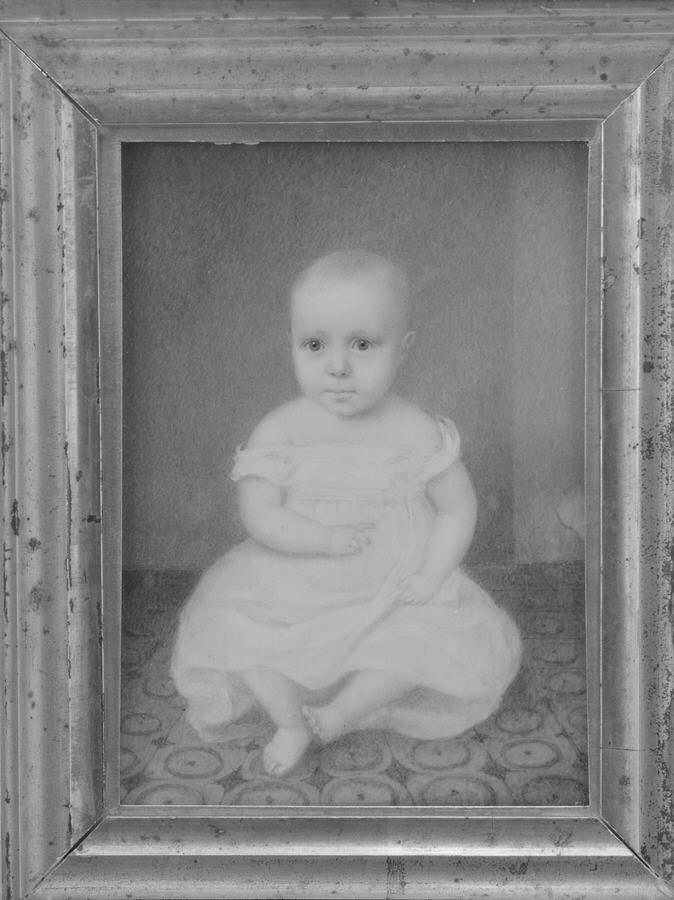
Executive Heritage Analysis: Portrait of a Baby
This strategic research document examines the Portrait of a Baby, an American watercolor on ivory, as a singular artifact of profound cultural and commercial significance. For Katherine Fashion Lab, this piece is not merely a historical curiosity but a blueprint for a 2026 luxury strategy rooted in emotional permanence, protective symbolism, and the reclamation of intimate legacy. The analysis decodes the object’s symbolic power, historical adornment, and spiritual meaning, translating these elements into actionable haute couture directives.
Symbolic Power: The Micro-Monarch and the Gaze of Legacy
The American tradition of infant portraiture, particularly in the 19th century, was a deliberate act of immortalization against mortality. In an era of high infant mortality, commissioning a watercolor on ivory was a declaration of social standing and a desperate, beautiful act of defiance against the ephemeral. The symbolic power of this portrait lies not in the child’s individual identity, but in its role as a dynastic talisman. The baby is depicted not as a child, but as a micro-monarch—a vessel for the family’s future capital, both genetic and financial.
For the 2026 luxury market, this translates into a strategy of “Inherited Singularity.” Katherine Fashion Lab must position its offerings not as commodities but as portraits of the wearer’s potential legacy. The symbolic power of the baby portrait is its absolute focus on the individual as the center of a private universe. The Lab’s 2026 campaign should adopt a visual language that isolates the subject—a single model, a stark backdrop, a single, luminous garment—mirroring the intimate, undivided attention of the ivory miniature. This is not about mass appeal; it is about the cult of the one, where each piece is a bespoke “portrait” of the client’s status and future memory.
Historical Adornment: The Ivory as a Precious Envelope
The medium itself—watercolor on ivory—is the first and most critical layer of historical adornment. Ivory, a material of immense cost and fragility, was not a passive support; it was a luminous substrate that imparted a warm, internal glow to the sitter’s skin. The ivory was polished to a high degree, and the watercolor was applied in fine, almost invisible strokes, creating a surface that was simultaneously delicate and opulent. This is the antithesis of the modern, mass-produced image. The historical adornment here is the envelope—the tiny, jewel-like case, often set in gold or velvet, that protected the portrait. This case was worn as a locket or brooch, physically affixing the child’s image to the mother’s body.
This concept of the “Precious Envelope” is a direct directive for Katherine Fashion Lab’s 2026 accessories and outerwear. The strategy should pivot away from loud branding toward tactile, precious containment. Consider a collection of “Ivory-Touch” cashmere wraps with internal, hidden pockets designed to hold a miniature portrait or a lock of hair, or a line of structured, porcelain-like outerwear that encases the body as the ivory case encased the painting. The adornment is not the print; it is the material integrity that protects the wearer’s personal narrative. The Lab should source materials with a similar internal luminosity—pearlescent silks, polished bone buttons, and matte, high-density wools that mimic the polished ivory surface.
Spiritual Meaning: The Veil Between Worlds
In the American context, these portraits carried a profound spiritual weight, often straddling the line between memorial and celebration. A portrait of a living baby was a protective charm, a way to fix the soul in the earthly realm. Conversely, posthumous portraits were common, serving as a tangible bridge to the departed child. The spiritual meaning is rooted in the idea that the image holds the essence of the person—a pre-photographic belief in the soul’s imprint on the painted surface. The watercolor’s soft edges and translucent washes give the child an ethereal, almost angelic quality, reinforcing the notion that the child is a celestial visitor loaned to the family.
For 2026, Katherine Fashion Lab can harness this spiritual dimension through a strategy of “Aura Preservation.” This moves beyond sustainability into the realm of sentient luxury. The Lab should develop a narrative where garments are not just worn but are guardians of personal energy. This could manifest in a fragrance line named “Ivory Veil,” designed to evoke the clean, powdery scent of old ivory and linen, or a “Heritage Repair” atelier that restores and re-lines vintage garments, treating each piece as a spiritual vessel. The 2026 collection should feature “Veil” fabrics—sheer, layered organzas and translucent silks that mimic the watercolor’s ethereal washes, creating a sense of wearing a protective aura rather than a mere cloth.
2026 High-End Luxury Strategy: The “Ivory Index”
Synthesizing the symbolic, historical, and spiritual findings, Katherine Fashion Lab’s 2026 strategy should be codified under the internal moniker, “The Ivory Index.” This is a three-pillar directive designed to differentiate the brand in a saturated market.
Pillar One: The Miniature Commission
Launch a bespoke portraiture service, not of the face, but of the garment. Clients commission a watercolor-on-ivory miniature of their chosen Katherine Fashion Lab piece, which is then set into a locket or brooch and delivered with the garment. This transforms the purchase into a dynastic artifact, creating an immediate heirloom status. This service leverages the historical adornment of the ivory envelope, positioning the Lab as a creator of legacy objects, not just apparel.
Pillar Two: The “Aura” Textile Development
Invest in proprietary textile technology that mimics the luminosity of polished ivory. This involves developing a fabric with a high-luster, micro-porous finish that reflects light from within, rather than off the surface. This “Ivory Skin” fabric will be used in evening wear and signature outerwear, creating a visual effect of internal warmth and spiritual glow. This is a high-cost, high-exclusivity material, reserved for the “Portrait” tier of the collection, reinforcing scarcity and mystical value.
Pillar Three: The Protective Ritual Campaign
The 2026 marketing narrative will eschew seasonal trends for a ritualistic calendar. The campaign will be a series of short films titled “The Veil,” depicting the dressing process as a spiritual ceremony—the act of putting on the garment as a form of self-consecration. The messaging will pivot from “buy this” to “protect your legacy.” This aligns with the spiritual meaning of the baby portrait, positioning the client as the precious child at the center of their own dynastic portrait. The Lab will offer a “Guardianship” program, where pieces are stored in climate-controlled, ivory-lined archival cases, reinforcing the idea that the garment is a fragile, priceless soul needing protection.
Conclusion: The Portrait as a Commercial Compass
The Portrait of a Baby is not a relic; it is a strategic compass. It directs Katherine Fashion Lab away from the noise of fast luxury and toward a quiet, powerful, and deeply personal form of opulence. By adopting the symbolic power of the micro-monarch, the material integrity of the ivory envelope, and the spiritual gravity of the protective charm, the Lab can create a 2026 portfolio that is not merely worn but inherited, guarded, and venerated. The ultimate luxury is no longer visibility—it is the permanence of the personal portrait, and Katherine Fashion Lab is uniquely positioned to paint it.