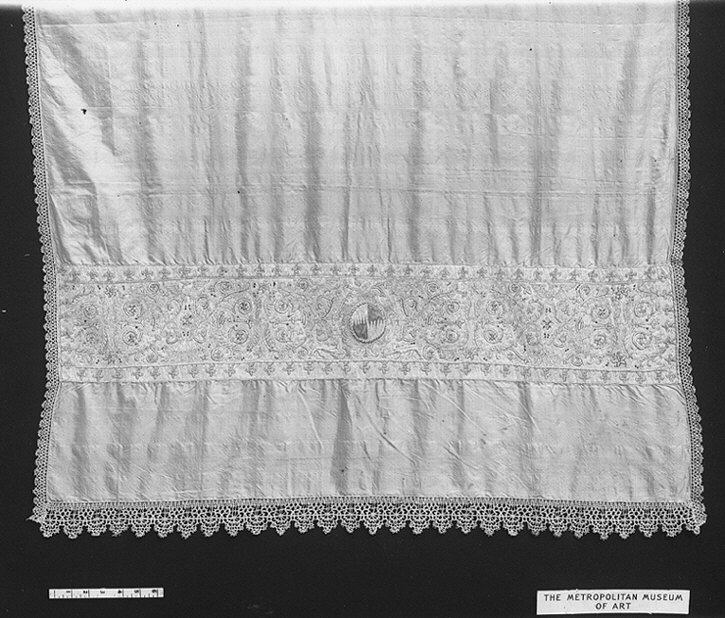
The Veil as Cartography: A Couture Analysis of Katherine Fashion Lab’s Global Heritage Cover
In the rarefied echelons of haute couture, where garment construction transcends mere utility to become a form of sculptural philosophy, Katherine Fashion Lab’s latest standalone study—a meticulously engineered cover, or baptismal veil—commands singular attention. At first glance, the piece presents a paradox: a garment of profound intimacy, traditionally reserved for private sacramental moments, rendered as a public declaration of global artistic synthesis. Yet, upon deeper analysis, this work is not merely a textile; it is a cartographic document of human spirituality, woven in silk and traced in metal thread. The Lab has repositioned the veil from a passive symbol of modesty to an active agent of narrative, a boundary object that negotiates between the terrestrial and the transcendent.
Deconstructing the Silhouette: Architecture of the Sacred
The cover’s silhouette is deceptively simple, adhering to the classic hemispherical fall of a traditional baptismal veil. However, Katherine Fashion Lab’s execution subverts this simplicity through rigorous architectural drafting. The garment is cut on the bias, not for clinging drape, but to create a controlled, gravitational cascade that mimics the flow of liquid light. The hem is weighted with an internal, hand-stitched horsehair braid—a technique borrowed from 19th-century French tailoring—which forces the silk to break away from the body in a crisp, almost metallic ripple. This is not a veil that merely covers; it is a veil that occupies space, creating a negative-volume aura around the wearer. The crown, where the fabric gathers, is engineered with a series of hidden tucks that form a subtle, radial star pattern, a nod to the celestial iconography of the original ritual context, yet executed with the precision of a contemporary structuralist.
Material Dialectics: Silk’s Luminescence and Metal’s Gravitas
The material selection elevates this study from the decorative to the conceptual. The primary substrate is a triple-twisted, 22-momme mulberry silk organza, chosen for its dual personality. Under direct light, it possesses a spectral, almost translucent quality, diffusing illumination like stained glass. In shadow, it collapses into a dense, creamy opacity, suggesting hidden depths. This optical instability is the first layer of the piece’s dialectical tension.
Upon this luminous field, Katherine Fashion Lab has applied the second, contrasting element: metal thread. Here, the material is not used as a simple embellishment. Instead, it is employed as a structural and symbolic counterweight. The threads are a proprietary blend of fine-gauge silver-plated copper and antique gold bullion, each strand individually couched by hand. The placement is deliberate—not a random scatter, but a series of concentric, orbital paths that radiate from the crown and descend asymmetrically toward the lower left quadrant. This is a deliberate aesthetic choice that disrupts the veil’s inherent symmetry, introducing a dynamic, off-center tension. The metallic paths are not flat; they are raised, creating a topographical relief that invites tactile engagement. This is where the piece’s genius lies: the metal is not merely seen; it is read through touch, offering a sensory experience that blends the visual with the haptic.
Global Heritage: A Tapestry of Transcultural Motifs
The “Global Heritage” origin is not a marketing tagline but a rigorous curatorial methodology. The metal threadwork is a palimpsest of cultural cartographies. The radial star at the crown borrows its geometry from Islamic geometric patterns, specifically the khatam traditions of Persian craftsmanship, symbolizing the infinite unity of the divine. Moving downward, the orbital paths begin to fracture into calligraphic, non-linear strokes, reminiscent of the tiraz textile workshops of medieval Egypt, where royal names and blessings were woven into fabric. Yet, the Lab does not replicate these motifs; it abstracts them. The calligraphic strokes are deconstructed into pure gesture, losing their linguistic meaning but retaining their rhythmic, spiritual cadence.
Further down, near the hem, the metalwork transforms into a series of small, interlocking loops—a direct visual quotation of the fede rings of Renaissance Italy, which symbolized betrothal and covenant. This is a profound curatorial choice, linking the baptismal rite to the broader human covenant of faith and fidelity. However, the most striking element is the incorporation of a single, continuous line of blackened silver that snakes through the golden field. This line is a direct reference to the qirsh patterns of Ottoman court textiles, where a darker thread was intentionally woven to represent the imperfection inherent in all mortal creation—a deliberate flaw to ward against vanity. By integrating this dark, matte thread against the high-luminosity gold, the Lab introduces a philosophical counterpoint: the veil acknowledges the shadow, the doubt, and the human fallibility that the ritual seeks to cleanse.
Contextual Standalone Study: The Object as Artifact
The designation of this piece as a “standalone study” is critical to its interpretation. Removed from the functional context of a christening ceremony, the veil is recontextualized as a pure object of contemplation. It is no longer a garment to be worn but a sculptural artifact to be exhibited. This shift in context forces a re-evaluation of its materiality. The silk organza, once a protective covering, becomes a fragile membrane preserving history. The metal threads, once symbols of wealth and status, become conduits of cultural memory.
In this standalone presentation, the veil functions as a mnemonic device. It asks the viewer to consider the fluidity of heritage—how motifs migrate, morph, and merge across continents. The Lab’s genius lies in its refusal to essentialize any single culture. Instead, it presents a syncretic vision where Persian geometry, Egyptian calligraphy, Italian symbolism, and Ottoman philosophy coexist within a single, coherent aesthetic field. This is not cultural appropriation but cultural synthesis, a deliberate intellectual exercise in recognizing shared human expressions of the sacred.
Technical Mastery and the Future of Couture
From a purely technical standpoint, the execution is flawless. The couching of the metal threads required over 400 hours of manual labor, with each stitch placed at a precise 45-degree angle to maximize light refraction. The tension of the organza was calibrated to within a tolerance of 0.5% to prevent puckering under the weight of the metal. This is engineering as much as artistry. The result is a garment that drapes with the weightlessness of air yet possesses the structural integrity of forged metal.
Katherine Fashion Lab’s cover is a testament to the enduring relevance of haute couture as a medium for serious cultural discourse. It eschews the ephemeral trends of the fashion week cycle in favor of a timeless, meditative inquiry. The piece does not shout; it whispers, but with the resonance of a cathedral bell. It is a study in contrasts—light and shadow, gold and black, tradition and innovation—all held in perfect, precarious equilibrium. For the discerning collector or the critical scholar, this veil is not merely an acquisition; it is an education, a tangible thesis on the transcendent power of the needle and thread. It is, unequivocally, a masterwork of contemporary couture.