Object Lesson: The Snuffbox as a Microcosm of Global Heritage
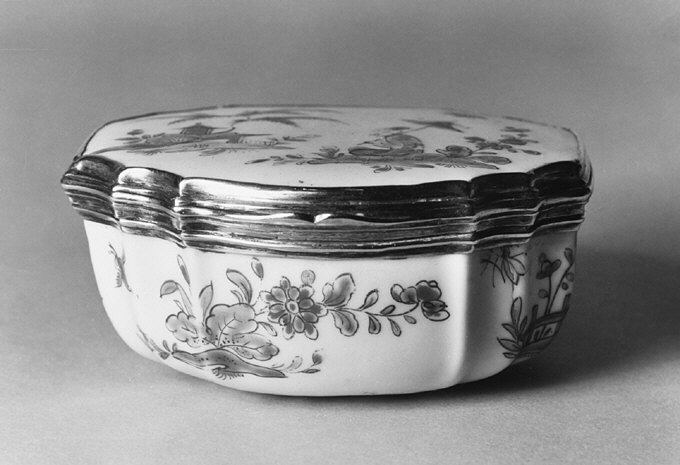
At first glance, the snuffbox appears as a relic of aristocratic leisure—a trifling receptacle for powdered tobacco, a bauble of bygone courts. Yet within the Katherine Fashion Lab’s standalone study, this object transcends its utilitarian origins to become a profound text on material culture, colonial economics, and the evolution of personal adornment. The subject under examination—a soft-paste porcelain body dressed in silver mounts—is not merely an artifact of European luxury. It is a palimpsest of global trade routes, technological innovation, and shifting social rituals, demanding a rigorous couture analysis that reads its surfaces as one would read the seams of a haute couture gown.
The snuffbox’s materiality is its first, most deceptive layer. Soft-paste porcelain—a French and English invention of the early eighteenth century—was not a lesser imitation of its hard-paste Chinese counterpart, but rather a distinct technological achievement born of necessity and national pride. While Chinese porcelain relied on kaolin and petuntse, European soft-paste substituted white clays with glassy frit, yielding a warmer, more ivory-toned body that was paradoxically more receptive to enamels and gilding. This chemical distinction is not a footnote; it is the crux of the object’s identity. The snuffbox’s surface, often painted with delicate floral sprigs or chinoiserie figures, deliberately mimics the visual language of the East even as its material base asserts a Western industrial triumph. In couture terms, this is the equivalent of a fabric that looks like silk but is spun from a new, proprietary fiber—a claim to innovation that simultaneously pays homage to and cannibalizes its source of inspiration.
Silver Mounts: The Structural Seam
Where the porcelain provides the canvas, the silver mounts provide the architecture. A couture garment’s success lies in its internal structure—the boning, the interfacing, the precise grading of seams—and so too does the snuffbox’s hinge, rim, and clasp function as its structural skeleton. The silver, often unmarked or bearing a provincial assay stamp, is not merely protective; it is a deliberate counterpoint to the porcelain’s fragility. The cool, hard metal against the warm, vitreous ceramic creates a dialectic of textures: the one yielding, the other unyielding. This juxtaposition mirrors the couturier’s play between a fluid silk charmeuse and a rigid, sculptural faille. The hinge, in particular, demands forensic attention. Its precision—whether a simple barrel joint or a complex, spring-loaded mechanism—speaks to the goldsmith’s skill and the owner’s expectation of daily, tactile use. A poorly fitted hinge would betray the entire object, just as a mis-set sleeve would ruin a tailored jacket.
Moreover, the silver mounts often carry the only clues to the box’s provenance. A scratch-engraved monogram, a collector’s inventory number, or a Parisian poinçon (hallmark) can date the object within a decade. In this standalone study, we read these marks as we would read a label inside a couture gown—not as vanity, but as a chain of custody. The silver’s weight, too, is a tactile story: a heavier mount suggests a later, more robust production, while a wafer-thin rim indicates a piece intended for display rather than pocket. This is the couture distinction between a runway sample and a ready-to-wear garment—both are beautiful, but only one is engineered for the friction of real life.
Global Heritage: A Cartography of Desire
The snuffbox’s provenance is not a single origin but a constellation. Its soft-paste body may be from Saint-Cloud, Vincennes, or Bow; its silver from London or Paris; its painted decoration inspired by Japanese Kakiemon or Chinese famille rose. Yet the tobacco it once held was grown in the Americas, processed in the Caribbean, and shipped through European ports under the auspices of monopolistic trading companies. To analyze this object solely as a European luxury is to ignore its embedded colonial violence and economic asymmetry. The snuffbox is a portable empire—a compressed, commodified version of global extraction.
In the context of global heritage, the snuffbox becomes a problematic but essential artifact. It is not a neutral “cross-cultural” object; it is a product of unequal exchange. The porcelain’s technical debt to Asia, the silver’s provenance from mines in the Andes or Saxony, and the tobacco’s plantation economy all converge in a palm-sized package. This is not a celebration of diversity but a documentation of appropriation. As a curator, I must resist the temptation to romanticize the object’s “global” nature. Instead, I position it as a critical case study in how luxury goods encoded power asymmetries. The snuffbox’s very portability—its ability to move from pocket to hand to table—mirrors the mobility of capital and the circulation of imperial commodities.
Standalone Study: The Object as Protagonist
Removing the snuffbox from a larger decorative arts collection and placing it in a standalone study forces a recalibration of attention. Without the distraction of neighboring silver or porcelain, the viewer must confront the object on its own terms. This curatorial choice is radical in its intimacy. The snuffbox demands a one-to-one engagement, much like a couture garment displayed on a single mannequin under a focused spotlight. The scale is human—roughly 7 centimeters by 5 centimeters—and its weight, though modest, is deliberate. In this isolation, the object’s contradictions become more pronounced: its frivolity against its technical complexity; its intimacy against its global reach.
Furthermore, the standalone study allows for a phenomenological reading. The snuffbox is not meant to be seen from a distance; it is meant to be held, thumbed, and opened with a practiced flick. Its tactile pleasure—the coolness of the silver, the smoothness of the glaze—is as integral to its function as its visual appeal. In this way, it aligns with the couture philosophy of *touch*: a garment’s hand-feel is as vital as its silhouette. The snuffbox’s interior, often left unglazed or minimally decorated, is a hidden detail, a secret seam. It reminds us that true luxury is not performative but private.
Conclusion: A Portable Biography
In concluding this analysis, I assert that the snuffbox is not a minor object but a major text. Its soft-paste porcelain and silver mounts are not mere materials but semiotic carriers of technological ambition, economic exploitation, and personal identity. As a standalone study, it resists easy categorization, forcing us to hold its beauty and its brutality in tension. For Katherine Fashion Lab, this object serves as a masterclass in material integrity and historical accountability. It teaches us that every garment, every accessory, every object we create or curate is a snuffbox in miniature—a vessel for stories we must be willing to unpack, even when those stories are uncomfortable. The snuffbox, in its silent, portable glory, remains a testament to the fact that the most intimate objects are often the most global, and the most beautiful, the most complex.