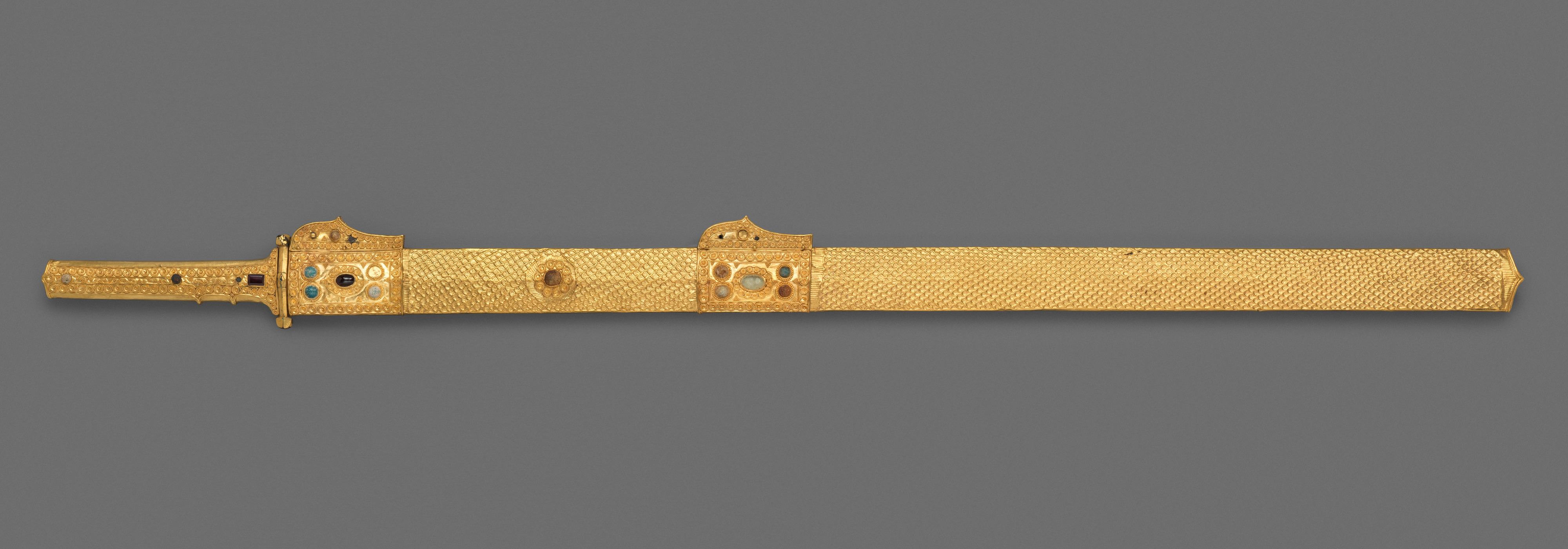
Heritage Analysis: The Sasanian Sword and Scabbard
Within the pantheon of imperial artifacts, the Sasanian sword and scabbard (circa 3rd–7th century CE) stands as a masterclass in the convergence of martial utility, sacred kingship, and opulent artistry. For Katherine Fashion Lab, this object is not merely a relic of ancient Persia; it is a strategic blueprint for communicating authority, transcendence, and uncompromising craftsmanship in the 2026 luxury landscape. This analysis deconstructs the artifact’s material, symbolic, and spiritual lexicon to translate its enduring power into a contemporary high-end brand strategy.
Symbolic Power: The Weapon as Sovereign Mandate
In Sasanian iconography, the sword was never a mere tool of combat. It was the physical embodiment of farr—the divine royal glory that legitimized a monarch’s rule. The blade, forged from iron, represented the unyielding terrestrial force of the empire, while its ornate scabbard elevated it from a weapon of war to a scepter of cosmic order. The deliberate pairing of utilitarian iron with precious gold and garnets created a dialectic: strength disciplined by splendor. For the Sasanian elite, to draw the sword was to enact justice; to display it sheathed was to project the promise of controlled, imminent power.
For Katherine Fashion Lab, this duality is a critical strategic asset. In 2026, the luxury consumer is less interested in overt aggression and more drawn to latent authority—the power that does not need to be demonstrated to be felt. The Sasanian sword teaches us that true luxury lies in the tension between raw material and refined finish. A high-end collection should therefore not shy away from robust, masculine silhouettes (the iron) but must envelop them in meticulously crafted, jeweled closures, embroidered cuffs, or metallic-thread lapels (the gold and garnets). The message is clear: We possess the strength to dominate, but we choose to present it as art.
Historical Adornment: A Study in Material Hierarchy
The artifact’s medium—gold over wood, garnets, glass-paste, and gilt-bronze—reveals a sophisticated economic and aesthetic hierarchy. The wooden core provided structure, but the gold overlay signified immortality and solar divinity. Garnets, with their deep, blood-red hue, symbolized life force, vitality, and the enduring flame of the dynasty. The inclusion of glass-paste is particularly telling; it was a deliberate imitation of more precious stones, demonstrating that in Sasanian culture, perception of value could be engineered through brilliance, not just intrinsic rarity. The gilt-bronze guard, a less noble metal, was reserved for the point of contact—a pragmatic nod to wear and tear, yet still gilded to maintain visual consistency.
From a historical adornment perspective, this object was designed for ceremonial visibility. It was worn at the hip, positioned to be seen during processions, court audiences, and diplomatic exchanges. The placement was not incidental; it created a direct line of sight from the emperor’s face to the sword’s pommel, reinforcing the indivisibility of the ruler and his martial might. The scabbard’s suspension system likely included intricate belt fittings, ensuring that the weapon moved with a rhythmic, deliberate sway—a kinetic advertisement of imperial grace.
Katherine Fashion Lab can translate this material hierarchy into a 2026 product strategy by adopting a “core-and-carat” approach. Just as the Sasanian sword used wood as its hidden foundation, our garments should feature invisible, high-performance structural bases—advanced technical fabrics or tailored corsetry—that provide impeccable form. The visible exterior must then be treated as a canvas for strategic embellishment: not uniform beading, but clustered, deliberate placements of crystal, enamel, or metallic thread that mimic the garnet’s focal intensity. The use of glass-paste in the original should inspire us to experiment with high-refractive-index synthetics that offer the visual drama of gemstones at a fraction of the environmental cost—a key selling point for the eco-conscious ultra-luxury buyer of 2026.
Spiritual Meaning: The Blade as Cosmic Axis
Beyond politics and aesthetics, the Sasanian sword carried profound spiritual weight. Zoroastrian cosmology, the dominant faith of the era, held that the material world was a battleground between order (Asha) and chaos (Druj). The king, as the representative of Ahura Mazda, was duty-bound to wield his sword in defense of cosmic truth. The garnets were not merely decorative; they were seen as fragments of sacred fire, the primary symbol of divine presence. The act of sheathing the sword was a ritual of sealing order, while drawing it was an invocation of divine wrath. Thus, the scabbard was not a container but a reliquary, housing the instrument of cosmic justice.
This spiritual dimension offers Katherine Fashion Lab a profound narrative hook. In a 2026 market saturated with nihilistic or purely hedonistic luxury, a brand that offers objects of protection and intention will stand out. The sword’s spiritual meaning can be translated into a “talismanic” collection where each garment or accessory is designed not just to adorn, but to empower the wearer. This could manifest as hidden interior pockets lined with symbolic embroidery (representing the scabbard’s inner sanctum), or outer closures that feature a single, prominent “guard” element—a sculpted metal clasp or a heavy, polished stone—that anchors the garment’s energy. The marketing narrative should emphasize that wearing the piece is an act of self-sovereignty, a modern ritual of preparing oneself to face the daily chaos of the world with grace and unshakeable resolve.
2026 High-End Luxury Strategy: From Artifact to Aura
To operationalize this heritage analysis, Katherine Fashion Lab must move beyond mere visual inspiration and adopt a multisensory and narrative-driven strategy. The following pillars define the 2026 approach:
Pillar One: The “Sheathed Power” Silhouette
Design collections that emphasize controlled volume. Outerwear should feature structured, high-shouldered lines that suggest a “blade’s edge,” but fasten with asymmetric, jeweled closures that demand a deliberate, slow unbuttoning—mirroring the ritual of unsheathing. Evening gowns can incorporate a metallic underlay visible only at the hem or slit, representing the iron core beneath the golden exterior. The goal is to create garments that feel like armor, but move like silk.
Pillar Two: The “Garnet Cluster” Embellishment Logic
Avoid uniform beading. Instead, employ a “constellation” technique where deep-red crystals, black onyx, and burnished gold threads are clustered at key power points: the sternum, the shoulders, and the hip line (echoing the sword’s suspension point). This creates a visual hierarchy that draws the eye to the wearer’s core, projecting stability and focus. For entry-level luxury items, use high-quality glass-paste with a proprietary high-refractive coating, allowing a larger consumer base to access the “fire” of the garnet without the ethical or financial weight of mined stones.
Pillar Three: The “Reliquary” Retail Experience
The 2026 flagship store should be designed as a modern scabbard—a long, narrow, dimly lit corridor with walls of brushed bronze and dark wood. Each garment will be displayed on a floating mannequin, illuminated by a focused, warm spotlight that mimics the glint of gold on iron. The purchase process should be ritualized: the client is invited to a private “guard room” where the garment is presented on a velvet-lined tray, accompanied by a curated scent (sandalwood and myrrh) and a card explaining the specific Sasanian symbolism of the piece’s embellishments. This transforms a transaction into a ceremony of investiture.
Pillar Four: Strategic Storytelling and Exclusivity
Launch a limited “Farr” capsule collection of no more than 100 pieces, each numbered and accompanied by a certificate referencing a specific Sasanian king or battle. The marketing campaign should not focus on the sword as a weapon, but as a guardian of legacy. Collaborate with a contemporary art historian to produce a short documentary on the artifact’s journey from the Iranian plateau to the modern atelier, emphasizing the continuity of human desire for protection and beauty. In 2026, the luxury client does not buy a product; they buy a provenance of power. By positioning Katherine Fashion Lab as the only house that can translate Sasanian imperial theology into wearable form, we secure a unique, defensible niche at the apex of the market.
Conclusion: The Eternal Sheath
The Sasanian sword and scabbard is a testament to the fact that true luxury is never purely decorative. It is a compressed narrative of a civilization’s highest ideals. For Katherine Fashion Lab, this artifact provides a robust strategic framework for 2026: embrace material hierarchy, engineer perceived value through brilliance, and imbue every creation with a spiritual purpose. By adopting the ethos of the sheathed blade—power held in perfect, jeweled restraint—the brand will not only honor a magnificent heritage but also define the next standard of authoritative elegance. The sword is ancient; its strategy is timeless.