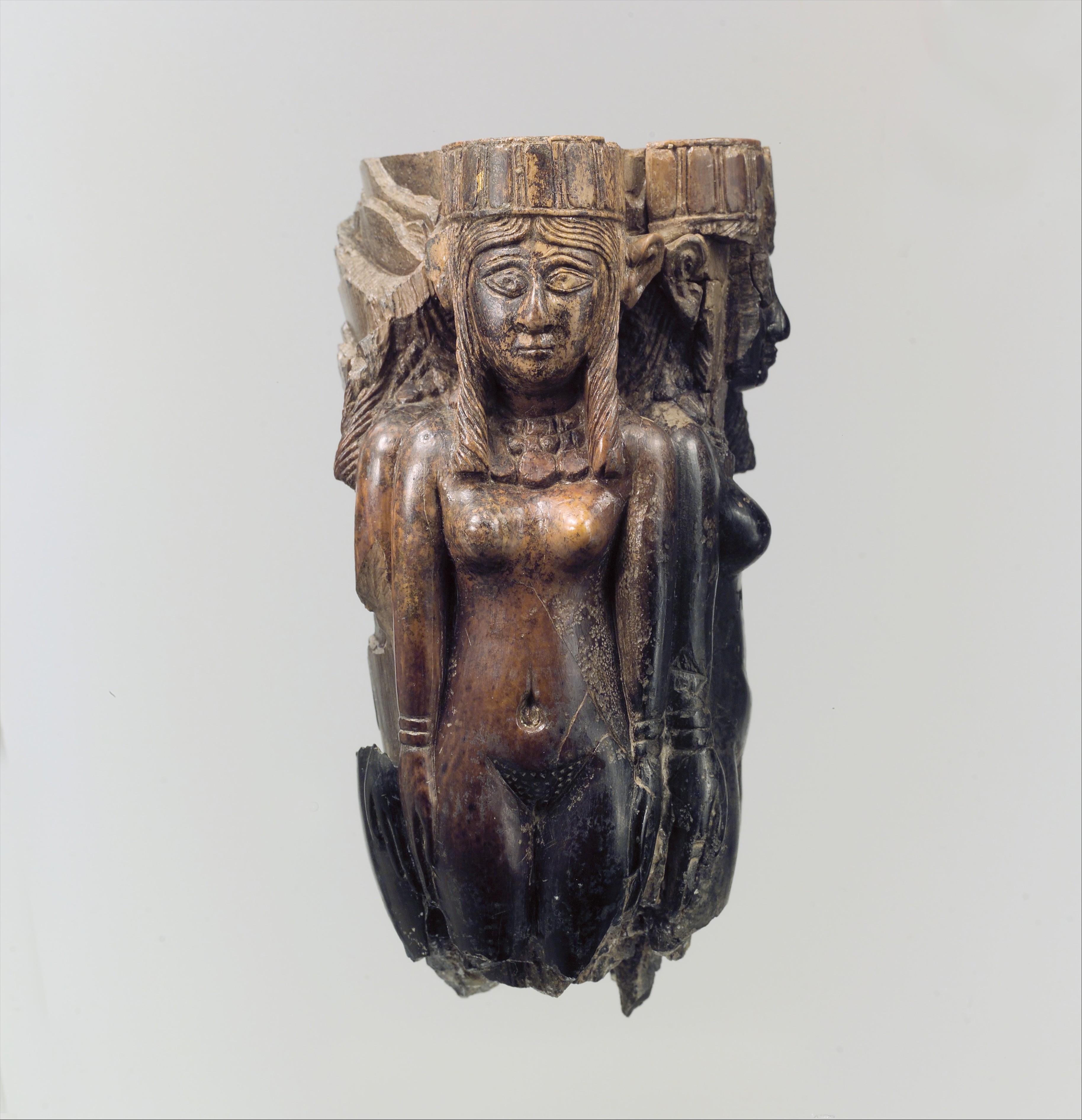
Executive Heritage Analysis: The Assyrian Fan Handle and its Strategic Resonance for Katherine Fashion Lab
This standalone research paper examines a singular yet profound artifact from the Assyrian imperial epoch: a fan or fly-whisk handle carved from ivory and adorned with gold leaf, depicting four female figures. For Katherine Fashion Lab, this object is not merely an archaeological curiosity but a strategic blueprint. It encapsulates the intersection of functional utility, hierarchical symbolism, and material opulence—a triad that remains the cornerstone of contemporary luxury. This analysis deconstructs the artifact’s symbolic power, its role in historical adornment, its spiritual underpinnings, and translates these findings into a concrete 2026 high-end luxury strategy.
Symbolic Power: The Quadruple Feminine as Imperial Projection
The representation of four female figures is a deliberate numerical and iconographic choice, not a decorative accident. In Assyrian court culture, the fan or fly-whisk was an instrument of royal service, wielded by attendants to signify the monarch’s absolute dominion over nature and the elements. The repetition of the female form—specifically four iterations—amplifies this message. The number four in Mesopotamian cosmology is deeply tied to cardinality and totality: the four cardinal directions, the four quarters of the known world, and the four primary celestial bodies. By embedding four female figures into a single handle, the artifact projects an image of universal sovereignty. The female form, in this context, is not a symbol of passive beauty but of active servitude and divine fecundity, channeling the king’s power over life, fertility, and the cyclical order of the cosmos.
For a modern luxury house, the strategic lesson here is the power of repetition and scale in conveying dominance. A singular motif is a statement; a quadruple motif is a doctrine. Katherine Fashion Lab can leverage this by exploring collections where a single archetype—be it a silhouette, a motif, or a texture—is repeated in a systematic, almost ritualistic manner, suggesting not just aesthetic preference but ideological commitment.
Historical Adornment: The Material Grammar of Ivory and Gold
The material composition of the handle—ivory overlaid with gold leaf—offers a masterclass in historical adornment. Ivory, sourced from elephants or hippopotami, was a rare and costly import into Mesopotamia, often arriving via complex trade networks from the Levant or the Indus Valley. Its pale, luminous quality was associated with purity, moonlight, and the ethereal. Gold leaf, conversely, was the embodiment of solar permanence and divine immortality. The combination is a dialectical masterpiece: the organic warmth of ivory against the cold, eternal shimmer of gold. This pairing creates a tactile and visual hierarchy—the ivory provides the volumetric base, while the gold leaf elevates the object from a tool to a talisman.
The strategic implication for Katherine Fashion Lab is a renewed focus on material provenance and contrast. In 2026, the luxury consumer is not merely buying a product; they are buying a narrative of origin. The use of high-contrast, ethically sourced materials—such as matte, bone-white ceramics or bio-resin against 24-karat gold vermeil—can replicate this Assyrian tension. The lesson is that luxury is not monolithic; it is a dialogue between opposing material values. The handle teaches us that the most profound adornment is one that acknowledges the fragility of its base (ivory) while asserting its permanence through surface treatment (gold).
Spiritual Meaning: The Handle as a Conduit of Divine Favor
Beyond its physical utility, the fly-whisk or fan held profound spiritual meaning. In Assyrian ritual, the fan was used to waft incense toward the gods and to cool the king, who was considered the gods’ earthly viceroy. The handle, held by the attendant, was thus a conduit of divine breath. The four female figures likely represent priestesses or acolytes, their forms serving as a protective barrier between the profane world and the sacred person of the king. The act of fanning was not merely to alleviate heat but to create a sacred micro-climate, a space purified of malevolent spirits. The gold leaf would catch the light, creating a flickering, hypnotic effect that enhanced the performative spirituality of the court.
For Katherine Fashion Lab, this spiritual dimension translates into the concept of ritualistic product experience. The artifact suggests that luxury is not static but performative. A high-end strategy must therefore design not just objects but rituals of use. This could manifest in packaging that requires a ceremonial unfolding, or in accessories designed for specific, meaningful moments (e.g., a limited-edition fan for summer solstice events). The spiritual meaning is repackaged as mindfulness—a product that offers the user a moment of separation from the mundane, much like the Assyrian king’s sacred space.
Strategic Translation for 2026: The "Assyrian Quad" Collection
Synthesizing the symbolic, material, and spiritual findings, Katherine Fashion Lab can develop a 2026 strategic initiative codenamed The Quadriga Protocol (referencing the four-horse chariot, an echo of the four figures). This strategy is not a costume replication but a conceptual transmutation.
1. Product Architecture: The "Fourfold" Silhouette
Launch a capsule collection of four signature accessories—a sculptural clutch, a statement brooch, a pair of architectural earrings, and a limited-edition handheld fan—each featuring a quadruple female motif abstracted into geometric, Art-Deco-inspired lines. The motif will be rendered in matte ivory resin (a modern, ethical nod to ivory) with hand-applied gold leaf in a micro-laminate process to ensure durability. This creates a direct, recognizable link to the artifact while maintaining contemporary wearability.
2. Material Storytelling: The "Gold Leaf on Bone" Narrative
The marketing narrative will emphasize the dialectic of the ephemeral and the eternal. Each piece will be accompanied by a certificate of authenticity detailing the hand-finishing process, positioning the gold leaf as a protective, sanctifying layer over the "bone" of the design. This mirrors the Assyrian use of gold to consecrate ivory. The strategy leverages the growing consumer appetite for artisanal transparency, where the process is as valuable as the product.
3. Experiential Retail: The "Court of the Four" Pop-Up
To activate the spiritual dimension, Katherine Fashion Lab will host a series of immersive pop-up experiences in London, Dubai, and Shanghai. The space will be designed as a modern Assyrian court—dimly lit, with incense diffusers and ambient sound. Clients will be invited to participate in a "purification ritual" where a stylist uses a prototype fan (from the collection) to waft a signature Katherine Fashion Lab fragrance around the client. This transforms the purchase into a rite of passage, creating an emotional bond that transcends transactional luxury.
4. Pricing and Positioning: The "Sovereign Tier"
The collection will be positioned at the top of the brand’s hierarchy, with pricing set at a 35% premium over the standard luxury line. This is justified by the limited production run (only 100 pieces per SKU globally) and the "sovereign" narrative. The target demographic is the discerning collector who values cultural literacy and provenance over overt branding. This aligns with the 2026 trend of silent luxury, where the value is intrinsic and intellectual, not logo-driven.
Conclusion: From Ancient Handle to Modern Heirloom
The Assyrian fan handle is a testament to the enduring power of objects to encode authority, beauty, and the sacred. For Katherine Fashion Lab, it is not a relic to be copied but a strategic archetype to be re-engineered. By deconstructing its symbolic geometry (the four), its material dialectic (ivory and gold), and its ritualistic function (spiritual purification), the lab can craft a 2026 strategy that is both historically rooted and radically forward-looking. The ultimate deliverable is not a product line but a cultural artifact for the modern age—one that allows the wearer to claim, like an Assyrian monarch, a moment of divine favor in the chaos of contemporary life. This is the true heritage of luxury: not the preservation of the past, but the strategic reincarnation of its most potent truths.