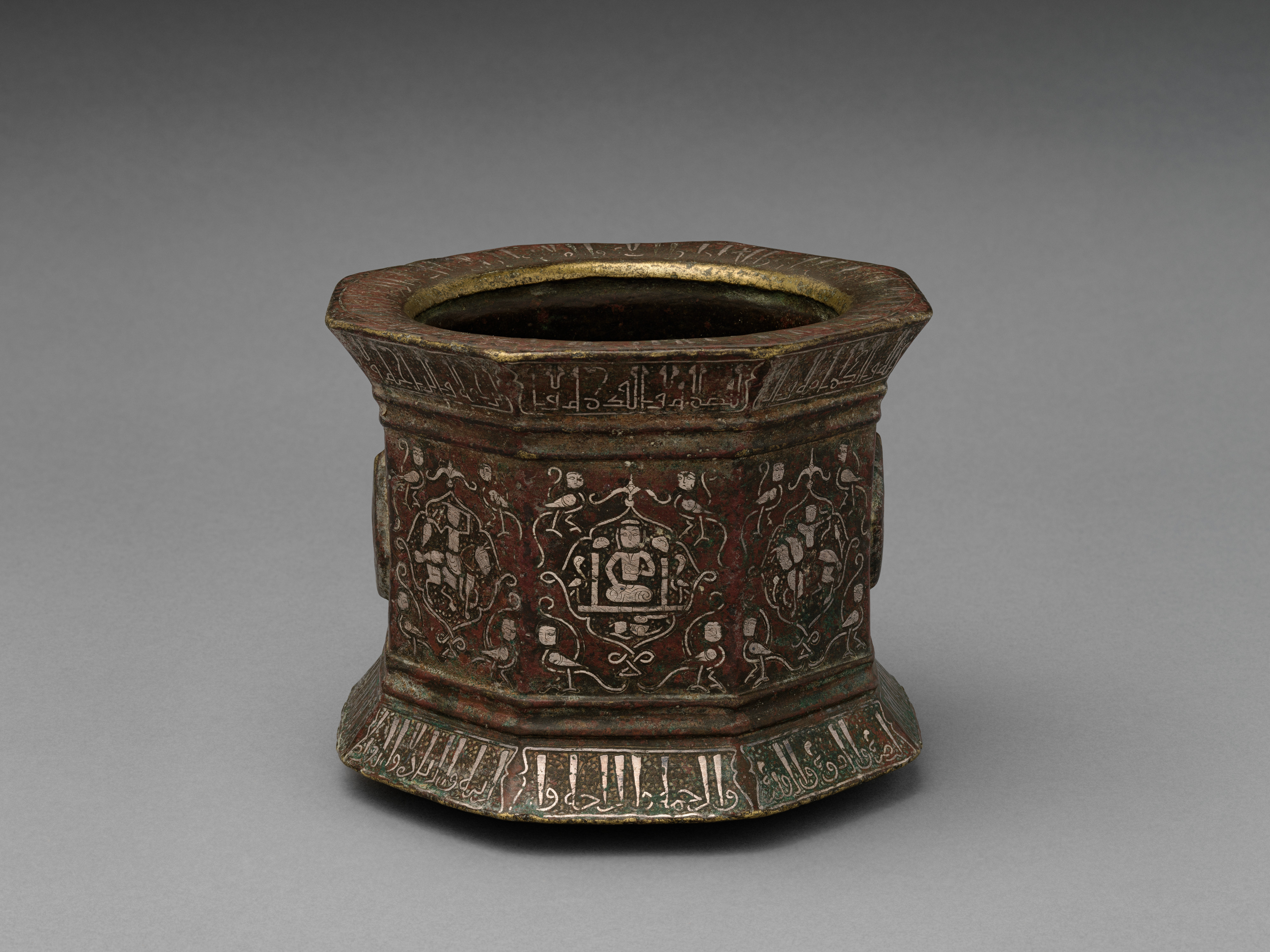
Executive Heritage Analysis: The Mortar and Pestle of Abu Bakr 'Ali Malikzad al-Tabrizi
This strategic heritage analysis examines the bronze mortar and pestle attributed to Abu Bakr 'Ali Malikzad al-Tabrizi, a master artisan of the ancient Persianate world. Commissioned for a princely patron, this object transcends its utilitarian classification as a kitchen or apothecary implement. It functions as a complex artifact of symbolic power, historical adornment, and spiritual meaning. For Katherine Fashion Lab, this piece offers a profound blueprint for a 2026 high-end luxury strategy rooted in ritualized craftsmanship, material alchemy, and tactile heritage.
Symbolic Power: The Alchemical Throne of Transformation
The mortar and pestle is not merely a tool for grinding; in the ancient civilization of the Islamic Golden Age, it was an instrument of alchemical transformation. The act of crushing substances—whether medicinal herbs, pigments, or aromatic compounds—was understood as a microcosmic reenactment of cosmic creation. The artisan, al-Tabrizi, has imbued the bronze form with a commanding presence. The heavy, flared base and robust pestle suggest a gravitational authority, anchoring the user to the earth while the upward gesture of the mortar’s lip reaches toward the celestial. In the courtly context of Tabriz, such objects were displayed as trophies of intellectual mastery, signaling the owner’s command over nature, chemistry, and the esoteric sciences. For the modern luxury consumer, this translates into a desire for objects that confer agency—items that do not merely decorate but empower the user through ritual action.
Adornment as a Language of Sovereignty
The decorative program of this artifact is a masterclass in historical adornment. The inlaid silver, meticulously hammered into channels carved into the bronze, creates a stark, luminous contrast against the dark, patinated ground. The black compound—likely a bitumen or lacquer-based substance—fills the recessed backgrounds, heightening the three-dimensional relief of the silver tracery. The motifs, likely featuring arabesques, interlacing geometric star patterns, and calligraphic bands, are not arbitrary. They encode the patron’s name, titles, and blessings, transforming the object into a portable proclamation of identity. The silver catches light with every movement, creating a kinetic shimmer that mirrors the flickering of courtly candlelight. This is adornment as a dynamic, living language—not static embellishment. In the 2026 luxury landscape, where digital saturation has dulled sensory impact, this artifact argues for a return to material contrast: the interplay of matte and polished, dark and light, weight and delicacy.
Spiritual Meaning: The Vessel of Sacred Preparation
Beyond its alchemical and political roles, the mortar and pestle held profound spiritual resonance. In Sufi and Islamic philosophical traditions, the grinding of substances symbolized the pulverization of the ego (nafs) to release the essential spirit. The pestle’s repetitive, rhythmic pounding was a form of dhikr—a meditative remembrance of the divine. The black compound inlaid within the bronze is particularly evocative; it represents the khala (void) from which creation emerges, while the silver signifies the nur (divine light) that illuminates it. This duality—void and light, base and precious—positions the object as a spiritual technology for attaining clarity. For Katherine Fashion Lab, this offers a potent narrative: luxury as a medium for mindful transformation. A 2026 collection could position its garments or accessories as 'ritual tools' for the modern individual, designed to be handled, worn, and used in daily ceremonies of self-care, grounding, and intentional focus.
Material Alchemy: Bronze, Silver, and the Patina of Time
The material composition of the artifact is itself a strategic lesson. Bronze, an alloy of copper and tin, was prized for its durability and its ability to hold intricate detail. The silver inlay adds a precious-metal counterpoint, elevating the object from mere utility to treasured heirloom. The black compound, often a mixture of copper sulfide or organic resin, serves not only a decorative purpose but also a protective one, sealing the incised lines from corrosion. This tri-material system—base metal, noble metal, and organic compound—creates a hierarchical value structure that is both tactile and visual. The inevitable patina that develops on bronze over centuries is not a flaw but a narrative deposit, recording the object’s journey through time. In luxury strategy, this translates to an appreciation for imperfect perfection: the acceptance of wear, the beauty of aging, and the story embedded in every scratch. The 2026 consumer, increasingly weary of mass-produced sameness, will pay a premium for objects that promise to accrue character.
2026 High-End Luxury Strategy: The Ritualized Object
Drawing from this heritage analysis, Katherine Fashion Lab can develop a cohesive 2026 strategy centered on the Ritual Object Archetype. This is not a literal reproduction of the mortar and pestle, but a philosophical and aesthetic translation into fashion and lifestyle products.
Design Principles: Contrast and Weight
First, the design language must embrace material contrast. We will explore textiles and hardware that juxtapose deep, matte blacks (echoing the black compound) with high-polish metallic accents (echoing the silver). Garments could feature structural, weighted elements—such as metal-tipped cords, heavy zippers, or sculptural buttons—that mimic the solid heft of the pestle, encouraging the wearer to feel grounded and present. The collection should include unisex, oversized silhouettes that drape like the heavy folds of a courtly robe, yet are cinched with belts or straps that reference the geometric interlacing of the artifact’s decoration.
Product Line: The Alchemist’s Kit
Second, we propose a limited-edition product line called 'The Alchemist’s Kit'. This would include a series of small, portable leather cases containing a set of ritual accessories: a solid-brass scent diffuser, a hand-carved stone massage tool, and a silk-wrapped journal. Each item is designed to be used in a daily 10-minute 'grinding' ritual—whether crushing a fragrant resin, applying pressure to acupressure points, or writing down a single intention. The packaging itself should be a bronze-toned, weighted box with a magnetic closure, echoing the mortar’s form. This transforms the purchase from a transaction into an initiation into a practice.
Brand Narrative and Marketing: The Patina of Provenance
Third, the marketing strategy must emphasize provenance and process. We will release a documentary-style film series titled Al-Tabrizi’s Echo, featuring contemporary artisans—metalworkers, perfumers, and textile weavers—who demonstrate their craft using methods unchanged for centuries. The narrative will position Katherine Fashion Lab not as a creator of newness, but as a custodian of ancient knowledge, translating the spiritual discipline of al-Tabrizi into modern wearable forms. The campaign tagline, 'Crush the Noise, Extract the Essence', speaks directly to the 2026 consumer’s desire for focus and authenticity in a fragmented world.
Pricing and Exclusivity: The Heirloom Contract
Finally, pricing should reflect the heirloom contract. Each piece will be numbered, and the owner will receive a certificate of authenticity that includes a digital ledger entry, tracing the item’s creation date, artisan’s name, and a unique 'patina code' that will evolve as the item ages. We will offer a lifetime restoration service, allowing clients to return their items for re-polishing or re-inlaying of metal accents, ensuring the object’s longevity and emotional resonance. This strategy positions Katherine Fashion Lab at the apex of the 2026 luxury market: not selling products, but bequeathing legacies.
Conclusion: From Ancient Bronze to Future Luxury
The mortar and pestle of Abu Bakr 'Ali Malikzad al-Tabrizi is a testament to the enduring power of objects that combine function, beauty, and meaning. Its symbolic power lies in its alchemical agency, its adornment speaks a sovereign language of contrast and light, and its spiritual meaning offers a path to inner clarity. For Katherine Fashion Lab, this artifact is not a museum piece but a strategic compass. By adopting its principles—ritualized craftsmanship, material contrast, and narrative depth—the brand can navigate the 2026 luxury landscape with authority, offering clients not just garments and accessories, but instruments of transformation worthy of an ancient court.