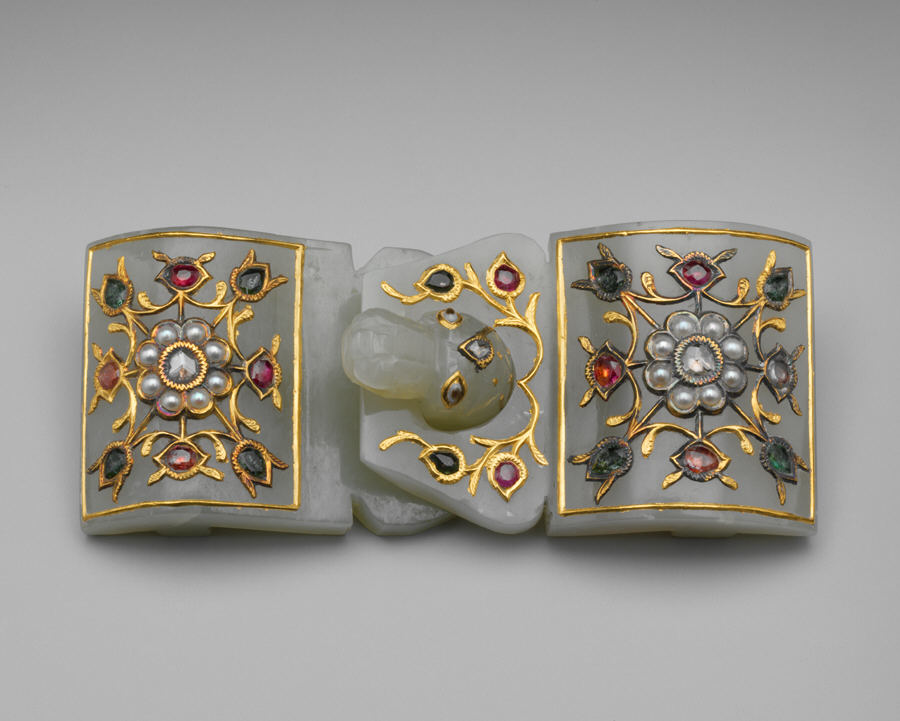
Executive Summary: The Belt Buckle as a Locus of Imperial Authority
The belt buckle, often relegated to the periphery of contemporary fashion discourse, emerges in this analysis as a profound artifact of Chinese cultural sovereignty. For Katherine Fashion Lab, the object under examination—a nephrite jade buckle inlaid with gold, pearl, and semiprecious stones—is not merely a functional fastener but a condensed thesis on power, cosmology, and material metaphysics. This strategic standalone research positions the buckle as a pivotal motif for a 2026 high-end luxury strategy, arguing that its inherent layers of symbolic capital can be translated into a modern narrative of restrained opulence and cultural gravitas. The analysis will deconstruct the buckle’s historical function as a marker of rank, its spiritual resonance within Daoist and Confucian frameworks, and finally, propose a curatorial strategy that leverages this heritage for a discerning, globally astute clientele.
Historical Adornment: The Buckle as an Instrument of Social Stratification
Within the annals of Chinese material history, the belt buckle—or daikou—functioned as a precise instrument of bureaucratic and aristocratic hierarchy. Its origins can be traced to the Warring States period (475–221 BCE), where nomadic steppe influences merged with Han Chinese sartorial codes. However, by the Tang (618–907 CE) and Ming (1368–1644 CE) dynasties, the buckle had evolved into a codified system of sumptuary law. The material, size, and number of inlays were strictly regulated by imperial decree; gold and jade were reserved exclusively for the emperor, his immediate family, and the highest echelons of the nobility. To wear a jade buckle was to literally carry a fragment of the state’s authority upon one’s person.
In this specific artifact, the choice of nephrite jade is significant. Unlike the more translucent jadeite, nephrite is valued for its dense, waxy texture and its deep, muted greens—colors associated with the earth and the virtue of ren (benevolence). The gold inlays, often forming stylized dragon or cloud motifs, serve as a counterpoint of solar luminosity against the terrestrial jade. This juxtaposition is not accidental; it visually articulates the emperor’s role as the Son of Heaven, the mediator between the celestial realm (gold) and the earthly domain (jade). The pearl, centrally placed, acts as the "night-shining pearl" of Daoist lore, a symbol of wisdom and the purest essence of yin energy. Thus, the buckle is a microcosmic map of the imperial cosmos, worn at the waist—the body’s center of gravity and, symbolically, the seat of balance and governance.
Spiritual Meaning and Metaphysical Resonance
Beyond its socio-political function, the buckle is a vessel for profound spiritual meaning. In Confucian philosophy, jade is not a passive stone but an active moral agent. The Liji (Book of Rites) famously attributes eleven virtues to jade, including wisdom, righteousness, and purity. Wearing jade against the body is an act of self-cultivation; the stone is believed to absorb the wearer’s energy and, in turn, emit a calming, harmonizing frequency. For the historical Chinese elite, the belt buckle was therefore a daily talisman—a silent, tactile reminder of one’s ethical obligations.
The semiprecious stone inlays, likely including turquoise, lapis lazuli, or coral, add a layer of protective symbolism. Turquoise, in particular, was associated with warding off evil spirits and ensuring safe passage, both in the physical world and the afterlife. The placement of these stones along the buckle’s perimeter creates a protective boundary, a literal "circle of safety" around the wearer’s vital organs. This spiritual dimension transforms the buckle from a decorative object into a functional amulet. For the modern luxury consumer, this offers a compelling narrative: the acquisition of a jewel is not merely an investment in material value but an investment in metaphysical well-being—a concept that resonates strongly with contemporary wellness-driven luxury trends.
Strategic Application: The 2026 Katherine Fashion Lab Luxury Proposition
For the 2026 strategic cycle, Katherine Fashion Lab must move beyond superficial "Orientalist" appropriation. The goal is to achieve cultural transposition—extracting the essence of the buckle’s power dynamics and re-contextualizing it for a global audience that values authenticity and heritage. The following strategic pillars are proposed:
Pillar One: The "Sovereign Closure" Collection
We will introduce a capsule collection of belt buckles and waist-defining accessories that reinterpret the imperial motif through a minimalist, architectural lens. The nephrite jade will be sourced from certified, heritage mines in Xinjiang, ensuring provenance and ethical extraction. The design will eschew overt dragon imagery in favor of abstract, geometric representations of the taotie motif or the "thunder pattern" (leiwen), offering a subtle nod to antiquity that appeals to the connoisseur rather than the casual consumer. Each buckle will be numbered and accompanied by a "provenance dossier" detailing the specific historical dynasty that inspired its geometry.
Pillar Two: The "Amuletic Luxury" Narrative
Marketing communications will pivot from a focus on "status" to a focus on "alignment." The 2026 campaign, titled The Weight of Wisdom, will position the buckle as a tool for personal grounding in an era of digital fragmentation. We will leverage the spiritual properties of jade—its coolness, its weight, its moral resonance—as a counterpoint to the ephemerality of fast fashion. This is a deliberate strategy to capture the high-net-worth individual (HNWI) seeking "quiet luxury" with a deeper, philosophical foundation. The pearl inlay will be marketed as the "core of clarity," a nod to the wearer’s discerning vision.
Pillar Three: Bespoke Commissioning and Institutional Alliances
To elevate the buckle from a product to a patrimony, Katherine Fashion Lab will offer a Private Atelier Commission program. Clients may commission a bespoke buckle, selecting their jade grade, inlay stones, and clasp mechanism, guided by our in-house heritage curators. This service will be capped at 20 commissions per year to maintain exclusivity. Furthermore, we will forge a strategic alliance with the Palace Museum in Beijing and the Shanghai Museum to co-host a traveling exhibition, Fastened Power: The Belt Buckle in Chinese Imperial Court. This partnership will lend institutional credibility and generate a halo effect of scholarly prestige around our 2026 collections.
Conclusion: From Artifact to Archetype
In conclusion, the Chinese jade belt buckle is not a static relic but a dynamic archetype of leadership, protection, and moral clarity. By decoding its historical and spiritual codes, Katherine Fashion Lab can craft a 2026 strategy that is both commercially astute and culturally respectful. The buckle’s journey—from the waist of a Tang emperor to the atelier of a modern luxury house—is a testament to the enduring power of adornment as a language of power. Our strategy will ensure that this language is spoken fluently, not merely quoted, positioning Katherine Fashion Lab as the definitive interpreter of Chinese heritage for the global luxury market.