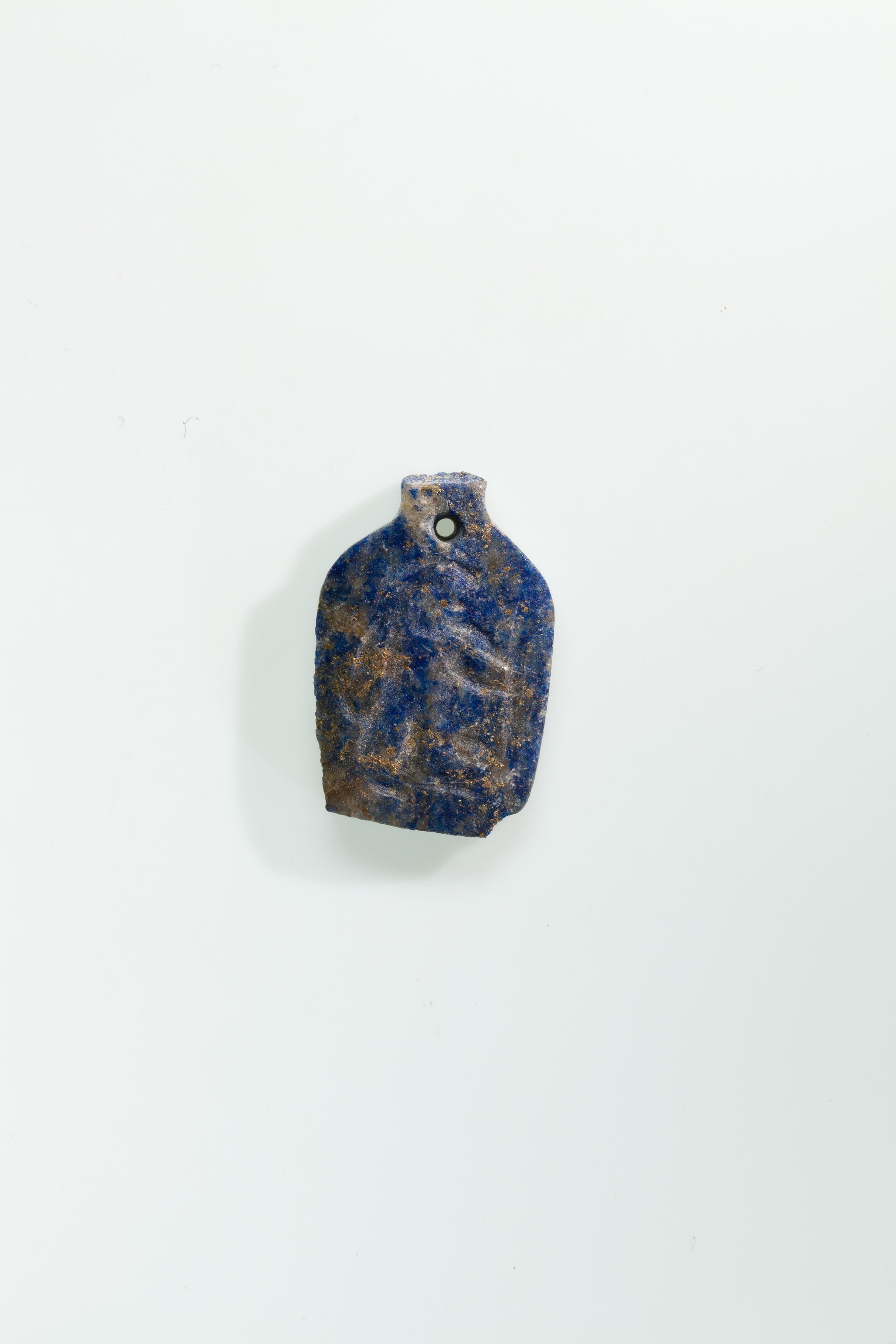
Heritage Analysis: The Striding Man Plaque and Its Resonance for Katherine Fashion Lab
In the rarefied sphere of high-end luxury, the past is not merely a prologue; it is a repository of potent symbols, capable of conferring depth, authority, and narrative weight upon contemporary creations. For Katherine Fashion Lab, the strategic integration of heritage artifacts into its design philosophy is not an exercise in antiquarianism but a deliberate act of brand alchemy. The subject of this analysis—a plaque depicting a striding man, carved from lapis lazuli and originally part of a string of amulets from an Ancient Civilization—offers a uniquely compelling lexicon for a 2026 luxury strategy. This artifact is not simply an ornament; it is a condensed thesis on power, protection, and the human condition, rendered in one of history’s most coveted materials.
Symbolic Power and the Iconography of Motion
The most immediate and potent element of the plaque is the depiction of the striding man. In the artistic conventions of antiquity, the striding pose was rarely a casual representation of movement. It was a formalized icon of agency, dominion, and purposeful advance. The figure, with one leg forward, embodies the act of overcoming—the physical and metaphysical traversal of boundaries. In a strategic context, this symbol aligns perfectly with the ethos of the modern luxury consumer: the individual who defines their own path, who moves with intention, and who commands their environment. For Katherine Fashion Lab, this iconography translates into a design language of assertive elegance. It is not the static pose of a sovereign at rest, but the dynamic energy of a leader in motion. This can be expressed through garment silhouettes that suggest forward momentum—sharp tailoring, asymmetric draping, or the strategic placement of a motif that implies trajectory.
Furthermore, the materiality of the artifact amplifies its symbolic power. Lapis lazuli, with its deep celestial blue flecked with pyrite, was more than a gemstone; it was a fragment of the heavens. In ancient Mesopotamia and Egypt, it was associated with the divine, with kingship, and with the night sky. To wear lapis was to wear the firmament, to claim a connection to the gods. The color itself—a profound, saturated blue—is a perennial signifier of royalty, wisdom, and truth. In a 2026 luxury strategy, this translates into a chromatic authority. Katherine Fashion Lab can leverage this specific hue as a signature color, not merely as a trend, but as a foundational brand element. The use of deep lapis blue in evening wear, accessories, or as a lining detail becomes an insider’s code, a signal of depth and discernment that resonates with clients who understand the language of rarity.
Historical Adornment and the Semiotics of the Amulet
The context of the plaque—as part of a string of amulets—is critical to its strategic interpretation. Amulets were not passive decorations; they were active agents of protection, health, and fortune. The striding man, in this context, was likely a talisman for safe passage, a guardian against malevolent forces, and a charm for vitality. This transforms the plaque from a purely aesthetic object into a functional one, imbued with purpose. The historical function of adornment was thus deeply intertwined with wellbeing and spiritual security. The modern luxury consumer, despite living in an age of unprecedented material comfort, often experiences a profound sense of precarity—be it economic, environmental, or social. There is a growing demand for objects that offer a sense of grounding, protection, and inner resolve.
Katherine Fashion Lab can strategically respond to this by repositioning its offerings not just as garments or accessories, but as modern talismans. The concept of the "protective layer" can be translated into design through the use of high-performance, tactile fabrics that shield the wearer from the elements, or through the integration of concealed, symbolic hardware. The amulet's function as a portable, personal artifact suggests a strategy of intimate luxury. This could manifest in a focused line of "personal power" pieces—pendants, cufflinks, or belt buckles—that are designed to be worn close to the body, each carrying the striding man motif as a private emblem of intent. This narrative moves beyond the superficiality of "fast fashion" and into the realm of meaningful, lasting value.
Spiritual Meaning and the Narrative of Ascendancy
The spiritual dimension of the lapis lazuli plaque cannot be overstated. In many ancient cultures, lapis was a bridge between the earthly and the divine. It was ground into pigment for sacred murals and inlaid into funerary masks to ensure the deceased’s passage into the afterlife. The striding man, therefore, is not merely walking on earth; he is potentially striding between worlds, a liminal figure of transition and transcendence. This spiritual connotation offers a profound narrative for a luxury brand in 2026. As consumers increasingly seek meaning and authenticity, they are drawn to brands that offer a sense of purpose beyond the transactional. The story of the striding man is one of ascension, of moving from a state of being to a higher state of becoming.
For Katherine Fashion Lab, this translates into a brand narrative centered on transformation. The design process can be framed as a journey of refinement, where raw materials are elevated into objects of beauty and significance. Marketing campaigns can weave this narrative, positioning the wearer of Katherine Fashion Lab creations as an individual in a constant state of evolution, striding confidently toward their own potential. The spiritual meaning also allows for a sophisticated dialogue around sustainability. The ancient reverence for materials, where a stone like lapis was treasured for centuries, stands in stark contrast to modern disposability. By championing a philosophy of "sacred permanence"—creating pieces designed to be heirlooms, not ephemera—the brand aligns itself with a more conscious, spiritual approach to consumption.
2026 High-End Luxury Strategy: Integration and Exclusivity
To operationalize this heritage analysis into a concrete 2026 strategy, Katherine Fashion Lab must adopt a multi-pronged approach that blends storytelling, product development, and experiential marketing.
Product Development: The "Ascension" Collection
Launch a capsule collection titled "Ascension," directly inspired by the striding man. The collection would feature a signature lapis-blue colorway across all categories. Key pieces could include a tailored wool coat with a hidden internal pocket embroidered with the striding man motif in metallic thread—a private talisman for the owner. Accessories would feature hardware cast in a matte, gunmetal finish, echoing the pyrite inclusions in the lapis, with the striding man figure integrated into clasps and zipper pulls. A limited-edition high jewelry line would feature actual lapis lazuli cabochons, set in 18k gold, with the striding man engraved on the reverse side—a wearable amulet for the modern era. This product line is not merely apparel; it is a collection of protective, empowering artifacts.
Experiential and Narrative Marketing
The brand should eschew conventional advertising in favor of immersive storytelling. A private, invitation-only event could be staged in a museum or a gallery, where the original artifact (or a high-fidelity replica) is displayed alongside the new collection. The narrative would be presented by a historian and a designer, connecting the ancient symbolism to the modern silhouette. Digital content should take the form of a "visual essay" or a short documentary, exploring the provenance of the piece and the craftsmanship of the new line. The tone must be scholarly yet accessible, reinforcing the brand's intellectual authority. This approach positions Katherine Fashion Lab not as a seller of goods, but as a curator of meaningful experiences and a guardian of cultural narratives.
Brand Positioning and Client Engagement
The final strategic pillar is the cultivation of exclusivity. The "Ascension" collection should be produced in extremely limited quantities, with a portion of the proceeds donated to archaeological preservation efforts. This creates a virtuous cycle, linking the brand to the stewardship of cultural heritage. For top-tier clients, a "Bespoke Talisman" service could be offered, where clients commission a personal piece featuring the striding man, with the option to incorporate personal gemstones or engravings. This service transforms a purchase into a ritual, forging an unbreakable bond between the client and the brand. In 2026, luxury is defined by depth of meaning, rarity of experience, and the resonance of a story that speaks to the soul. The striding man of lapis lazuli provides Katherine Fashion Lab with precisely that—a timeless symbol of power, protection, and purposeful advancement, ready to be reimagined for the discerning few.