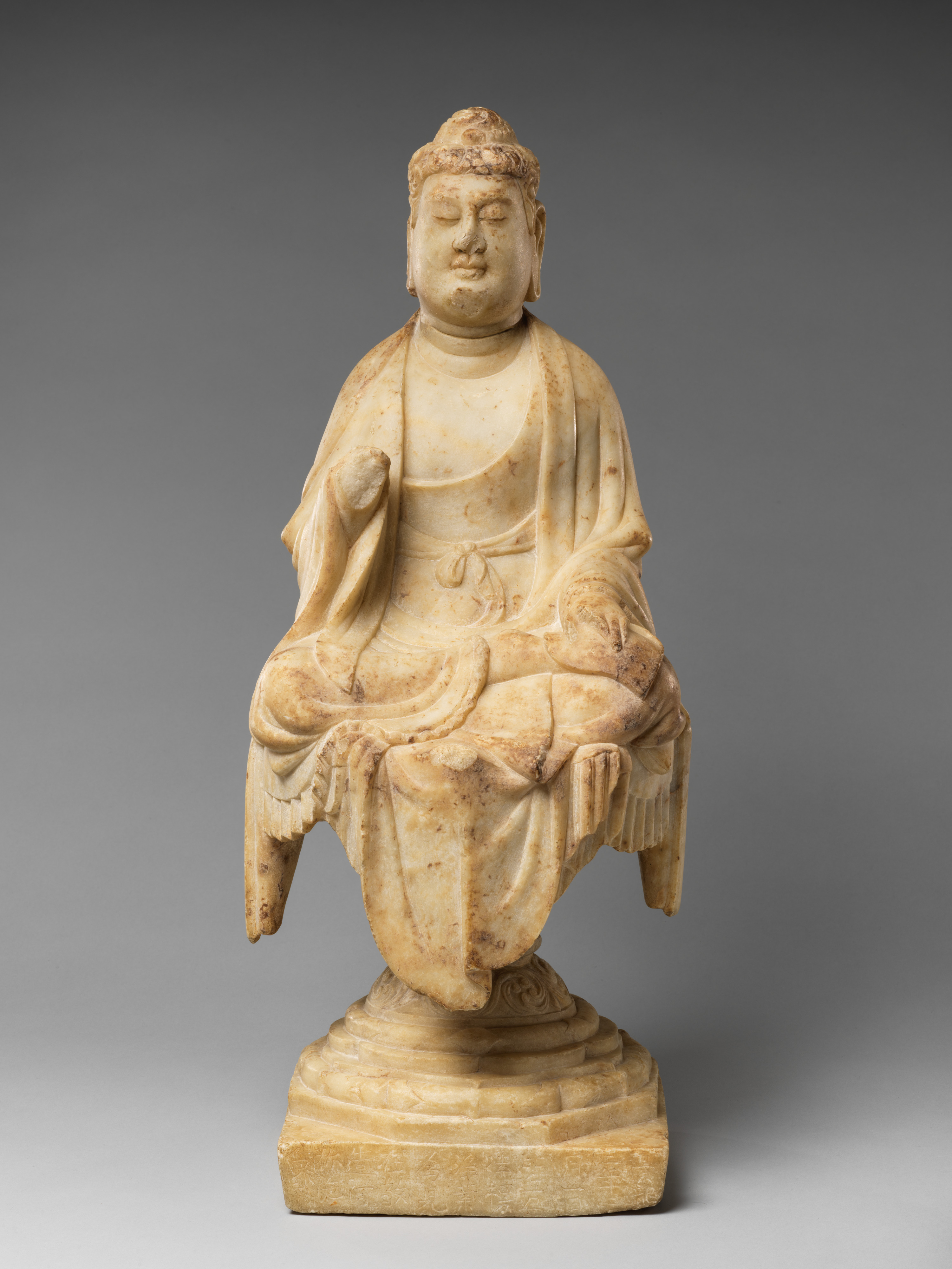
The Sacred Geometry of Stone: A Couture Analysis of the Marble Buddha
In the rarefied echelons of high fashion, where fabric is but a whisper and form is the ultimate statement, Katherine Fashion Lab presents a study in transcendental minimalism. The subject—a Buddha rendered in pristine Chinese marble—is not merely a sculptural artifact but a profound lesson in the architecture of serenity. Placed as a standalone study, this piece transcends its material origins to become a masterclass in the couture principles of drape, structure, and the deliberate absence of excess. Here, the cold, unyielding stone is transformed into the softest, most ethereal garment ever conceived: the robe of enlightenment.
Deconstructing the Drape: Marble as Fluid Couture
The first point of analysis is the illusion of fabric in a medium of absolute rigidity. In couture, the plastron and the drapé are techniques used to create volume and movement. The anonymous sculptor has achieved a feat that rivals the ateliers of Paris: the carving of a garment that appears to be draped, folded, and cinched, yet is hewn from a single block of stone. The folds of the monastic robe (kāṣāya) are not random; they follow a deliberate gravitational logic, pooling at the shoulders and cascading in rhythmic, parallel lines toward the base. This is the couture ideal of engineered fluidity—a paradox where weightlessness is achieved through immense weight.
Observe the neckline. The way the marble folds over the left shoulder, leaving the right bare, is a deliberate asymmetry that modern fashion houses employ to create visual interest. This is not a mistake of antiquity but a sophisticated design choice, echoing the asymmetry found in avant-garde draping by designers like Madame Grès. The stone’s surface is polished to a soft, matte sheen, absorbing light rather than reflecting it, which further enhances the illusion of a heavy, luxurious silk that has been gently laid upon the form. The tactile quality—the suggestion of sensual softness within a mineral hardness—is the hallmark of Katherine Fashion Lab’s philosophy: that true luxury is found in the tension between opposing forces.
Structural Silhouette: The Architecture of Stillness
Moving from the micro-detail of the folds to the macro-silhouette, the standalone composition presents a vertical, monolithic block that is both grounding and elevating. The absence of a pedestal—the figure sits directly on the ground—anchors the piece in a present, tangible reality. This is a deliberate rejection of the elevated, untouchable nature of typical museum displays. In couture terms, this is the ultimate grounded silhouette, akin to a heavy, floor-sweeping evening gown that creates a powerful, immovable presence. The proportions are exaggerated in their simplicity: a broad, stable base that tapers gently upward to the crown of the head, forming a near-perfect pyramid. This geometric stability is the antithesis of the fleeting, ephemeral nature of seasonal trends.
The posture—the dhyāna mudrā, with hands resting in the lap—creates a closed, self-contained energy. There is no outward reach, no gesture toward the viewer. This internalized focus is a powerful lesson in negative space. In fashion, negative space is the void between the garment and the body, the breath that gives a design life. Here, the negative space is internal; it is the conceptual void within the figure that represents the absence of desire. The lab’s analysis highlights how the shoulder line is relaxed, not forced, and the chest is subtly concave, suggesting an exhalation of breath. This is the antithesis of the power-shouldered, aggressive tailoring of Western business attire. It is a couture of surrender, not conquest.
The Material Lexicon: Marble as the Ultimate Textile
China’s long history with marble—particularly the pure, white varieties from provinces like Yunnan and Hebei—provides a contextual richness that is essential to this analysis. Unlike the colorful brocades or silks of the imperial court, marble offers a monochromatic palette. This restraint is the ultimate luxury. The stone is not dyed, printed, or embellished. Its value lies in its intrinsic, geologic pattern—the subtle veining that runs like a faint watermark through the figure. These veins are the fabric’s grain, the natural irregularities that make each piece an original, one-of-a-kind toile.
Katherine Fashion Lab posits that this material choice represents a form of permanent couture. While silk rots, wool moths, and sequins tarnish, marble is immutable. It is a garment that will never be worn out, never be discarded, and never go out of style. The choice of marble over jade or bronze is significant; jade is precious and ornate, bronze is martial and historic. Marble, however, is intellectual and pure. It speaks to a philosophy of less, but better. The coolness of the stone to the touch is a sensory detail that a fabric designer would replicate with high-thread-count cottons or temperature-regulating technical knits. Here, it is a literal, physical reality.
Contextual Solitude: The Standalone Study as a Fashion Statement
The placement of this Buddha as a standalone study is a curatorial decision that amplifies its couture significance. It is isolated, unadorned, and given the entire stage. There is no crowd of other artifacts, no competing colors, and no explanatory wall text to distract the eye. This is the equivalent of a model walking a minimalist runway alone, in a single, perfect garment, with no accessories. The isolation forces a confrontation. The viewer must engage with the craft—the cut, the seam, the finish—without the crutch of context.
This solitude creates a powerful dialogue between the object and the observer. The Buddha’s serene, downcast gaze does not seek validation. It is confident in its own construction. In an era of fast fashion and visual noise, this standalone presentation is a radical act of curatorial editing. It suggests that true style does not require a chorus; it is a solo performance. The empty space around the sculpture functions as a bespoke showroom, where the silence is the most luxurious accessory.
Conclusion: The Eternal Garment
In conclusion, the Marble Buddha from China, as analyzed by Katherine Fashion Lab, is not a relic of religious history but a timeless piece of wearable philosophy. It deconstructs the very notion of clothing, asking us to consider what it means to be draped, to be structured, and to be present. The stone robe is not a covering; it is an expression of the self. The lab’s analysis reveals a garment that is simultaneously ancient and avant-garde, heavy and light, silent and profoundly communicative. It is the ultimate couture piece—one that cannot be bought, only contemplated. It teaches us that the most powerful statement in fashion is not the loudest print or the most complex construction, but the serene, unshakeable confidence of a perfect, unadorned form. The Buddha, in his marble drapery, is the eternal muse for the modern designer—a testament to the fact that true elegance is carved, not sewn.