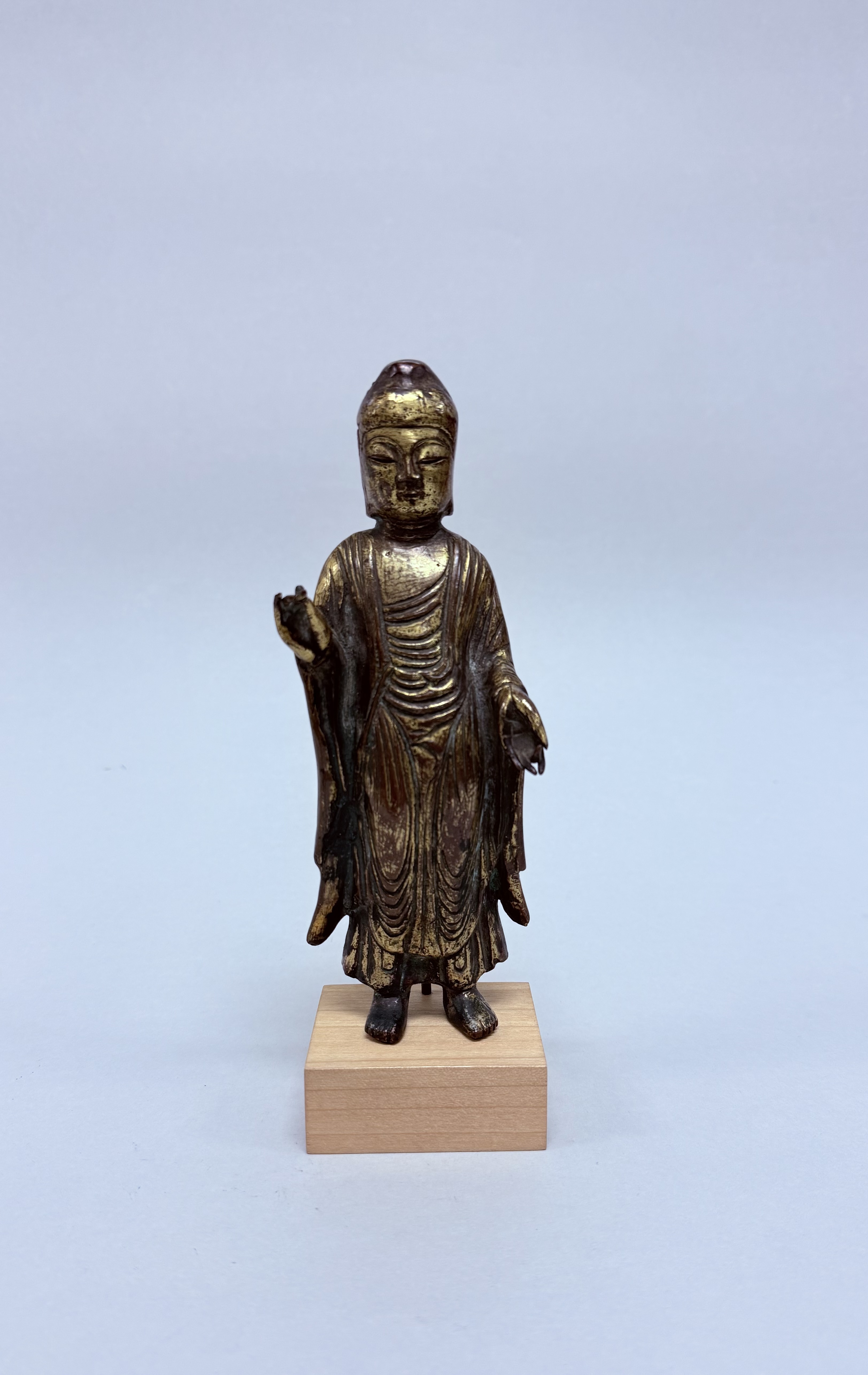
Executive Heritage Assessment: The Standing Gilt-Bronze Buddha of Korea
This strategic heritage analysis examines the Standing Gilt-Bronze Buddha from the Korean peninsula as a masterwork of spiritual artistry and a potent cultural asset for Katherine Fashion Lab’s 2026 luxury positioning. The analysis decodes the object’s symbolic power, historical adornment practices, and spiritual resonance, translating these into actionable insights for high-end brand narrative, product architecture, and client experience. The Buddha is not merely an artifact; it is a repository of disciplined aesthetics, material transcendence, and quiet authority—attributes that align precisely with the evolving semantics of contemporary luxury.
I. Symbolic Power: The Architecture of Serenity and Authority
The Standing Buddha embodies a paradox central to its symbolic endurance: absolute stillness as the ultimate form of power. Unlike seated meditative forms, the standing posture (abhaya or varada mudra variations) signals active presence, readiness, and benevolent protection. In Korean Buddhist iconography, this stance—often associated with the Maitreya (Future Buddha) or Amitabha (Western Paradise)—communicates a sovereign calm that does not demand attention but commands it through gravitational stillness. For Katherine Fashion Lab, this translates into a luxury archetype of “quiet command”: garments and accessories that do not shout but radiate an unassailable internal coherence.
The gilt surface amplifies this symbolism. Gold, in Korean Buddhist tradition, is not decorative excess but alchemical illumination—the material manifestation of enlightenment. The reflective quality of gilt bronze catches light not to dazzle but to disperse it gently, creating a halo effect that is both terrestrial and celestial. In a 2026 luxury context, where ostentatious logos are declining in favor of material intelligence, this suggests a strategy of using precious metals and reflective finishes sparingly, as accent points that suggest inner radiance rather than external wealth.
Mudra as Brand Gesture
The specific hand gestures (mudras) of the Standing Buddha are codified signals of intention. The abhaya mudra (fearlessness) and varada mudra (gift-giving) are not passive; they are performative acts of spiritual generosity. For Katherine Fashion Lab, this informs a gestural design language—consider sculptural sleeves, asymmetric drapes, or clasp details that mimic these hand positions, transforming a garment into a silent blessing. The brand can adopt a “mudra signature” in its runway staging or product photography: models holding a specific hand pose that echoes the Buddha’s, creating a visual mnemonic of protection and offering.
II. Historical Adornment: Gilt Bronze as a Luxury Material Lexicon
The medium of gilt bronze—copper alloy gilded with a mercury-based gold amalgam—represents one of the most sophisticated material technologies of the Korean Three Kingdoms and Unified Silla periods (6th–9th centuries). This technique demanded exceptional metallurgical skill, as the gilding process was hazardous, labor-intensive, and reserved for objects of supreme religious and political importance. The result is a surface that is both durable and ethereal, with a depth that pure gold leaf cannot achieve.
For Katherine Fashion Lab, this historical material science offers a premium material narrative for 2026. The brand could develop a signature textile or hardware finish that mimics the “gilt bronze effect”—a layered, burnished surface that appears to glow from within. This could be achieved through:
- Double-faced metallic silk with a matte-gold reverse, echoing the bronze’s dual nature.
- Hand-finished brass or bronze hardware with a proprietary patina process, referencing the aged, revered surfaces of museum-grade statues.
- Jacquard weaves that replicate the subtle hammer marks and casting seams of the original artifact.
Historically, such adornment was not worn but venerated. The shift for luxury is to transform veneration into wearable reverence—pieces that carry the weight of ritual without the literal religious context. The 2026 client seeks “adornment with ancestry”: objects that feel inherited, not merely purchased. Gilt bronze’s history as a material for eternal offerings positions Katherine Fashion Lab’s products as modern-day heirlooms.
III. Spiritual Meaning: The Economics of Inner Stillness
Korean Buddhism, particularly the Seon (Zen) tradition, emphasizes direct insight over doctrinal learning. The Standing Buddha is not a deity to be worshipped but a mirror of the practitioner’s own potential for awakening. This is a profound shift from Western luxury’s traditional focus on external achievement. The spiritual meaning here is self-realization through simplicity—a stripping away of the superfluous to reveal the essential.
In 2026, the luxury consumer is increasingly seeking “meaningful minimalism”—not the austerity of scarcity, but the richness of intentional curation. The Standing Buddha’s spiritual core offers Katherine Fashion Lab a philosophical framework:
- Reduction as luxury: Each garment or accessory must justify its existence, much like every line of the Buddha’s robe.
- Presence over performance: The Buddha’s power lies in its stillness; the brand’s power lies in its refusal to chase trends.
- Impermanence as value: The natural patina on gilt bronze is not a flaw but a record of time. Katherine Fashion Lab can adopt a “patina program” where leathers and metals are designed to age gracefully, telling the owner’s story.
This spiritual dimension also informs client experience design. A luxury boutique could be reimagined as a contemplative space—sound-dampened, low-lit, with a single focal object (perhaps a replica or abstract nod to the Standing Buddha) that anchors the visitor’s attention. The sales ritual becomes a form of sila (ethical discipline): listening without urgency, offering without pressure.
IV. 2026 High-End Luxury Strategy: The Gilt Serenity Collection
Translating this heritage analysis into a concrete 2026 strategy, Katherine Fashion Lab should launch a capsule collection titled “Gilt Serenity”, anchored by the following pillars:
1. Material Alchemy
Develop a proprietary “Gilt Bronze” finish for jewelry and hardware—a multi-layer electroplating process followed by a hand-burnished patina. This will be positioned as a “living metal” that deepens in tone with wear, directly referencing the aged statues. For apparel, use a limited-edition silk-wool blend with a metallic gold weft, creating a subtle shimmer that shifts with movement, akin to the Buddha’s halo.
2. Silhouette as Mudra
Design a series of outerwear and dresses with “standing drapery”—clean, vertical lines that mimic the Buddha’s robe folds, but with asymmetric closures that suggest the abhaya gesture. The collection will include a signature “Mudra Clutch”—a structured bag with a clasp shaped like a stylized hand, a modern talisman of protection.
3. The Contemplative Retail Ritual
Redesign flagship retail environments with a “Buddha Axis”—a central display plinth (in bronze or mirrored steel) that holds a single hero product under a focused beam of warm light. Staff will be trained in “presence selling”: minimal speech, unhurried gestures, and an invitation to the client to hold the product in silence. This creates a luxury experience that is less transactional and more ceremonial.
4. Heritage Storytelling as Asset
Produce a short film titled “The Gilt Hour” that documents the restoration of a Korean Standing Buddha, intercut with the creation of the collection. This content will be gated for top-tier clients, reinforcing the brand’s role as a cultural steward, not just a commercial entity. The film’s closing line: “True luxury is the patience to become radiant.”
Conclusion: The Standing Buddha as a 2026 Luxury Archetype
The Standing Gilt-Bronze Buddha of Korea offers Katherine Fashion Lab more than an aesthetic motif; it provides a complete philosophical and material system for high-end strategy. Its symbolic power of quiet authority, its historical adornment of gilt bronze, and its spiritual meaning of inner stillness converge into a luxury proposition that is both timeless and timely. In 2026, as the market pivots toward authenticity, material integrity, and contemplative consumption, this heritage artifact becomes a strategic compass. The brand that can translate the Buddha’s presence—not its religion, but its essence—into wearable and experiential form will not merely sell products; it will offer a rare commodity in the attention economy: serenity as status.
Katherine Fashion Lab is advised to proceed with this collection not as a thematic nod, but as a cultural commitment—one that honors the artifact’s origin through respectful collaboration with Korean heritage institutions, ensuring that the spiritual and historical integrity remains intact while the commercial expression achieves global resonance. The result will be a luxury line that stands, like the Buddha itself, immutable and radiant above the noise of transient fashion.