The Embroidered Armor: A Couture Analysis of Global Heritage on Silk Velvet
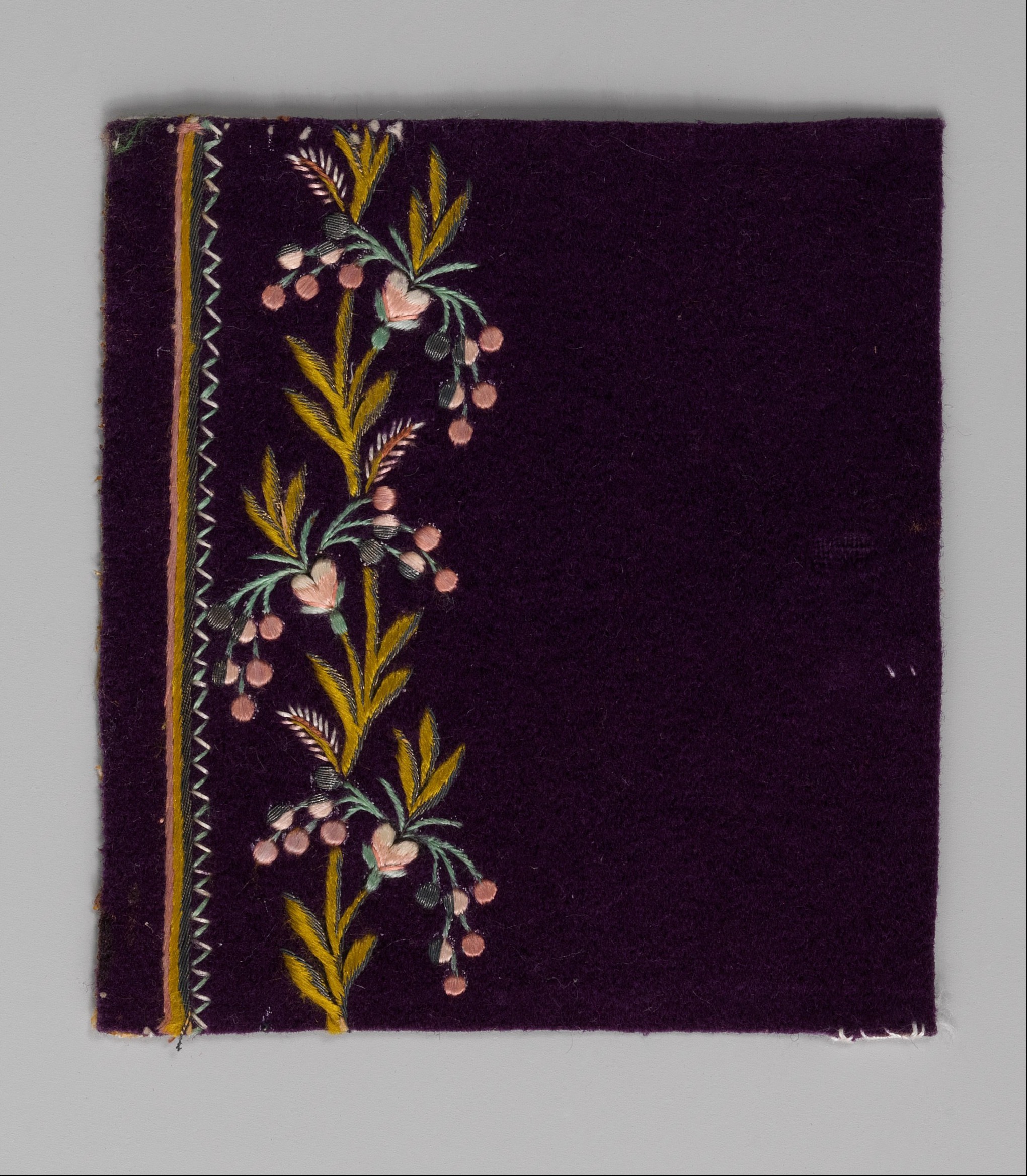
In the rarefied echelons of haute couture, where the garment transcends the corporeal to become a thesis on material culture, the embroidery sample stands as a potent artifact. Katherine Fashion Lab’s latest study—a standalone panel destined for a man’s suit—is not merely a decorative exercise. It is a rigorous interrogation of patrimony, a deliberate collision of geographies rendered in silk and metal. This analysis dissects the sample’s material syntax, its geopolitical resonance, and its radical proposition for contemporary menswear.
Material Dialectics: The Tactile Politics of Silk and Metal
The substrate itself is a declaration of intent. Silk velvet, with its plush, light-absorbing pile, provides a nocturnal depth that is both opulent and austere. It is a fabric of paradoxes: supremely tactile yet visually elusive, soft to the touch but commanding in presence. Against this ground, the lab deploys a dual-thread system: lustrous silk filament for the organic forms and a twisted metal thread—likely a gilded silver or copper alloy—for the structural elements. This is not a casual pairing. The silk offers fluidity, the suggestion of a living, breathing organism; the metal offers permanence, the rigidity of an architectural frame.
This dialectic is the sample’s first intellectual move. The metal is not used as mere glitter; it is employed as a structural exoskeleton, outlining the negative spaces and defining the silhouette of each motif. The silk, in turn, softens the metallic glare, creating a chiaroscuro effect that shifts with the viewer’s angle. Under direct light, the metal flares like a warning; in shadow, it recedes, allowing the velvet’s nap to absorb the eye. The result is a surface that demands kinetic engagement—a garment that is never seen twice in the same way.
Thread as Cartography: Reading the Global Heritage Motif
The "Global Heritage" origin is not a vague nod to eclecticism; it is a curatorial position. The embroidery eschews a single cultural cipher for a deliberate, almost cartographic, synthesis. One can discern the sinuous, calligraphic tendrils of Ottoman saz style, characterized by long, feather-like leaves that twist with a rhythmic, almost hypnotic energy. These are interwoven with the geometric precision of Central Asian girih patterns—eight-pointed stars and interlaced polygons that speak to mathematical harmony and celestial order.
Yet, the lab does not merely quote these traditions. It re-contextualizes them through a lens of modern abstraction. The motifs are not scaled to their historical proportions; they are enlarged, cropped, and repositioned to create a composition that feels simultaneously ancient and futuristic. A Mughal-inspired lotus bud, rendered in dense silk satin stitch, sits adjacent to a stark, metallic lattice that evokes Art Deco architecture. The effect is not a pastiche but a palimpsest—a layering of cultural memories that suggests a global citizen’s subconscious, where the Silk Road, the Spice Route, and the Trans-Siberian railway converge on a single lapel.
Technical Virtuosity: The Grammar of the Stitch
From a purely technical standpoint, the sample is a masterclass in haute broderie. The lab employs a hybrid methodology, combining traditional hand techniques with a controlled, almost surgical, application of contemporary machinery. The primary ground is worked in a point de tige (stem stitch) that follows the undulating contours of the leaves, lending them a sculptural, three-dimensional quality. This is juxtaposed with a point de chaînette (chain stitch) used to outline the metallic stars, creating a crisp, raised edge that catches the light independently of the metal core.
However, the most compelling technical feat is the treatment of the metal thread. Rather than laying it flat in a conventional couching technique, the lab employs a raised couching method, where the metal is padded with a layer of silk cord beneath. This lifts the metal off the velvet’s surface, creating a topographic relief that casts its own shadow. The effect is akin to low-relief sculpture, imbuing the suit with a weight and presence that defies its textile nature. This is not embroidery that decorates a garment; it is embroidery that armors it.
The Suit as a Site of Resistance
The choice of a man’s suit as the vehicle for this opulence is a deliberate provocation. The Western business suit is the uniform of globalized capital, a symbol of conformity and erasure of individual identity. By encrusting this archetype of corporate neutrality with the dense, labor-intensive ornamentation of global heritage, Katherine Fashion Lab stages a quiet rebellion. The embroidery does not feminize the suit; it historicizes it. It reminds the wearer that the suit’s sober lines are a recent invention, a 19th-century Anglo-Saxon imposition, and not a universal truth.
This sample proposes a new masculinity—one that is not afraid of ornament, of craft, of the time-intensive labor of the hand. The metal thread, in this context, becomes a symbol of strength not derived from brute force, but from cultural memory and technical mastery. It is a suit for the modern patriarch who understands that true power lies not in erasure, but in the confident display of accumulated wisdom.
Standalone Study: The Fragment as a Complete Thought
The designation of this piece as a "standalone study" is critical to its interpretation. It is not a swatch awaiting approval for a larger garment; it is a complete artistic statement. By isolating the embroidery from the constraints of a full suit, the lab forces the viewer to confront the craft as an autonomous art form. The fragment becomes a synecdoche—a part that contains the whole philosophy of the atelier.
In this context, the absence of a finished garment is not a lack but a liberation. The sample hangs as a canvas would in a gallery, its edges raw, its purpose self-evident. It allows the observer to study the density of the stitches, the exact curvature of each leaf, the precise tension of each metal coil—details that would be lost in the chaos of a runway presentation. It is an invitation to slow down, to engage in the kind of close looking that the fast-fashion era has rendered obsolete.
Conclusion: A New Lexicon for Luxury
Katherine Fashion Lab’s embroidery sample is a decisive statement on the future of luxury. It argues that true opulence is not found in logos or volume, but in the intensity of labor and the depth of cultural reference. The silk and metal threads are not just materials; they are the conduits of a global conversation that spans centuries. The velvet is not just a fabric; it is a dark, fertile ground from which a new visual language emerges.
For the discerning collector, this sample is more than a precursor to a garment—it is a portable museum, a testament to the enduring power of the human hand to create objects of profound meaning. It challenges the wearer to embody the complexity of their own heritage, to wear their history not as a burden, but as a finely wrought, metallic-threaded crown. In a world of disposable trends, this is couture that demands to be inherited, studied, and ultimately, passed down as a heirloom of our collective, entangled past.