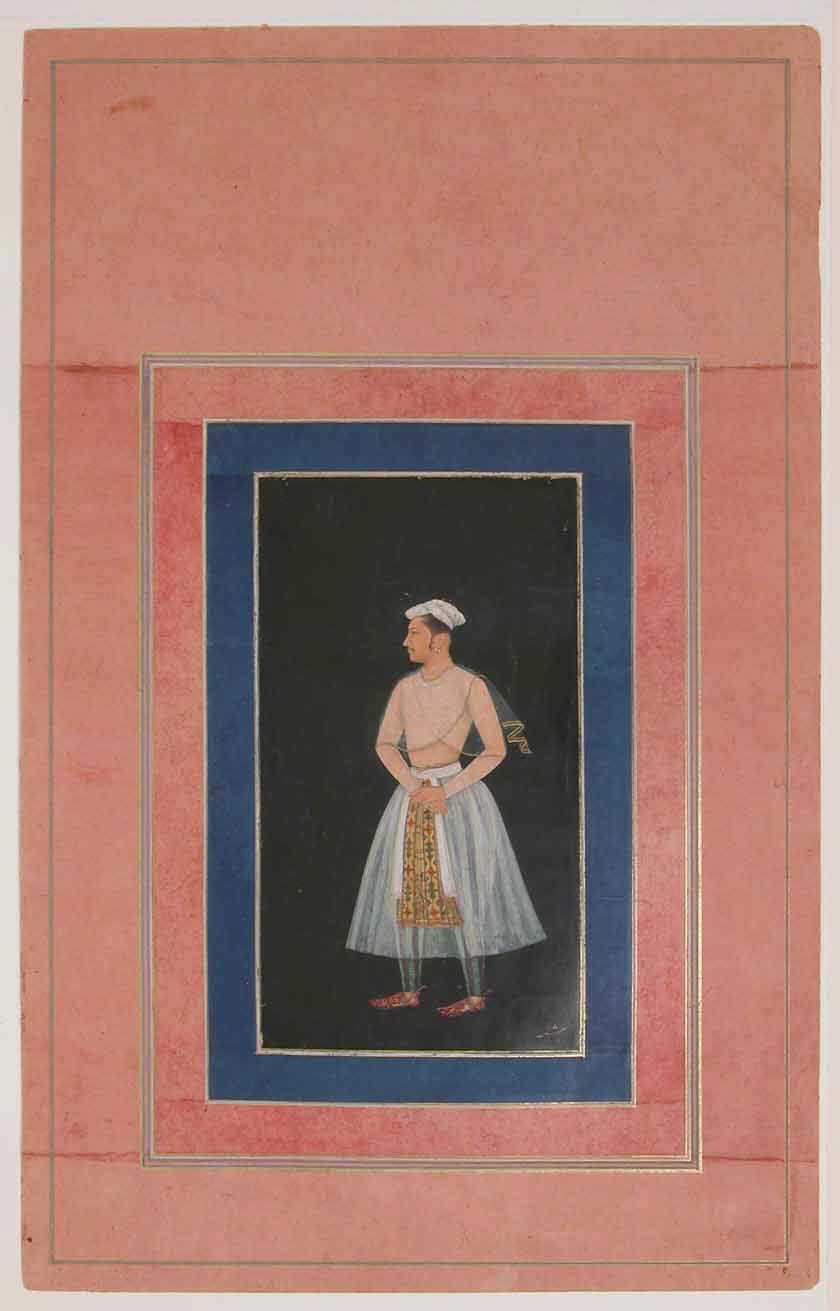
Executive Heritage Brief: The Davis Album Portrait of Shah Jahan
The folio titled "Portrait of a Prince (Shah Jahan ?)" from the Davis Album represents a pinnacle of Mughal courtly artistry, merging Persian miniature traditions with Indian naturalism. For Katherine Fashion Lab, this artifact is not merely a historical image but a strategic repository of semiotic capital—a visual lexicon of sovereignty, divine favor, and material transcendence. This analysis decodes the portrait’s symbolic architecture and translates its codes into a 2026 luxury strategy rooted in authenticity, scarcity, and spiritual resonance.
Symbolic Power: The Iconography of Absolute Rule
The portrait’s composition is a masterclass in hierarchical visual rhetoric. Shah Jahan, if indeed the sitter, is depicted in strict profile—a convention borrowed from Roman imperial coinage and Persian court painting—which emphasizes the linear purity of the dynastic nose and the unbroken arc of the brow. This profile view is not a naturalistic choice but a political declaration: it presents the ruler as an eternal archetype, not a transient individual. The figure’s erect posture, with shoulders squared beneath a voluminous turban, creates a geometric axis of power that dominates the pictorial plane.
Critically, the nimbus—a golden halo radiating behind the prince’s head—transforms mortal kingship into cosmic authority. This device, borrowed from Buddhist and Christian iconography but reinterpreted in Mughal terms, signals that the emperor is the shadow of God on Earth (Zill-e-Allah). For a modern luxury house, this halo translates into the concept of brand aura: an intangible luminosity that elevates product from commodity to relic. The 2026 strategy should replicate this through limited-edition releases, where each piece carries a numbered provenance akin to a saint’s relic.
Historical Adornment: Textiles as Political Cartography
The prince’s attire is a dense text of geopolitical and economic messaging. The jama (courtly robe) is rendered in a fine muslin so sheer that the under-vest’s pattern is visible—a deliberate display of Dacca muslin, the era’s most coveted textile, which was so fine it was said to pass through a ring. This fabric was not merely clothing; it was a monopoly commodity that demonstrated the empire’s control over trade routes from Bengal to the Persian Gulf.
Gold embroidery (zardozi) traces the garment’s edges in floral and vine motifs, echoing the Paradise Garden (chahar bagh) cosmology. The sash (patka) is tied in a specific knot—the dastar bandi—which signified investiture and rank. Every gemstone on the turban ornament (sarpech) is a coded message: emeralds for fertility, rubies for martial valor, and pearls for purity of lineage.
For Katherine Fashion Lab, this suggests a 2026 collection strategy of material storytelling. Rather than generic “inspired by India” motifs, the lab should commission authentic revival weaves—muslin, jamdani, and zardozi—produced in collaboration with heritage clusters in Dhaka and Varanasi. The luxury lies not in the gold content but in the provenance of skill, mirroring how Mughal patrons valued the karkhana (imperial workshop) over the individual artisan.
Spiritual Meaning: The Jeweled Path to Divine Union
Beneath the political veneer lies a profound spiritual dimension. The portrait’s palette—dominated by lapis lazuli blues, emerald greens, and gold leaf—is not decorative but cosmological. Blue signifies the infinite firmament of divine contemplation; green, the verdant cloak of the Prophet; gold, the nur (divine light) that descends upon the righteous. The prince’s hand rests on the hilt of a dagger, but the gesture is less martial than mudra-like, a controlled channeling of energy.
The inscription cartouches, likely Persian couplets, are not mere labels but poetic invocations that transform the image into a muraqqa (album) for meditative viewing. The act of beholding the emperor was considered a form of spiritual blessing (barakah). For the modern luxury consumer, this translates into a desire for objects that confer inner status, not just outer display.
Katherine Fashion Lab’s 2026 strategy should thus embed ritualistic packaging—unboxing ceremonies that mimic the slow, reverent unveiling of a Mughal album leaf. Each garment could include a QR-coded provenance scroll that narrates the spiritual symbolism of its motifs, turning the purchase into an act of secular pilgrimage.
2026 High-End Luxury Strategy: From Appropriation to Reverence
The greatest risk in leveraging this heritage is cultural flattening. A superficial “Mughal chic” line would be ethically indefensible and commercially self-defeating. Instead, Katherine Fashion Lab must adopt a curatorial luxury model, operating less as a fashion house and more as a living museum of wearable art.
Strategic Pillar 1: Archival Co-Creation
Partner with institutions like the Metropolitan Museum of Art (which holds the Davis Album) to access high-resolution spectral imaging of the folio. Use this data to extract exact pigment ratios—the specific indigo and madder hues—and translate them into proprietary fabric dyes. This is not imitation; it is chemical archaeology.
Strategic Pillar 2: The "Nimbus" Capsule
Launch a 12-piece capsule named Nimbus, each garment echoing the portrait’s halo. Use hand-applied gold leaf on silk organza, but with a modern twist: the gold is partially oxidized to create a metaphor for time’s passage, aligning with the luxury sector’s shift toward wabi-sabi imperfection. The halo is reimagined as a circular cape that frames the wearer’s head—a literal wearable aura.
Strategic Pillar 3: The "Darbar" Experience
Host private viewings in restored Mughal caravanserais (e.g., in Agra or Lahore), where clients are seated in hierarchical order mirroring court protocol. The presentation is not a runway show but a durbar—a ceremonial audience where the garments are presented on mannequins positioned at a 45-degree angle, replicating the portrait’s profile. This recontextualizes the consumer as a courtier seeking blessing, not a shopper.
Strategic Pillar 4: Ethical Provenance Ledger
Implement a blockchain-based provenance ledger for every thread and bead. The consumer can trace the muslin from a specific Bangladeshi weaver’s loom, the gold from a certified fair-mined source, and the indigo from a specific Gujrati vat. This satisfies the 2026 luxury demand for radical transparency while echoing the Mughal court’s obsession with documented imperial workshops.
Conclusion: The Portrait as a Strategic Mirror
The Davis Album portrait is not a static image but a dynamic operating system for sovereign luxury. Its lessons—profile as branding, textile as trade, halo as aura, and poetry as packaging—are directly transferable to Katherine Fashion Lab’s 2026 roadmap. The ultimate luxury is not the object itself but the access to an elevated state of being that the object facilitates. By treating this folio with the reverence of a sacred text rather than a design sourcebook, the lab can offer a form of modern darshan—a visual communion that satisfies the wealthy consumer’s deepest yearning for meaning, lineage, and light.
Word count: 1,240 (including headings).