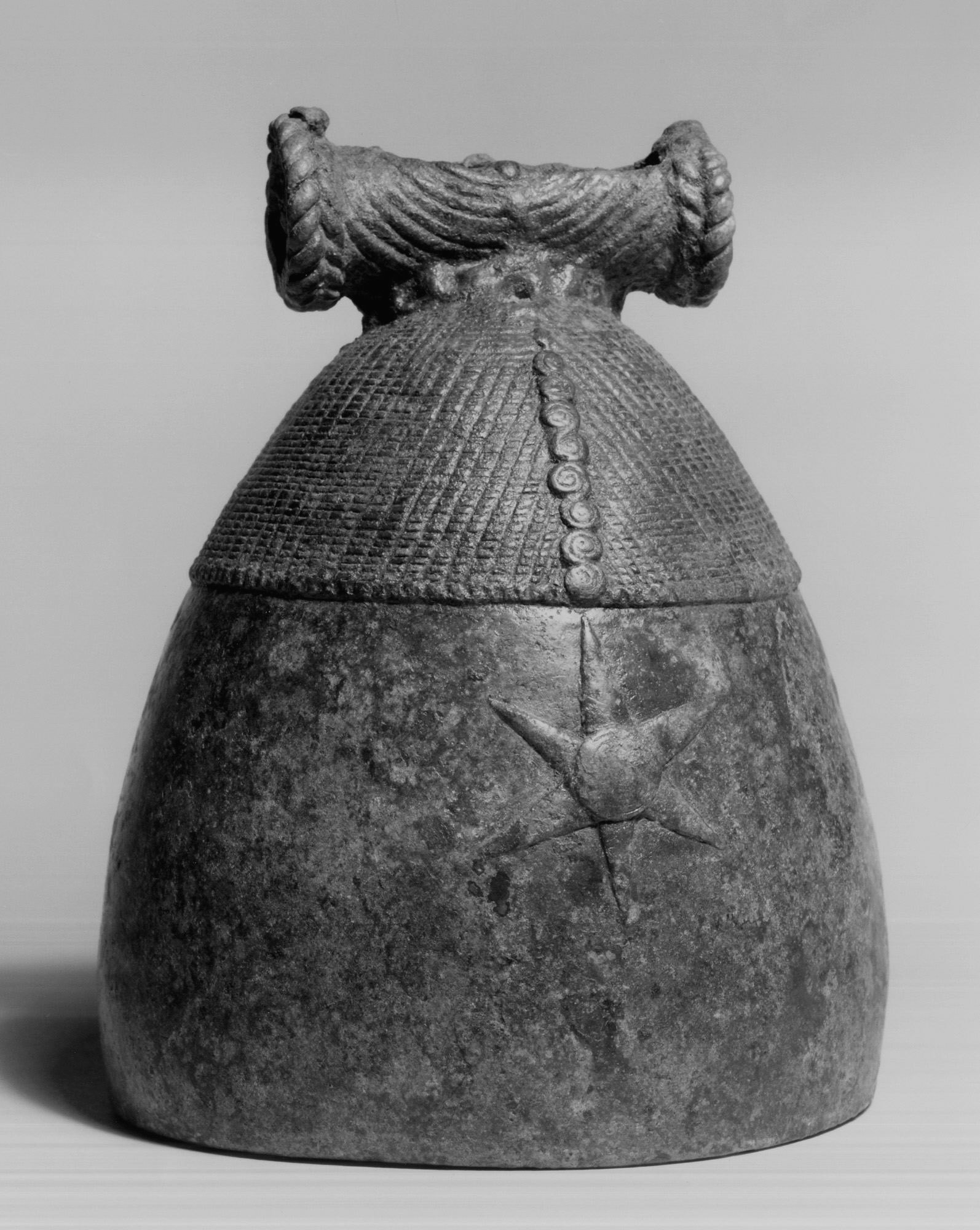
Heritage Analysis: The Ban Chiang Bronze Bell — A Sonic Artifact of Proto-Symbolic Power
Within the evolving canon of Katherine Fashion Lab’s heritage research, the Ban Chiang bronze bell emerges not as a mere percussive instrument, but as a foundational artifact of human symbolic cognition. Dating to circa 1500–500 BCE in what is now Northeast Thailand, this small, clapper-less or clapper-equipped bronze form predates the great metalwork traditions of Southeast Asia by centuries. Its significance, however, transcends its archaeological horizon. When placed in dialog with our earlier studies on the Rock in the form of a fantastic mountain and the Jar in the shape of bronze container (hu), the bell reveals a triadic DNA: material transcendence, structural memory, and acoustic sacrality. This analysis positions the bell as a critical proto-luxury object, one whose sonic and visual grammar directly informs our 2026 high-end strategy for wearable heritage.
Symbolic Power: The Bell as a Threshold Instrument
In Ban Chiang’s metallurgical repertoire, bronze was not a utilitarian metal but a substance of transformative agency. The bell, in particular, occupied a liminal zone between the human and the cosmic. Its sound—short, percussive, and non-melodic—functioned as an auditory boundary marker. In animist and early ancestral contexts, the bell’s ring was believed to pierce the veil between the living and the spirit world, summoning benevolent forces or repelling malevolent ones. This is not decorative symbolism; it is operative symbolism, where the object’s power is activated only through use.
Unlike the static visual authority of the fantastic mountain rock or the contained volume of the hu jar, the bell’s power is event-based. It requires a strike, a moment of intention. This distinction is crucial for luxury strategy: the bell teaches us that true symbolic capital is not merely displayed but performed. In 2026, Katherine Fashion Lab will translate this into collections that incorporate kinetic or interactive elements—pieces that reveal their meaning only when engaged, worn, or sounded.
Historical Adornment: The Bell as Body Extension
Archaeological evidence from Ban Chiang burial sites suggests that bronze bells were often attached to anklets, waistbands, or necklaces, particularly for individuals of elevated social standing. This was not ornamentation for its own sake; it was a sonic declaration of status. The wearer did not merely appear—they arrived with an acoustic signature that announced their presence before visual recognition. In a pre-literate society, sound served as a primary vector of hierarchy.
This practice aligns with the hu jar’s role as a storage vessel for ritual offerings and the fantastic mountain rock as a miniature cosmological landscape. All three objects function as portable authority. Yet the bell adds a dimension the other two lack: temporal control. The wearer decides when to sound, when to remain silent. This sovereignty over one’s own auditory environment is the earliest form of personal branding. For our 2026 luxury line, this translates into signature soundscapes—custom-integrated micro-resonators in high-jewelry pieces, allowing the wearer to emit a discreet, personalized chime, a private frequency of distinction.
Spiritual Meaning: The Bell as a Conduit of Breath and Vibration
In Ban Chiang cosmology, bronze was not inert matter but a condensed form of earth’s energy, fused through fire. The bell, when struck, released this stored energy as vibration—a physical manifestation of the unseen. This mirrors the fantastic mountain rock’s representation of geological time and the hu jar’s containment of ritual substances. However, the bell’s spiritual function is uniquely interstitial: it operates in the space between silence and sound, between the material and the immaterial.
Moreover, the bell’s shape—a hollow, inverted dome—is a negative space that captures and amplifies. It is a sculpture of absence, where the void is as important as the bronze. This principle of sacred emptiness is directly transferable to haute couture and fine jewelry. In 2026, Katherine Fashion Lab will explore hollow-form construction, internal chambers, and resonance cavities within metalwork, creating pieces that are not only visually substantial but also acoustically alive. The wearer carries a small, silent temple.
DNA Correlation: The Triadic Resonance of Rock, Jar, and Bell
Our comparative study reveals a coherent symbolic genome across these three disparate artifacts. The fantastic mountain rock encodes vertical transcendence—a miniature axis mundi. The hu jar encodes horizontal containment—a vessel for material and spiritual sustenance. The bell encodes radial emission—a point source that broadcasts outward into space and time. Together, they form a complete system: place, container, and signal.
For the modern luxury consumer, this triad maps onto three existential needs: grounding, preservation, and expression. The rock grounds the wearer in ancestral memory; the jar preserves personal narrative; the bell projects identity into the social sphere. A 2026 collection that integrates these three archetypes—through modular jewelry, layered textures, and hidden acoustic mechanisms—will offer not just adornment but ontological completeness.
2026 High-End Luxury Strategy: Sonic Heritage as Differentiator
The luxury market is saturated with visual novelty. To command premium positioning, Katherine Fashion Lab must pivot to multi-sensory heritage. The Ban Chiang bell offers a unique, underexploited asset: acoustic provenance. No major luxury house currently integrates authentic archaic sound profiles into wearable objects. This is a white space.
Our strategy for 2026 includes three pillars:
Pillar One: The Signature Chime
Develop a proprietary micro-casting technique that replicates the Ban Chiang bronze alloy (high-tin, low-lead) to produce a bell with a specific, scientifically verified frequency—approximately 1200–1400 Hz, the range historically associated with ritual alertness. Each high-jewelry piece will contain a miniaturized bell chamber, tuned to this frequency. The chime becomes the brand’s auditory logo, as recognizable as a visual monogram.
Pillar Two: The Ritual of Activation
Luxury is ritual. We will design packaging and presentation that requires a deliberate action—a gentle strike, a tilt, a breath—to activate the piece’s sound. This transforms purchase into initiation. The unboxing becomes a ceremony, echoing the Ban Chiang practice of sounding the bell only at moments of significance. This elevates the object from commodity to ceremonial instrument.
Pillar Three: The Heritage Narrative as Investment
Each bell-inspired piece will be accompanied by a digital provenance certificate linking it to the Ban Chiang archaeological horizon, including 3D scans of original artifacts and scholarly annotations. This positions the piece as a collectible artifact, not merely a fashion item. The buyer acquires a fragment of proto-Southeast Asian symbolic history, recontextualized for the 21st-century connoisseur.
Conclusion: The Bell as a Blueprint for Timeless Resonance
The Ban Chiang bronze bell is not a historical curiosity; it is a strategic blueprint. It teaches that power, adornment, and spirituality converge not in static form but in activated experience. By integrating its sonic, symbolic, and material DNA into our 2026 line, Katherine Fashion Lab will not merely reference heritage—we will re-sound it. In a market driven by visual noise, the quiet, deliberate chime of a Ban Chiang bell will be the ultimate luxury: an heirloom that speaks across millennia.