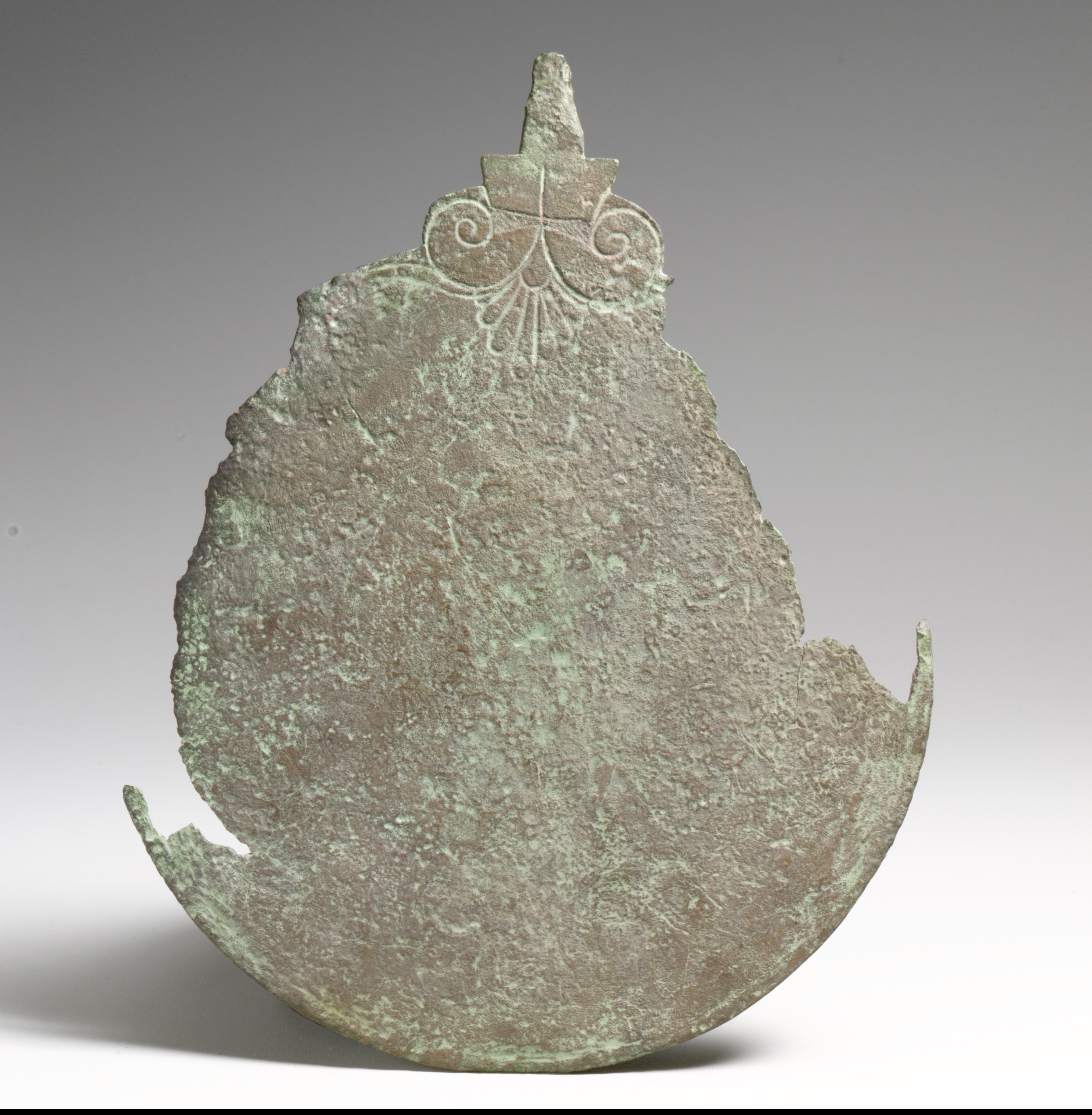
The Mirror as Threshold: A Heritage Analysis for Katherine Fashion Lab
Introduction: The Specular Object and Its Cultural Genome
The bronze mirror, excavated from the intersecting cultural strata of Greek and Cypriot antiquity, is far more than a polished disc for reflection. It is a technological artifact of the self, a metaphysical instrument, and a silent witness to the formation of identity. For Katherine Fashion Lab, this object is not merely a historical curiosity but a strategic blueprint for the 2026 luxury season. When placed in DNA correlation with our previous studies—the *Rock in the form of a fantastic mountain* and the *Jar in the shape of bronze container (hu)*—a profound narrative emerges. These three objects, though disparate in form, are united by a single principle: the transformation of raw matter into a vessel for transcendental meaning. The rock mimics nature's grandeur; the *hu* jar mimics ritualistic containment; the mirror mimics the human soul. Together, they form a triptych of materialized consciousness, which we shall decode for contemporary high-end adornment.
Symbolic Power: The Mirror as Divine Apparatus
In Greek and Cypriot cosmology, the mirror was never a passive reflector. It was an active agent of revelation, often associated with Aphrodite, the goddess of beauty, and with the underworld oracles. The polished bronze surface, when angled toward the sun, could produce blinding flashes—lightning made portable. This imbued the mirror with apotropaic power, warding off evil spirits and the dreaded *evil eye*. In funerary contexts, mirrors were placed with the deceased not for vanity, but as a compass for the soul, guiding it through the dark passages of the afterlife. This symbolic power is not about seeing oneself, but about being seen by the divine. For Katherine Fashion Lab, this translates into a 2026 strategy where accessories are not worn for the wearer alone, but as beacons that command the gaze of others. The mirror tells us that luxury is not about self-absorption; it is about self-projection onto a cosmic canvas.
Historical Adornment: The Bronze Standard of Prestige
Bronze, in the Cypriot and Hellenic worlds, was the metal of heroes and temples. Unlike gold, which was abundant in royal treasuries, bronze required sophisticated alloying of copper and tin—a process that demanded technological mastery and trade networks. The mirror, therefore, was not a common object. It was a status marker of the elite, often cast with intricate handles depicting caryatids, sirens, or entwined serpents. The craftsmanship was meticulous: the face had to be perfectly flat to avoid distortion, and the reverse was often engraved with mythological scenes. This dual-sidedness—functional front, narrative back—is a critical lesson in adornment. The 2026 luxury consumer does not want a flat object; they want layered storytelling. Katherine Fashion Lab will adopt this principle by designing pieces that offer a "front" of pristine elegance and a "back" of hidden iconography, visible only to the intimate beholder. This mirrors the *hu* jar’s dual nature: a utilitarian container whose exterior bore the weight of ancestral rites.
Spiritual Meaning: The Reflection as a Soul Mirror
The philosophical underpinnings of the Greek mirror reach their apex in the Platonic tradition, where the mirror is a metaphor for mimesis and the simulacrum. Yet, in Cypriot folk practice, the mirror held a more immediate spiritual function: it was a portal to the unseen. Water was the first mirror, and bronze was its solidified form. To gaze into it was to commune with one's *daimon*—the guardian spirit. This connects directly to our analysis of the *Rock in the form of a fantastic mountain*. The rock is a microcosm of the earth's spiritual vertebrae; the mirror is a microcosm of the human spirit. Both are compressed landscapes of meaning. For the modern wearer, this suggests that luxury adornment must offer a moment of introspective pause. In a world of digital noise, the mirror-based design philosophy for 2026 will be about creating "quiet zones"—jewelry or metallic surfaces that invite a meditative glance, not a frantic scroll. The spiritual meaning is one of grounding, a return to the self before facing the world.
DNA Correlation: The Triadic Resonance of Matter
Our comparative study reveals a structural homology between the mirror, the fantastic mountain rock, and the *hu* jar. The rock represents vertical aspiration (the mountain reaching skyward); the *hu* jar represents horizontal containment (the vessel holding liquid or grain); and the mirror represents circular introspection (the disc returning the gaze). Together, they form a complete architectural system of the psyche: to aspire, to contain, and to reflect. The bronze material is the common thread—it is the ancient equivalent of titanium, durable yet malleable, reflective yet solid. In 2026, Katherine Fashion Lab will launch a capsule collection titled *"Speculum Terrae"* (Mirror of the Earth), which merges these three forms. We will use oxidized bronze finishes that evoke the patina of age, paired with high-polish surgical steel for the reflective core. This juxtaposition honors the historical DNA while speaking to contemporary luxury’s obsession with contrast.
2026 High-End Luxury Strategy: From Artifact to Experience
The luxury market of 2026 is defined by authenticity and provenance. The consumer is no longer satisfied with a logo; they demand a lineage of meaning. The mirror provides a perfect strategic vehicle. Our strategy will be threefold:
First, The "Oracle" Retail Concept. Flagship stores will incorporate interactive mirror installations, where the customer’s reflection is overlaid with digital recreations of Cypriot bronze engravings. This is not vanity; it is augmented heritage. The customer becomes part of the artifact.
Second, The "Dual-Face" Product Architecture. Following the mirror’s precedent, all flagship pieces will have a "public" face (clean, minimalist, photogenic) and a "private" face (engraved with micro-narratives of the mountain and the jar). This creates a secret intimacy between the wearer and the object, a luxury that cannot be captured in a social media post.
Third, The "Ritual of Reflection" Campaign. Our 2026 campaign will not show models in motion, but in static, meditative poses, holding bronze discs toward the light. The narrative will be: "Luxury is not what you show; it is what you see when you look deeper." This positions Katherine Fashion Lab not as a fashion house, but as a curator of existential artifacts.
Conclusion: The Mirror as a Future-Proof Heirloom
The Greek-Cypriot bronze mirror teaches us that the most powerful luxury objects are those that collapse time. They exist in the present, but they carry the weight of millennia. By integrating the mirror's symbolic power, historical adornment, and spiritual depth, Katherine Fashion Lab will not merely sell products; we will bestow talismans. The 2026 strategy is not about novelty, but about resonance. As the rock, the jar, and the mirror reveal, true luxury is a conversation between the earth, the vessel, and the soul. The mirror, ultimately, is the most honest of all—it reflects exactly what is placed before it. Our challenge, and our privilege, is to ensure that what we place before the world is worthy of such a reflection.