The Reliquary of Memory: Deconstructing the Souvenir Spoon as Couture Artifact
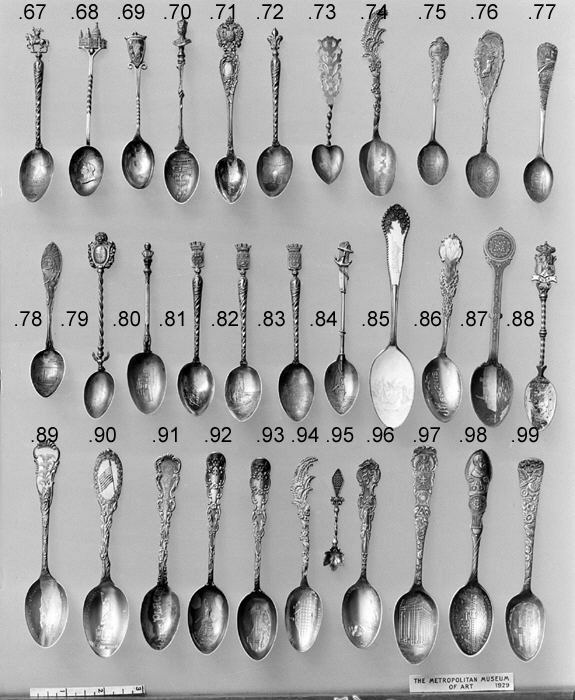
In the rarefied echelons of haute couture, where the ephemeral is rendered eternal through masterful manipulation of material, Katherine Fashion Lab presents a singular study: the souvenir spoon bearing the west front of Notre-Dame de Paris, crowned by a finial of Joan of Arc. At first glance, this object—silver, parcel-gilt, and no larger than a hand—appears to be a humble travel keepsake. Yet within the analytical framework of our atelier, it transcends its utilitarian origin to become a potent reliquary of collective memory, a micro-architectural monument, and a profound commentary on the intersection of pilgrimage, patrimony, and personal adornment. This is not merely a spoon; it is a wearable thesis on the endurance of French identity, rendered in precious metal.
Material Dialectics: Silver as Canvas, Gilt as Divine Light
The choice of silver, parcel-gilt, establishes a sophisticated chromatic and symbolic dialogue. Silver, in its unadorned state, speaks to the earthly, the quotidian, and the reflective—literally mirroring the viewer’s gaze and, by extension, their own journey. It is the metal of the artisan, of the smithy, and of the common table. Conversely, the parcel-gilt—a selective application of gold—serves as a strategic accent, a chiaroscuro of value. In our couture analysis, this gilding is not arbitrary; it functions as divine light, illuminating the sacred elements of the composition. The gilded finial of Joan of Arc, the Maid of Orléans, elevates her from a historical figure to a celestial icon, her armor catching an eternal sun. Similarly, the gilded details of Notre-Dame’s facade—the twin towers, the central rose window, the flying buttresses—are not merely decorative. They are the architectural equivalent of gold thread in a couture gown, drawing the eye to the structural sanctity, to the very bones of the edifice that have withstood revolution, war, and, most recently, the ravages of fire.
This material dialectic mirrors the couture principle of contrast texture. The polished silver provides a cool, smooth ground, akin to a silk faille, while the matte or burnished gilt offers a tactile interruption, reminiscent of metallic lace or brocade. The weight of the spoon, its heft, is a physical reminder of its substance—not a flimsy trinket, but a solid, enduring artifact. In an era of disposable fashion, this object demands permanence, a quality we champion at Katherine Fashion Lab.
Architectural Cartography: The West Front as a Body of Knowledge
The bowl of the spoon presents a breathtaking feat of miniature engraving: the west front of Notre-Dame. This is not a mere tourist’s sketch; it is a cartographic representation of faith and power. The three portals—the Portal of the Virgin, the Portal of the Last Judgment, and the Portal of St. Anne—are etched with astonishing precision, their tympanums and lintels compressed into a space less than two inches wide. For the couture analyst, this is the equivalent of a micro-pleat—a complex structural element that requires immense technical skill to execute at scale. The verticality of the towers is emphasized, drawing the eye upward, a visual prayer. The rose window, the circular heart of the facade, is rendered as a delicate mandala, a focal point of spiritual geometry.
This architectural engraving is not static. It is a narrative topography. The spoon invites the holder to trace the contours of the building with their thumb, to feel the grooves of the arches and the recesses of the portals. This tactile engagement transforms the object from a passive image to an active, haptic experience. It is a form of blind reading, a way of "seeing" through touch, which we consider the highest form of sensory design. The spoon becomes a portable architectural model, a pocket cathedral that one can carry into the world, a private audience with a public monument.
Joan of Arc: The Finial as Symbolic Apex
Crowning this miniature monument is the figure of Joan of Arc, her standard aloft, her visage resolute. As a finial, she serves as the pinnacle, the apex of the object’s symbolic hierarchy. Her placement is deliberate: she stands above the cathedral, not as a conqueror, but as a protector and a martyr. In the context of French national identity, Joan is the embodiment of la France éternelle—the eternal France that resists occupation and defends its spiritual core. Her presence on a souvenir spoon, an object of travel and memory, is profoundly poignant. She is the guardian of the journey, the patron saint of the pilgrim who carries this spoon home.
From a couture perspective, the finial is the closing statement, the final button, the signature bow. It is the moment where the design culminates. Joan’s figure, though miniature, possesses a dynamic energy. The folds of her armor and the flutter of her banner are rendered with a fluidity that belies the rigidity of the metal. She is a study in kinetic stillness, a figure caught in a moment of eternal charge. This juxtaposition—the immobile cathedral and the advancing saint—creates a tension that is the hallmark of great design. It is the tension between the institutional and the individual, between the edifice and the spirit.
Standalone Study: The Object as Complete Narrative
In the context of a standalone study, this spoon is not a fragment of a larger set, nor is it a functional utensil awaiting its place at a table. It is a complete, self-contained narrative. It tells the story of a journey—physical, spiritual, and aesthetic. It is an heirloom in waiting, an object designed to be passed down, carrying with it the memories of its original owner and the immutable history of its subject. The spoon is a micro-monument, a personal reliquary that holds not the bones of a saint, but the essence of a place and a people.
Katherine Fashion Lab posits that true couture is not limited to the body; it extends to the objects we curate around ourselves. This spoon is a piece of wearable architecture, a brooch for the soul, a ring for the memory. It challenges the notion of luxury as mere opulence, instead proposing that luxury is the density of meaning contained within a small, precious object. The silver is cool to the touch, yet the narrative is warm with devotion. The gilt catches the light, but the shadow of history is cast long.
In conclusion, this souvenir spoon is a masterclass in symbolic compression. It takes the vastness of Parisian heritage—its architecture, its faith, its warrior-saint—and distills it into a single, elegant, and deeply resonant artifact. It is a testament to the power of the miniature, the eloquence of metal, and the enduring human desire to carry a piece of the sacred with us, always. It is, in the truest sense, a couture object for the global citizen, a silent poem of silver and gold.