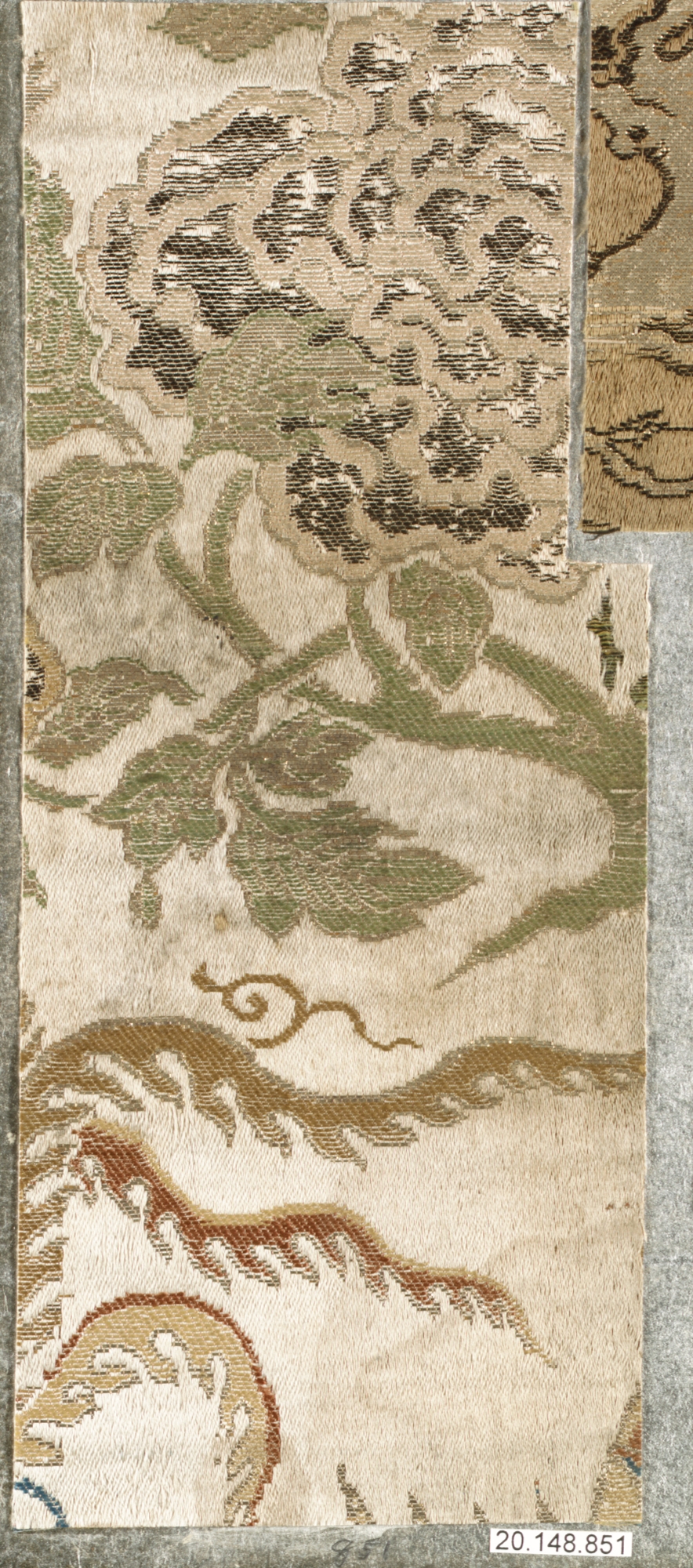
A Study in Structural Poetry: The Compound-Weave Silk of Katherine Fashion Lab
Within the rarefied echelons of contemporary couture, where innovation is often mistaken for spectacle, Katherine Fashion Lab’s standalone piece—a Japanese-origin compound-weave silk garment—commands a quieter, more formidable authority. This is not a dress; it is a thesis. It is a meditation on the dialectic between the hand of the artisan and the logic of the engineer, rendered in a material that has been revered for millennia yet here feels startlingly new. To analyze this piece is to deconstruct a paradox: a fabric of immense historical weight that achieves an effect of weightless, almost architectural, modernity.
The Genesis of Material: Japan’s Weaving Alchemy
The provenance of the silk is not a mere footnote; it is the foundational argument of the work. Japanese silk cultivation and weaving, particularly in regions like Kyoto and the historic textile centers of the Kansai region, operate on a philosophical plane distinct from their Western counterparts. The Japanese approach treats the loom not as a machine of production, but as a partner in a dialogue with nature. The compound weave—a structure employing multiple warp and weft systems to create a patterned, often double-faced, fabric—is a testament to this philosophy. It is a technique that demands obsessive patience; a single misstep in the sequence of interlacing can compromise the entire architectural integrity of the cloth.
In this piece, the compound structure is not used for ostentatious brocade or heavy damask effect. Instead, Katherine Fashion Lab has subverted the technique’s traditional opulence. The yarns are of an exceptional, gossamer fineness, likely reeled from the cocoons of silkworms fed on a specific mulberry cultivar, resulting in a filament of extraordinary luster and tensile strength. The compound weave here is deployed to create a subtle, topographical relief—a play of matte and sheen that shifts with the wearer’s movement, like light on a rippled body of water. This is not a surface pattern; it is a structural pattern, born from the very density and direction of the interlacing threads. The result is a fabric that possesses a dual nature: it is fluid as a liquid, yet it holds a crease and a volume with the precision of a tailored suit. This duality is the core of its genius.
Deconstructing the Silhouette: Architecture in Motion
The garment’s silhouette is a study in controlled asymmetry. It avoids the facile drama of a deconstructed, slashed look. Instead, the construction is a series of deliberate, engineered biases. The compound weave is cut on the grain in some panels to maximize its inherent stiffness, creating sharp, sculptural planes that jut away from the body—shoulder lines that suggest a samurai’s armor, reimagined in a whisper of silk. In other panels, the fabric is cut on a severe bias, allowing the compound structure to relax and flow, cascading into a liquid pool of fabric at the hem.
This juxtaposition is not accidental; it is a choreographed tension. The garment appears to be in a constant state of becoming—partly rigid, partly yielding. A closer inspection reveals the couture-level construction beneath: seams that are hand-felled to a microscopic tolerance, internal structures of horsehair canvas and silk organza that support the heavier woven panels without adding visible bulk. The closure is a masterpiece of hidden engineering—a series of hand-worked silk loops and covered buttons that are invisible from the exterior, allowing the line of the garment to remain unbroken, a pure, uninterrupted flow of textile. This commitment to invisible structure elevates the piece from mere clothing to a form of wearable sculpture, where the internal logic dictates the external beauty.
The Palette of Absence: Color as a Negative Space
Color is treated with the same rigorous restraint. The base silk is an undyed, ecru white—a shade that in Japanese aesthetics is known as shiro, but here it is not a pure, sterile white. It is the color of raw silk, a warm, slightly golden ivory that carries a hint of the natural gum (sericin) that has been only partially removed. This is a deliberate choice. It speaks to the Japanese concept of wabi-sabi, finding beauty in imperfection and impermanence. The compound weave introduces a secondary weft of a deep, ink-black silk, but it is not used to create a distinct pattern. Instead, the black threads emerge and recede within the weave, creating a shadowy, gradient effect—a chiaroscuro that is not painted but woven. The black appears to bleed into the white, not as a sharp line, but as a soft, atmospheric diffusion, reminiscent of a sumi-e ink wash on handmade paper.
The effect is one of profound subtlety. From a distance, the garment reads as a monochromatic study. Up close, the complexity is breathtaking. The interplay of the two colors within the compound structure creates a moiré-like optical illusion, a shimmer that is both alluring and intellectually stimulating. This is a masterclass in the power of negative space. The absence of vibrant color is not an absence of expression; it is a amplification of it. The focus is shifted entirely to texture, drape, and the play of light on the dimensional surface of the weave. In this, the piece aligns with a distinctly Japanese design philosophy of ma—the meaningful void, the interval that gives shape to the whole.
Contextualizing the Standalone Study
As a standalone study, this piece functions as a laboratory experiment in pure materiality. It is not part of a seasonal narrative, nor is it designed to be commercial. It is a proof of concept—an assertion that couture’s future lies not in digital gimmickry or aggressive branding, but in a deeper, more intelligent engagement with its raw materials. Katherine Fashion Lab positions this work as a direct challenge to the fast-fashion ethos of disposable novelty. The garment demands a slow, contemplative viewing. It asks the wearer and the observer to consider the thousands of hours of handwork, the generations of weaving knowledge, and the singular vision that converged to create this object.
In this context, the Japanese origin of the silk is not a point of exoticism but of ethical and aesthetic clarity. It represents a lineage of mastery that is increasingly rare. The compound weave, a technique that many Western mills have abandoned for cost-effective jacquard machines, is here celebrated as a hand-driven, intellectual process. The piece becomes a symbol of resistance against the homogenization of global fashion. It is a quiet, powerful argument for the enduring value of the artisan’s hand, and for the idea that true luxury is not about logo recognition, but about the profound, tactile intelligence of the cloth itself.
Ultimately, this garment is a triumph of restraint. It does not shout; it whispers. It does not impose; it invites. It is a piece that will be studied by future generations of designers not for its trends, but for its timeless principles: that material, structure, and technique are the true foundations of couture. In its silent, ivory-and-ink splendor, it achieves what so much contemporary fashion fails to do—it creates a moment of genuine, contemplative awe. It is not merely a garment; it is an heirloom of the future, a testament to the fact that the most radical statement in fashion is, and always will be, perfect mastery.