Executive Summary: The Divine as Brand Archetype
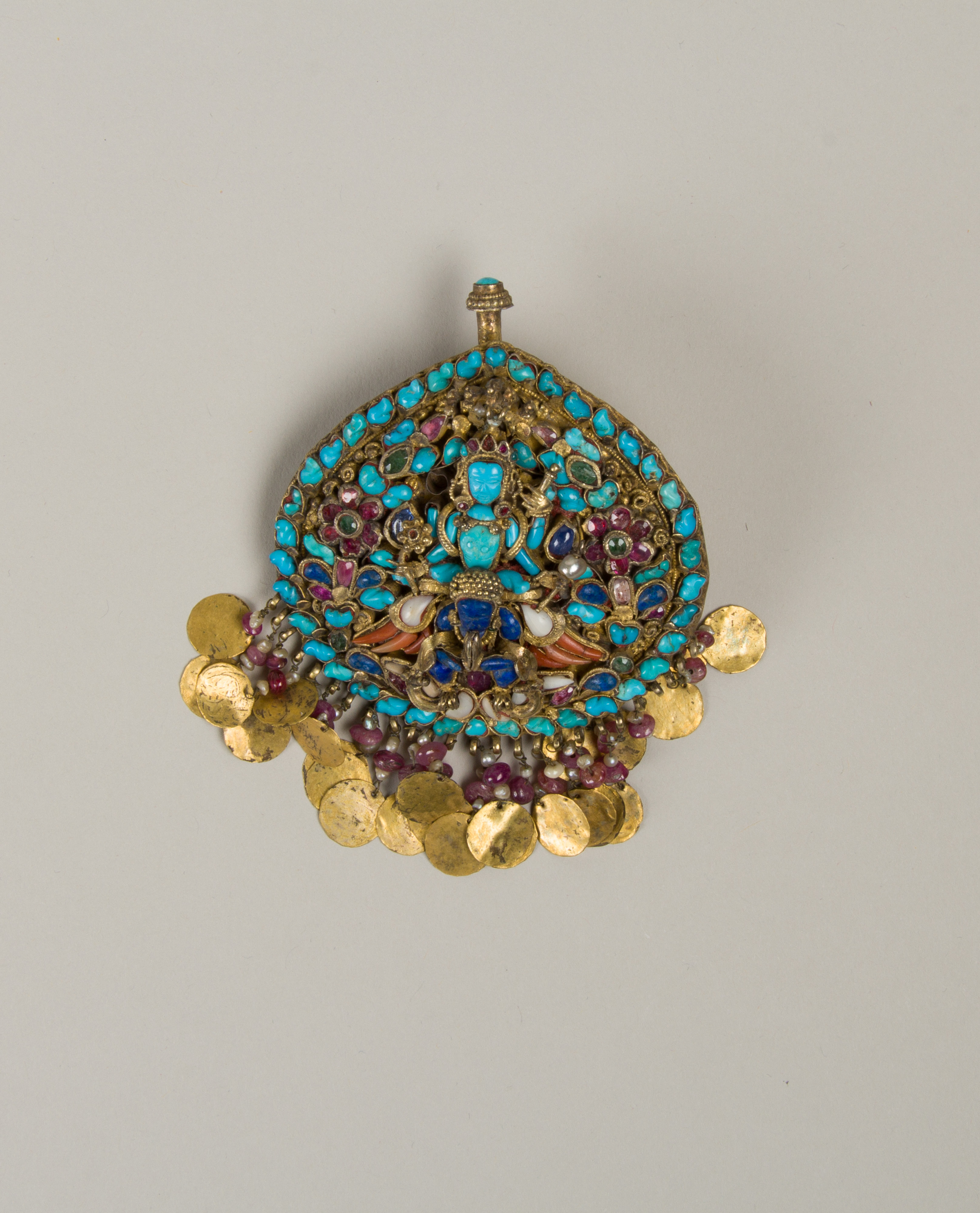
Katherine Fashion Lab presents a heritage analysis of a Nepalese ceremonial earring depicting Vishnu astride Garuda. This object is not merely an artifact; it is a concentrated thesis on divine sovereignty, material alchemy, and the architecture of eternal power. For a 2026 luxury strategy, this earring offers a blueprint for transcending transient trends by anchoring collections in mythic permanence. The analysis decodes its symbolic grammar, historical lineage, and spiritual resonance, then translates these into actionable high-end positioning—where ornament becomes ontology, and patronage becomes participation in the sacred.
Symbolic Power: The Iconography of Cosmic Governance
Vishnu as Preserver and Sovereign
At the center of the earring, Vishnu is depicted not in passive contemplation but in active guardianship. As the Preserver within the Hindu Trimurti, Vishnu embodies dharma—the cosmic order that sustains creation. His presence on the earring signals that the wearer, or the deity honored, is aligned with stability, moral law, and the cyclical renewal of time. In luxury terms, this translates to a brand promise of enduring relevance: not fleeting novelty, but a curated permanence that outlasts seasonal cycles. The iconography of Vishnu holding his attributes—the discus (chakra), conch (shankha), lotus, and mace—each represents mental clarity, primordial sound, purity, and raw authority. A 2026 campaign could leverage these as four pillars of brand governance: clarity of vision, resonant messaging, unblemished craftsmanship, and decisive leadership.
Garuda: The Velocity of Devotion
Garuda, the eagle-like mount, is not a passive vehicle. He is the personification of antigravity—the force that lifts the divine above the mundane. In Nepalese iconography, Garuda’s wings are often depicted with jewel-like precision, suggesting that speed and splendor are inseparable. For Katherine Fashion Lab, Garuda represents the logistics of desire: the ability to move products, narratives, and cultural capital across global markets with the swiftness of a mythic bird. Yet Garuda is also a devotee, constantly serving Vishnu. This dual role—supreme power in service to a higher order—mirrors the ideal luxury house: unmatched operational excellence in service to an artistic vision. The earring’s composition, with Garuda’s talons gripping Vishnu’s throne, visually locks the relationship between agency and surrender, a dialectic that high-net-worth clients recognize in their own pursuit of mastery.
Historical Adornment: The Nepalese Courtly Tradition
Ritual Jewelry as Political Theology
In the Malla and Shah dynasties of Nepal, jewelry was never decorative in the Western sense. It was sacramental armor, worn by royalty and clergy to project divine right. Gilt silver, the primary medium, was a deliberate choice: silver signified lunar purity and receptivity, while gold gilding signified solar authority. The combination created a bimetallic aura—neither fully earthly nor wholly celestial. The earring’s scale, likely worn during temple festivals or royal darshan (ritual viewing), was designed to catch torchlight and oil lamps, creating a shimmering halo around the wearer’s face. This historical function offers a direct parallel to modern luxury presentations: the runway as ritual space, where lighting, movement, and materiality converge to transform a garment into a relic.
Material Hierarchy and Stone Semantics
Each stone in the earring is a coded message. Rubies, the “king of gems,” denote invincibility and vital energy. Sapphires, associated with Saturn, bring discipline and karmic structure. Lapis lazuli, imported via ancient trade routes, signifies the night sky and royal judgment. Coral, from the ocean, grounds the piece in the element of water—emotion and flow. Shell, often carved into Garuda’s eye, represents the primordial sound of the conch. Pearls, symbols of the moon, add a feminine counterpoint to the masculine rubies. Turquoise, a Himalayan staple, protects against evil and connects the wearer to the high-altitude landscape. For a 2026 strategy, this poly-chromatic lexicon is a masterclass in material storytelling. Each stone becomes a “feature” in a narrative of wholeness—no single hue dominates, yet each contributes to an integrated whole. Katherine Fashion Lab can adopt this by creating “semantic suites”: collections where each piece carries a specific symbolic function, but the full set conveys a unified cosmology.
Spiritual Meaning: Adornment as Meditation
The Earring as a Mandala
In tantric traditions, the ear is a threshold organ—the gateway through which sacred sound enters consciousness. An earring depicting Vishnu and Garuda transforms the wearer’s ear into a portable shrine. The act of wearing it becomes a mnemonic device, reminding the devotee of their place within the cosmic hierarchy. For the luxury consumer, this suggests a shift from “accessorizing” to “embodying.” A 2026 high-end strategy should position jewelry not as an addition to an outfit, but as an anchoring ritual—a daily practice of self-alignment. Marketing copy could emphasize “wearing your intention” rather than “wearing a product.” The earring’s vertical composition (Vishnu above, Garuda below) mirrors the human spine, aligning the chakras from root to crown. This anatomical symbolism can be leveraged in bespoke fittings, where the jeweler measures not just the ear lobe but the client’s energetic posture.
Duality and Non-Duality
The iconography also encodes a philosophical paradox: Vishnu is both immanent (riding Garuda, acting in time) and transcendent (as the eternal Preserver). This duality—action within stillness—is the core of Hindu aesthetics. For luxury branding, this translates into a dual-speed strategy: rapid innovation in product drops (Garuda’s speed) paired with timeless, unchanging core values (Vishnu’s constancy). The earring’s reverse side, often left unadorned or with a simple lotus engraving, reminds the wearer that power has a private face. A 2026 VIP program could offer “reverse-side experiences”—private viewings, provenance deep-dives, and silent meditation sessions—that mirror this hidden dimension.
2026 High-End Luxury Strategy: From Artifact to Archetype
Positioning: “Preserved Power” as a Brand Pillar
Katherine Fashion Lab should position this earring as the centerpiece of a “Preserved Power” capsule. The narrative is not “ancient jewelry” but “permanent sovereignty.” The target client is not a collector of antiques but a steward of legacy—someone who sees their personal brand as an extension of cosmic order. The earring’s gilt silver, with its intentional wear and patina, becomes a metaphor for authentic aging—the opposite of disposable fashion. A 2026 launch event could be held at a Himalayan-inspired venue, with soundscapes of temple bells and low-frequency drone chanting, positioning the product as a sensory portal rather than a visual object.
Product Architecture: The “Deity Line”
Extrapolating from this earring, Katherine Fashion Lab can develop a “Deity Line” with three tiers:
Tier 1 – The Icon: A limited edition of 108 pieces (a sacred number in Hinduism), each hand-finished with certified provenance. Price point: $250,000+. Includes a “ritual commissioning” where the client’s name is recited in a private puja at a Kathmandu temple.
Tier 2 – The Devotee: Modern reinterpretations using lab-grown rubies and sapphires, ethically sourced, with the same iconography but simplified for daily wear. Price point: $15,000–$40,000. This tier democratizes the symbol without diluting its potency.
Tier 3 – The Acolyte: Fine jewelry pieces (pendants, rings) featuring only Garuda’s wing or Vishnu’s chakra, abstracted into geometric motifs. Price point: $2,000–$8,000. This tier functions as an entry ritual, attracting younger clients who will graduate to higher tiers.
Experiential Retail: The “Darshan Room”
In Nepalese temples, darshan is the sacred act of seeing and being seen by the deity. A 2026 flagship store should include a “Darshan Room”—a dimly lit, incense-scented chamber where the earring is displayed on a rotating pedestal under a single beam of light. Clients are invited to sit in silence for three minutes before the piece is revealed. This delayed gratification creates a neurological imprint of value. After the viewing, a “material priest” (a trained gemologist) explains the stone semantics, using a touchscreen that traces each gem’s origin from mine to mountain temple. This converts the purchase from a transaction into a pilgrimage.
Digital Strategy: The “Garuda Drop”
Leveraging Garuda’s speed, Katherine Fashion Lab should deploy a “Garuda Drop” model: limited, unannounced online releases of Deity Line pieces, available for only 24 hours. This creates scarcity and aligns with the mythic bird’s swiftness. Each drop is preceded by a cryptic social media post—a close-up of a ruby, a sound clip of a conch—that builds anticipation without revealing the product. This narrative withholding mimics the temple’s inner sanctum, where the deity is only glimpsed at specific times. For 2026, the brand’s website should be redesigned as a digital mandala, with navigation paths that spiral inward, requiring the user to “unlock” deeper levels of content through engagement (e.g., watching a documentary on Nepalese gilding techniques).
Collaborative Patronage: The “Court of Collectors”
Historically, Nepalese royalty commissioned such earrings to consolidate political alliances. A 2026 strategy should revive this via a “Court of Collectors”—an invitation-only council of 50 high-net-worth individuals who co-commission new Deity Line pieces. Each member contributes to a “patronage fund” and receives an annual piece inspired by a different deity (e.g., Shiva as the