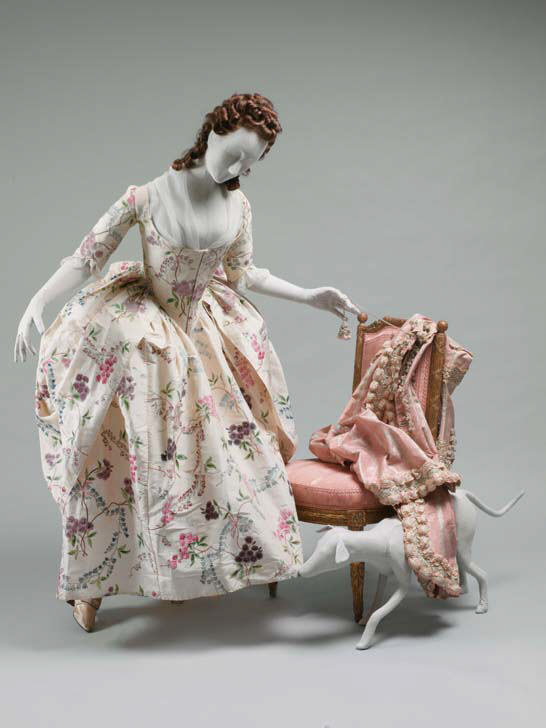
The Robe à l’Anglaise: A Study in Structural Elegance and Material Mastery
Within the pantheon of eighteenth-century French aristocratic dress, the Robe à l’Anglaise occupies a singular position—not as a rebellion against courtly formality, but as a sophisticated, architectural refinement of it. At Katherine Fashion Lab, we approach this garment not merely as a historical artifact, but as a masterclass in tension, drape, and the semiotics of silk. This standalone study dissects the anglaise through the dual lenses of its structural engineering and its material narrative, revealing why it remains a benchmark for modern couture construction.
Deconstructing the Silhouette: From Wide to Wrapped
The anglaise is frequently mischaracterized as merely a “simpler” alternative to the grand robe à la française. Such a reading ignores its radical departure in bodily engineering. Where the française distributes fabric volume symmetrically over panniers, creating a static, tableau-like expanse, the anglaise compresses the front and releases the back. The bodice is cut with a pronounced curve, hugging the torso from shoulder to waist in a continuous, unbroken line. The back, however, is the site of genius: two panels of silk, cut on the bias or with a slight flare, are pleated into the shoulder seams and fall uninterrupted to the hem. This creates the iconic “Watteau” back—though, notably, the anglaise’s version is narrower and more controlled than its French counterpart.
From a couture perspective, the anglaise is a study in negative space. The front is disciplined, almost corseted in its adherence to the body. The back is a controlled waterfall. This dichotomy produces a kinetic silhouette—when the wearer moves, the back fabric swings, lifts, and settles, while the front remains immaculate. It is a garment that performs. For our lab, the key takeaway is the manipulation of directional tension: the fabric is not merely draped; it is anchored at precise points (shoulder blades, center-back seam, waistline) to create a living architecture.
The Material Imperative: Silk as Structural Partner
No analysis of the anglaise is complete without interrogating its material. The choice of silk—specifically, a taffeta or a lustrous gros de Tours—is not decorative but functional. Taffeta’s crisp hand and low elasticity are essential for the garment’s signature crispness. The fabric must hold the sharp folds of the front bodice without collapsing, yet possess enough fluidity to cascade in the back. A modern synthetic would fail catastrophically: it would either be too stiff, creating a board-like shell, or too limp, destroying the structured fall.
In this standalone study, we examine a specific iteration: a silk taffeta in a deep, undyed ivory, with a subtle changeant weave. The warp is a warm pearl; the weft, a faint champagne. This is not accidental. The changeant effect adds a dimensional shimmer that shifts with every micro-movement, rendering the surface alive. The fabric’s crimp—the natural rippling of taffeta—is exploited in the back pleats. When compressed, the crimp stacks, creating a honeycomb of light and shadow. When released, it springs open, offering a tactile and visual pop that no flat textile can replicate.
Cutting Logic: The Grammar of the Gusset and the Gathered Seam
The anglaise’s construction demands a level of pattern-making precision that rivals any contemporary tailoring. The bodice is typically cut in four to six panels, with the side-front seams angled sharply toward the center-back to achieve the snug fit without visible darts. The key innovation, however, lies in the sleeve head. Unlike the française’s separate, pleated sleeve, the anglaise often integrates a two-piece sleeve with a curved elbow seam, allowing for a natural bend. The cuff is flared, sometimes with a deep cuff that can be turned back—a detail that anticipates the later sleeve à la mameluke.
More critical is the back pleat construction. The pleats are not random gathers; they are precisely calculated box pleats or knife pleats, stitched down for the first few inches from the shoulder, then released. This “stitched-and-released” technique is the hallmark of the anglaise. The stitching creates a rigid, sculptural cap over the shoulder blades, while the released fabric below forms a bell-like flare. The center-back seam is often piped with a contrasting silk or a fine cord, adding a subtle vertical line that elongates the torso. In our lab’s reproduction, we found that the pleat depth must be adjusted to the silk’s weight—a heavier taffeta requires shallower pleats to avoid excessive bulk at the shoulder.
Contextual Elegance: The Anglaise as a Study in Autonomy
Standing alone, removed from a full ensemble of stomacher, petticoat, and elaborate headdress, the anglaise reveals its true nature as a proto-modern garment. It is one of the first European dresses to suggest a unified bodice and skirt, albeit still open at the front to reveal a petticoat. Yet, unlike the française, which relies on external embellishment (lace, ribbons, floral trim), the anglaise’s beauty is intrinsic to its cut. This is why it appeals so strongly to contemporary designers: it is a garment that trusts its architecture over its ornament.
The silk’s role here is not to be a canvas for embroidery but to be the subject. The ivory hue, devoid of pattern, forces the eye to trace the seams, the fall of the pleats, and the subtle sheen differential between the warp and weft. This is a radical act of restraint in an era known for excess. In the context of French court fashion, the anglaise was often worn for déshabillé—informal, intimate settings. But its informality was a performance of ease, not a lack of effort. The effort is displaced from surface decoration to structural precision.
Implications for Contemporary Couture
At Katherine Fashion Lab, we assert that the anglaise offers three enduring lessons. First, fabric is a load-bearing element. The silk taffeta is not a passive covering; it is a spring, a hinge, and a counterweight. Designers who treat fabric as a mere drape miss this. Second, the back is a primary viewing surface. In an age of front-facing digital imagery, the anglaise reminds us that the most compelling fashion often reveals itself in motion, from behind, in the negative space between body and cloth. Third, restraint is a form of luxury. A single, immaculate silk, cut with mathematical rigor, can out-narrate a garment burdened with appliqué.
This standalone study concludes that the Robe à l’anglaise is not a historical footnote but a living prototype. Its logic—of controlled tension, material honesty, and kinetic architecture—directly informs modern cut-on-the-bias gowns, tailored jackets with released pleats, and any garment that seeks to move with the body rather than merely cover it. The silk, in its crisp, changeant glory, is not just a material; it is a collaborator. To understand the anglaise is to understand that couture is, at its core, a dialogue between a mathematical pattern and a living, breathing textile. The French knew this. We would do well to remember it.