The Sovereign Veil: Deconstructing Katherine Fashion Lab’s “Cover” as a Cartography of Heritage
In the rarefied echelons of contemporary couture, where novelty often masquerades as innovation, Katherine Fashion Lab’s standalone study, “Cover,” presents a formidable counter-narrative. This is not a garment designed for the transient gaze of a runway; it is an object of profound intellectual and material inquiry. Positioned as a standalone study—divorced from the commercial imperatives of a seasonal collection—it functions as a thesis on the dialectic between protection and revelation, between the global lexicon of craft and the intimate architecture of the body. The piece’s provenance, rooted in Global Heritage, is not a nostalgic appropriation but a rigorous re-contextualization of ancestral techniques within a modernist, almost archaeological, aesthetic framework.
Materiality as Memory: The Alchemy of Wool, Silk, and Metal
The initial encounter with “Cover” is mediated through its extraordinary material constitution. The primary substrate—a plain-weave wool—is chosen with deliberate intelligence. Wool, in its cellular memory, carries the pastoral histories of the Caucasus, the Andes, and the Scottish Highlands; it is a fiber of resilience, of weather-worn survival. Yet, here it is not the coarse, utilitarian homespun of agrarian life. The fabric has been refined to a gabardine-like density, its surface a smooth, matte canvas that absorbs light rather than reflecting it. This choice establishes a somber, contemplative ground—a literal and metaphorical foundation for the narrative to unfold.
Interlaced within this woolen field is the second protagonist: silk. Employed not as a contrasting panel but as a subtle structural weft in select zones, the silk introduces a play of luster that is almost imperceptible until the wearer moves. This is a masterful exercise in tactile duplicity—from a distance, the garment appears monolithic, severe; in proximity, it reveals a shimmering, liquid interiority. The silk does not shout; it whispers of a hidden opulence, a private luxury reserved for the initiated. This dichotomy—the public austerity of wool against the private sensuality of silk—establishes the garment’s central philosophical tension.
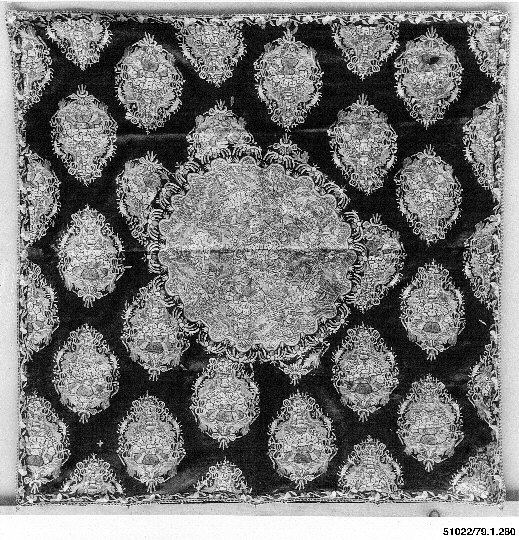
The true tour de force, however, resides in the metal-wrapped thread that executes the embroidery. This is not the gilded bullion of ecclesiastical vestments, nor the fragile metallic lamé of evening wear. The thread, likely a fine silver or gold alloy wrapped around a silk core, possesses a distinct, burnished patina. It suggests the aged surfaces of reliquaries and the worn edges of ancient coins. Its application is not decorative in the conventional sense; rather, it functions as a form of structural calligraphy, tracing the garment’s architecture with a precision that borders on the cartographic.
The Embroidered Cartography: Mapping the Global Unconscious
The embroidery itself is the intellectual heart of “Cover.” Eschewing the floral or figurative motifs that dominate heritage revivals, Katherine Fashion Lab deploys an abstract, quasi-geometric lexicon. The stitches—a complex amalgam of satin, chain, and couching techniques—form patterns that evoke topographical maps, the branching of river deltas, and the migratory routes of nomadic tribes. There are no literal representations; instead, the threadwork suggests pathways and boundaries, the invisible lines that delineate cultures and connect distant geographies.
In one quadrant, the metallic threads converge into a dense, knotted cluster, reminiscent of a celestial constellation or a market town’s central square. In another, they disperse into fine, hairline tendrils that creep toward the garment’s edge, like the outermost frontiers of an empire. This is a global heritage rendered not as a static collection of artifacts, but as a dynamic, flowing system of exchange and conflict. The embroidery becomes a visual representation of the Silk Road, the Spice Route, and the transcontinental trade winds that have woven humanity’s shared fabric. It is a bold claim, but one executed with such technical restraint that it never descends into pastiche.
Architectural Silhouette: The Cover as Shelter and Statement
The silhouette of “Cover” is a study in controlled volume. It is neither a clinging sheath nor a billowing cape, but rather a structured, cocoon-like form that respects the body’s geometry while simultaneously creating a new one. The shoulders are softly extended, not with aggressive padding, but through the natural stiffness of the densely woven wool. The garment falls in clean, vertical planes from this point, skimming the torso without ever adhering to it. The length, reaching just below the knee, provides a sense of monumental gravity, anchoring the piece in the realm of the ceremonial.
This architectural approach is reinforced by the strategic placement of the embroidery. The metallic patterns are concentrated along the seam lines and stress points—the shoulders, the center back, the cuffs—functioning almost as structural rivets. This is a brilliant conceptual inversion: the decorative element is also the load-bearing component. The embroidery does not adorn the garment; it constructs it. The resulting form is one of protective authority, a modern-day armor that shields the wearer not from physical weapons, but from the cacophony of the contemporary world.
Standalone Study: A Manifesto Against the Ephemeral
The decision to present “Cover” as a standalone study is critical to its reception. In an industry predicated on relentless seasonal churn, this piece exists outside of time. It is not designed to be trend-compliant or Instagram-optimized. It demands slow, deliberate contemplation. The garment’s weight, its texture, and the intricate detail of its embroidery all require the viewer to physically engage, to lean in, to touch. This is a haptic experience that digital reproduction cannot convey.
Furthermore, the “standalone” designation elevates the piece from the status of a commodity to that of a specimen. It is a laboratory experiment in material alchemy, a proof-of-concept for a new mode of couture that prioritizes longevity, cultural depth, and intellectual rigor over disposable novelty. Katherine Fashion Lab is not merely creating clothes; it is constructing a philosophical position. “Cover” argues that true luxury is not found in rarity alone, but in meaningful provenance—in the ability of a garment to carry the weight of history without being crushed by it.
In its synthesis of wool’s earthiness, silk’s refinement, and metal’s permanence, “Cover” achieves a rare equilibrium. It is a garment that feels both ancient and utterly futuristic, a relic from a civilization that has mastered the art of honoring its past while forging a new aesthetic future. It is, in the final analysis, a masterclass in restraint, a testament to the power of material and technique to transcend the superficial and speak directly to the human condition. The cover is not a hiding; it is an offering—a meticulously crafted veil through which we glimpse the infinite complexity of our shared heritage.