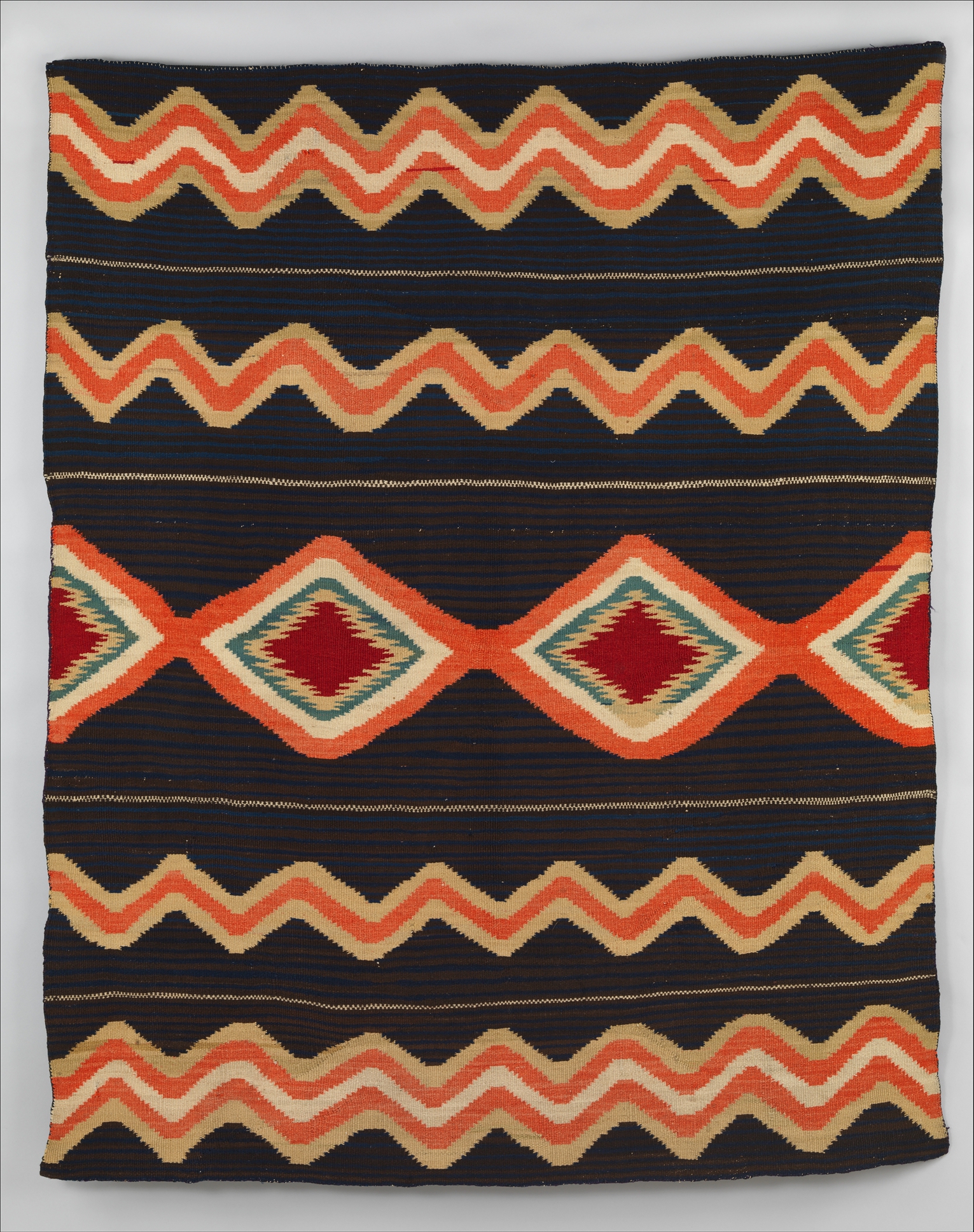
Executive Heritage Analysis: The Navajo Wearing Blanket
The Navajo wearing blanket, or tsiiyéél, represents one of the most sophisticated expressions of cultural identity, spiritual cosmology, and material artistry in North American textile history. For Katherine Fashion Lab, this object transcends its utilitarian origins to become a strategic case study in symbolic power, historical adornment, and the translation of sacred material culture into contemporary luxury. This analysis examines the wearing blanket’s significance across three dimensions—symbolic, historical, and spiritual—and concludes with a forward-looking 2026 luxury strategy that respects provenance while innovating form.
Symbolic Power: Weaving as Cosmic Cartography
The Navajo wearing blanket is not merely a garment; it is a woven cosmology. Every geometric pattern, color choice, and structural decision carries encoded meaning. The diamond shape, known as náátsʼíilid, represents the four sacred mountains that bound the Navajo homeland: Blanca Peak, Mount Taylor, San Francisco Peaks, and Hesperus Mountain. Wearing this symbol is an act of territorial and spiritual claiming—the body becomes a landscape, and the blanket becomes a mobile map of belonging.
Color symbolism further amplifies this power. Turquoise, often achieved through native indigo and mineral dyes, signifies sky and water, while red ochre references the earth’s lifeblood. Black represents the underworld and the potential for emergence, while white denotes dawn and purity. In strategic luxury terms, the wearing blanket’s symbolic architecture offers a blueprint for narrative-driven design—each piece becomes a storytelling system, not a passive accessory. For Katherine Fashion Lab, this suggests a 2026 collection where pattern is never arbitrary but rooted in a documented symbolic lexicon, allowing the wearer to participate in a deeper cultural dialogue.
Historical Adornment: From Utility to Status
Historically, the wearing blanket occupied a dual role: functional protection against the high desert’s extreme temperatures and a marker of social rank. Prior to the introduction of sheep by Spanish colonists in the 17th century, Navajo weavers used cotton and yucca fiber. The adoption of wool—specifically from the Churro sheep—revolutionized the craft, yielding a denser, more durable textile. By the 19th century, the wearing blanket had evolved into a prestige object, traded across the Southwest and coveted by neighboring tribes, Spanish settlers, and later Anglo collectors.
The Chief’s Blanket, a specific subtype with horizontal stripes and a central diamond, exemplifies this status trajectory. Despite its name, it was not exclusively worn by chiefs; rather, it signaled wealth, diplomatic importance, and access to rare materials. The number of stripes and the complexity of the diamond pattern indicated the weaver’s skill and the owner’s social standing. This historical precedent is critical for luxury strategy: the wearing blanket demonstrates that scarcity, craftsmanship, and visual complexity have always been the currency of high-status adornment. In 2026, Katherine Fashion Lab can leverage this by producing limited-edition pieces where the pattern’s complexity is explicitly tied to artisan hours and material rarity—creating a transparent value chain that modern consumers increasingly demand.
Spiritual Meaning: The Blanket as Protective Veil
Spiritually, the Navajo wearing blanket is inseparable from the concept of hózhó—harmony, balance, and beauty. Weaving ceremonies often begin with prayers and songs, and the weaver’s mental state is believed to directly influence the textile’s spiritual efficacy. The blanket is not created; it is emerged, mirroring the Navajo creation story where the Holy People emerged from the underworld into the present world. Wearing such a blanket is an act of alignment with cosmic order, offering protection against malevolent forces and physical elements alike.
This spiritual dimension introduces a profound ethical responsibility for any luxury brand. Unlike Western fast-fashion, where pattern is decorative, the Navajo blanket is a living entity. The act of wearing it is a form of prayer and a declaration of one’s place in the universe. For Katherine Fashion Lab, this demands a reverential design approach—not appropriation, but collaboration. This means engaging Navajo weavers as co-creators, not just suppliers, and ensuring that spiritual protocols are honored in production. The 2026 strategy should include a formal Cultural Stewardship Protocol, where each collection is vetted by Navajo cultural advisors to ensure that symbolic elements are used correctly and respectfully.
Materiality and Craft: Wool as Conduit
The medium of wool is not incidental; it is integral to the blanket’s power. Hand-spun, hand-dyed, and hand-woven wool retains the shepherd’s and weaver’s energy. The natural lanolin provides water resistance, while the tight weave creates thermal regulation. In a luxury context, this materiality offers a counter-narrative to synthetic, mass-produced textiles. The wearing blanket’s wool is a sensory differentiator—its weight, texture, and slight irregularity are markers of authenticity. For Katherine Fashion Lab, sourcing high-grade, ethically raised wool and collaborating with master weavers who use traditional spinning techniques can create a product that feels profoundly different from anything else in the market.
Moreover, the dyeing process historically used plants like rabbitbrush (yellow), walnut (brown), and indigo (blue). Modern synthetic dyes have largely replaced these, but a 2026 luxury strategy could reintroduce botanical dyeing as a signature element. This not only enhances the product’s heritage narrative but also aligns with sustainability trends, appealing to eco-conscious high-net-worth individuals who seek both beauty and environmental responsibility.
2026 High-End Luxury Strategy: Honoring Heritage, Innovating Form
Katherine Fashion Lab’s 2026 strategy for the wearing blanket should be built on four pillars: Provenance Partnership, Limited Edition Architecture, Immersive Storytelling, and Adaptive Design.
Provenance Partnership
Rather than mimicking Navajo patterns, Katherine Fashion Lab should establish a long-term, revenue-sharing partnership with a recognized Navajo weaving cooperative, such as the Navajo Nation’s Weaving Project or the Diné be’ iiná (Navajo Lifeway) organization. Each blanket would be co-signed by the weaver and the Lab, with a detailed provenance card documenting the weaver’s name, clan, region, and the blanket’s spiritual intent. This transforms the product from a commodity into a collectible with a verifiable lineage—a key driver for luxury buyers who value authenticity over mere aesthetics.
Limited Edition Architecture
Scarcity is the bedrock of luxury. The 2026 collection should be capped at 100 pieces worldwide, each numbered and accompanied by a certificate of authenticity. The pricing structure should reflect the true cost of master craftsmanship—accounting for 200+ hours of weaving per blanket—and position the product above conventional high-end cashmere or silk. This creates an investment-grade artifact, similar to how Hermès Birkin bags or haute couture pieces are viewed as appreciating assets.
Immersive Storytelling
Luxury is as much about narrative as product. Katherine Fashion Lab should produce a documentary series and a limited-edition coffee table book featuring interviews with Navajo weavers, historical photographs, and macro-detail shots of the weaving process. The brand could also host private viewing events in major cities—New York, Paris, Tokyo—where clients can touch the wool, hear the weaver’s story via video, and learn about the symbolism. This experiential layer elevates the purchase from a transaction to a cultural initiation.
Adaptive Design
While respecting the blanket’s traditional form, the 2026 strategy should offer subtle adaptations for modern wear. This could include incorporating hidden magnetic closures to transform the blanket into a cape or shawl, or adding a silk inner lining for comfort against skin. However, these modifications must be clearly presented as contemporary additions, not alterations to the core weaving. The goal is to make the blanket wearable in a boardroom or at a gala, not just in a desert landscape, thereby expanding its utility without diluting its spiritual essence.
Conclusion
The Navajo wearing blanket is a masterclass in the fusion of utility, art, and spirit. For Katherine Fashion Lab, it offers a rare opportunity to create a luxury product that is not merely beautiful but meaningful, ethical, and timeless. By honoring the blanket’s symbolic power, historical status, and spiritual depth, and by pairing it with a rigorous 2026 strategy of partnership, scarcity, storytelling, and adaptive design, the Lab can position itself as a leader in culturally intelligent luxury—one that does not exploit heritage but elevates it. In doing so, the wearing blanket becomes more than a garment; it becomes a bridge between worlds, a wearable testament to the enduring power of human creativity and connection.