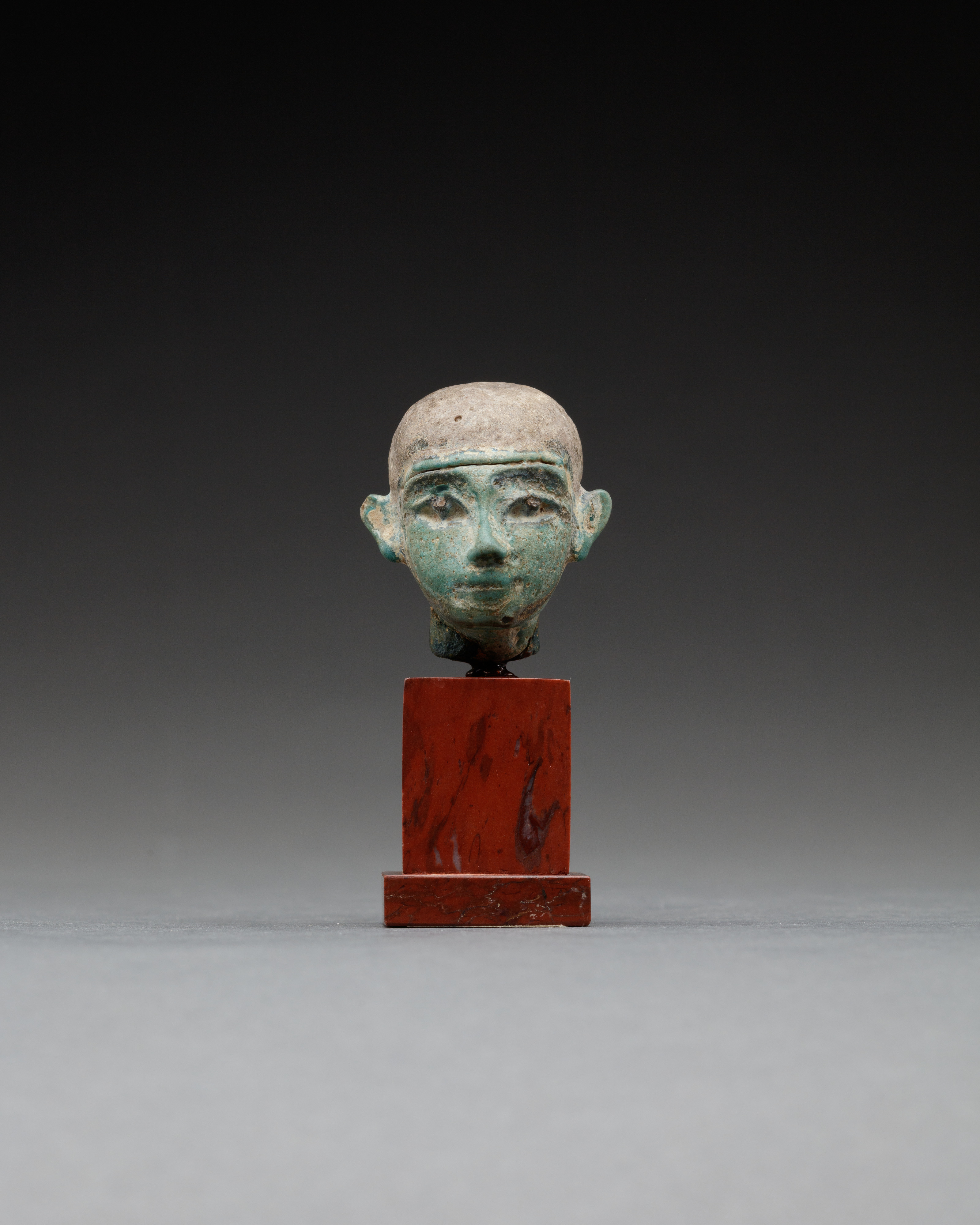
The Head of Ptah: A Heritage Analysis for Katherine Fashion Lab
The Head of Ptah, rendered in the luminous medium of faience, is far more than an artifact of Ancient Egyptian material culture; it is a concentrated emblem of creation, sovereignty, and the metaphysical resonance of craft. For Katherine Fashion Lab, this object offers a profound strategic lens through which to examine the intersection of spiritual authority and material luxury. This analysis deconstructs the Head of Ptah’s symbolic power, its historical role in adornment, its spiritual dimensions, and translates these findings into a cohesive 2026 high-end luxury strategy.
Symbolic Power: The Architect of Reality
Ptah stands as one of the most venerable deities in the Egyptian pantheon, revered as the patron of artisans, architects, and craftsmen. His iconography—a mummiform figure emerging from a tight-fitting shroud, with only his hands, holding the was scepter (dominion), the ankh (life), and the djed pillar (stability), visible—speaks to a contained yet omnipotent force. The head, however, is the epicenter of this power. Ptah is the god of immanent creation, not through physical action, but through the utterance of thought. The head is the seat of the intellect and the voice, the origin of the divine word that brought the universe into being. In the Memphite Theology, Ptah is credited with creating the world through his heart (thought) and tongue (command). Thus, the Head of Ptah is not merely a portrait; it is the physical manifestation of causative thought—the idea that reality is shaped by deliberate, intelligent design.
For a luxury house, this symbolism is directly transferable. The head represents the genius loci of the brand—the intellectual and creative core from which all collections emanate. It signifies that true luxury is not manufactured but conceived. It is the power of the designer’s vision to transform raw materials into objects of transcendent value, echoing Ptah’s role as the divine architect who shapes the cosmos from the primordial chaos. The strategic implication is to position Katherine Fashion Lab not as a producer of garments, but as a creator of realities, where each piece is an articulated idea made tangible.
Historical Adornment: Faience as the Skin of Eternity
The medium of faience is critical to understanding the object’s historical function. Composed of crushed quartz or sand, coated with a vitreous alkaline glaze, faience was a technological marvel of the ancient world. Its brilliant blue-green hue, known as tjehenet, was synonymous with rebirth, regeneration, and the shimmering quality of sunlight on the Nile. Faience was not a humble material; it was a substitute for precious stones like turquoise and lapis lazuli, democratizing divine color for broader ritual use while retaining its celestial prestige.
In the context of adornment, the Head of Ptah was often fashioned into amulets, pectorals, or beads. These were not mere decorations but functional talismans worn by the living and the deceased. When worn, the amulet was believed to transfer Ptah’s creative and protective qualities to the wearer, granting them skill, eloquence, and the ability to manifest their own desires. The placement of such amulets on the body was a deliberate act of proximal magic—the closer the divine image to the skin, the more immediate its influence. The head, specifically, was often placed near the throat or chest, aligning with the seat of speech and breath, thereby activating the wearer’s own power of logos.
Katherine Fashion Lab can draw a direct parallel here: the brand’s use of innovative, high-gloss, or vitreous materials in its 2026 collections can evoke the luminosity of faience. This is not about historical reproduction but about material alchemy—creating surfaces that appear to hold light, suggesting an inner vitality and an impression of permanence. Adornment, in this strategy, becomes a form of armor for the soul, a wearable technology of self-actualization.
Spiritual Meaning: The Triad of Creation and Stability
The spiritual resonance of the Head of Ptah is inextricably linked to the Memphite triad: Ptah, his consort Sekhmet (the fierce lioness goddess of healing and war), and their son Nefertum (the lotus god of perfume and sunrise). Ptah’s head, often depicted with a close-fitting skullcap and a straight beard, conveys a sense of austere wisdom and eternal stability. This is the antithesis of the ephemeral. It represents the eternal now—a state of being that exists outside of linear time, where creation is perpetual.
The spiritual function of the Head of Ptah in a funerary or temple context was to ensure the continuity of the soul and the efficacy of ritual. It was a conduit for divine energy. For the high-end consumer of 2026, this translates to a search for meaningful permanence in a disposable world. The spiritual value is not religious, but existential. The client seeks objects that provide a sense of grounding, of connection to a lineage of human mastery, and a feeling of internal coherence. The Head of Ptah offers a model of sovereign selfhood—the ability to remain composed, creative, and authoritative amidst external chaos.
Strategically, Katherine Fashion Lab can leverage this by framing its 2026 collections around the concept of the “Creator’s Mind.” The brand should not sell clothing; it should sell clarity and intention. The spiritual narrative is one of empowerment through discipline and design, echoing Ptah’s role as the master craftsman who brings order from disorder.
2026 High-End Luxury Strategy: The Ptah Protocol
Translating this heritage into a commercial strategy for 2026 requires a multi-faceted approach that moves beyond mere aesthetics into the realms of philosophy and experience. The following strategic pillars are proposed for Katherine Fashion Lab.
Pillar 1: The "Thought-Leadership" Collections
The 2026 collections should be structured around the concept of “Articulated Visions.” Each garment or accessory must be presented as a resolved idea, not a seasonal trend. The design process should be communicated as a form of intellectual craftsmanship, akin to Ptah’s divine utterance. Marketing materials should emphasize the why behind the design—the specific problem it solves or the sensation it evokes. The brand’s atelier should be positioned as a modern temple of creation, where master tailors and artisans act as priests of their craft.
Pillar 2: Material Innovation as "Modern Faience"
Katherine Fashion Lab must pioneer materials that replicate the luminous depth of faience. This involves investing in bio-ceramic coatings, high-polish technical fabrics, and iridescent finishes that shift color in light, evoking the tjehenet effect. These materials should be proprietary, patented, and exclusive to the house. The strategic goal is to create a signature sensory signature—a visual and tactile language that is instantly recognizable, just as faience was instantly recognizable as Egyptian. This material becomes the brand’s heraldic device.
Pillar 3: The "Amulet Strategy" for the Modern Elite
Introduce a line of “Power Objects”—limited-edition accessories, such as brooches, cufflinks, or even interior objects, that are direct stylistic descendants of the Ptah amulet. These are not jewelry in the traditional sense but functional talismans of intent. Each piece would be sold with a "manifesto" card explaining its symbolic function (e.g., "The Articulator" for communication, "The Architect" for strategic vision). This creates a new category of luxury consumption based on psychological utility and personal empowerment.
Pillar 4: Experiential Retail as a "Sacred Space"
Flagship stores should be redesigned not as retail spaces but as sanctuaries of creation. The architecture should evoke the silence and permanence of a temple. Private consultation rooms, or "chambers of design," should be offered where clients can co-create bespoke pieces with the atelier, mirroring the divine act of co-creation. The retail experience should be ritualistic: a process of discovery, selection, and personalization that culminates in the client leaving with a piece that feels not just worn, but consecrated to their own identity.
Pillar 5: Narrative of Sovereign Craft
The brand’s communication strategy for 2026 must pivot from "lifestyle" to "legacy and mastery." Campaigns should feature the hands of artisans, the precision of cutting, and the intellectual rigor of design. The message is clear: Katherine Fashion Lab is not for the passive consumer; it is for the active creator—the individual who understands that their personal style is a form of world-building. This aligns perfectly with Ptah’s essence: the power of the head to command reality.
Conclusion: The Eternal Head in the Modern Wardrobe
The Head of Ptah, in its silent, glazed majesty, offers a timeless blueprint for luxury that is intellectually rigorous, spiritually resonant, and materially exquisite. By adopting the "Ptah Protocol," Katherine Fashion Lab can transcend the cyclical nature of fashion, positioning itself as a purveyor of permanent value. The brand will not merely dress its clients; it will equip them with the symbolic tools of creation, stability, and eloquence. In a world saturated with noise, the Head of Ptah whispers the most powerful luxury of all: the power of the deliberate thought, made manifest in the world. This is the heritage, and this is the future.