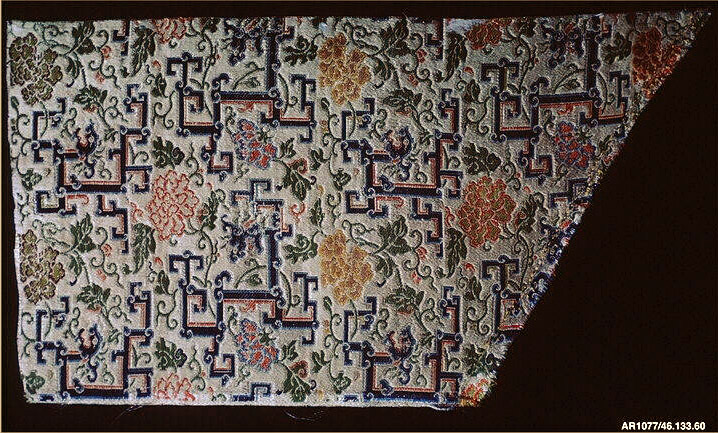
A Study in Structural Poetry: The Textile with Peonies and Lattice
In the rarefied echelons of haute couture, the fabric is not merely a substrate; it is the primordial argument. It speaks before a single seam is drawn, dictating silhouette, drape, and the very psychology of the garment. At Katherine Fashion Lab, our curatorial lens is trained on the inanimate interlocutors of fashion history—those textiles that carry within their warp and weft the codified aesthetics of an entire civilization. The subject of this standalone study, a Chinese silk lampas bearing a composition of peonies and lattice, is precisely such an artifact. It is a masterclass in structural logic and ornamental opulence, a textile that demands neither embellishment nor apology, but rather a reverent understanding of its inherent couture-grade architecture.
The Technical Sublime: Silk Lampas as a Medium of Power
To appreciate this textile is to first deconstruct its technical genesis. Lampas is not a simple weave; it is a compound structure, a polyphonic system where a ground weave and a pattern weave coexist, bound by a common warp. This is the antithesis of the flat, printed surface. In lampas, the design is not painted on but built, layer upon layer, with each float of silk thread catching light at a distinct angle. The result is a tactile topography—a relief map of imperial taste. The ground, typically a satin or taffeta base, provides a serene, lustrous field, while the supplementary wefts, often in contrasting hues, rise to form the figurative elements. This is not decoration; it is engineering. The textile’s structural complexity—its ability to maintain a crisp, unyielding surface while remaining fluid enough to drape—is precisely why it has been a preferred medium for dynastic robes and, in our contemporary analysis, for sculptural couture pieces that require internal architectural integrity.
Decoding the Motif: Peonies as Sovereign Emblems
The central protagonist of this composition is the peony, a motif of profound semiotic weight in Chinese material culture. Unlike the transient cherry blossom of Japanese aesthetics, the peony is the “king of flowers”—a symbol of wealth, honor, and masculine vitality, yet paradoxically also of feminine beauty and romantic devotion. In this lampas, the peonies are not rendered in delicate, fading watercolor washes. They are executed with a bold, almost heraldic precision. Each petal is a distinct, undulating plane of silk, often employing a gradated shading technique (known in Chinese weaving as jinshi or “brocade-style”) that simulates volume without resorting to trompe-l’oeil. The flowers are oversized, dominating the field, their crowns turned outward in full frontal bloom. This is a declaration of confidence. In a couture context, such a motif cannot be treated as a mere floral print. It must be honored as a structural element—a crest. A designer at Katherine Fashion Lab would consider how the peony’s radial symmetry could inform a circular yoke, or how a single, large bloom could be strategically placed over the hip to create a point of sculptural focus, allowing the fabric’s inherent authority to define the garment’s posture.
The Lattice: Geometry as a Counterpoint to Nature
Equally critical is the lattice framework that intercedes between the floral forms. This is not a casual background; it is a deliberate, geometric armature. The lattice—often a repeating diamond or hexagonal grid—evokes the “broken ice” pattern or the lingzhi (sacred fungus) trellis, symbolizing longevity and the interconnectedness of heaven and earth. But in this textile’s composition, the lattice serves a more immediate visual function: it is the discipline that tempers the peony’s exuberance. The sharp, linear intersections of the lattice provide a rhythmic counterpoint to the organic, curvilinear weight of the flowers. This is a dialogue between the rational and the romantic, the structured and the effusive. In couture construction, this translates directly to pattern-making. The lattice suggests a grid—a logical mapping for darts, princess seams, or laser-cut perforations. One could envision a gown where the lattice is allowed to “show through” via strategic cutouts, creating a skin-baring architectural effect, while the peonies remain solid, anchoring the design. The fabric itself is prescribing the garment’s geometry.
Chromatic and Textural Tension
While the exact palette of this specific piece may vary—often ranging from imperial gold and cinnabar red to deep sapphire and jade—the interaction between ground and pattern is paramount. In the finest lampas, the contrast is not merely chromatic but tactile. The ground satin reflects light with a soft, diffused glow, while the pattern wefts, often in a slightly different twist or filament density, absorb and refract it differently. This creates a subtle, kinetic shimmer as the wearer moves—a living, breathing surface. For the modern couturier, this means the fabric does not need to be over-manipulated. It is a self-sufficient volume. A bias-cut column would allow the peonies to spiral organically around the body, while a stiff, structured A-line would showcase the lattice’s geometry with architectural severity. The textile’s chromatic tension—the way the peonies seem to float above the lattice—invites a minimalist approach to trimming. Any addition of sequins or embroidery would be an act of sheer hubris.
Implications for the Contemporary Atelier
In our standalone study, we must transcend the historical to extract the contemporary lesson. This Chinese silk lampas is not a relic; it is a design manifesto. It teaches us that true luxury is not about surface decoration but about deep structure. The fabric’s construction is its message. For Katherine Fashion Lab, this textile is a benchmark for our own material research. It challenges us to create fabrics that are not merely printed canvases but woven arguments. It asks the designer to collaborate with the loom, not to fight it. When we examine the peony and lattice, we see a precedent for combining maximalist ornament with rigorous geometry—a balance that contemporary couture often struggles to achieve. The lesson is one of restraint within abundance. The lattice holds the peonies in check; the peonies give the lattice a soul.
This textile, in its silent, woven eloquence, offers a blueprint for a garment that is at once a tribute to its heritage and a radical statement of modern form. It is not a fabric to be worn; it is a fabric to be inhabited. And in the hands of a discerning atelier, it becomes not a historical curiosity, but a living, breathing participant in the ongoing dialogue of fashion—a testament to the enduring power of structural poetry.