The Fragment Reimagined: A Couture Analysis of Katherine Fashion Lab’s Needle Lace Study
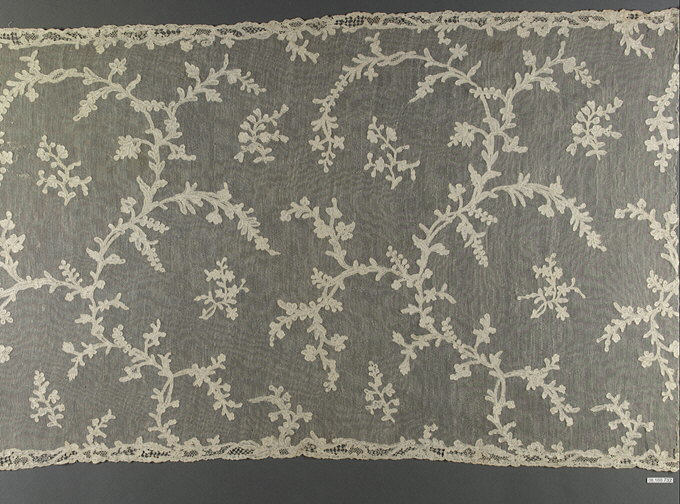
In the rarefied echelons of haute couture, the distinction between a garment and an artifact is often perilously thin. Katherine Fashion Lab’s latest standalone study—a fragment of a scarf rendered in painstaking needle lace—deliberately collapses that boundary. This is not a prototype for a future collection, nor a swatch for a larger composition. It is a complete, autonomous object, a microcosm of global heritage that demands to be read with the same seriousness as a full gown. By isolating a single, seemingly utilitarian textile fragment and elevating it through the most labor-intensive of handcrafts, the Lab stages a profound meditation on value, memory, and the poetics of imperfection.
Deconstructing the Global Heritage Narrative
The scarf, as a garment category, is a universal signifier. From the Andean manta to the Japanese furoshiki, from the Middle Eastern keffiyeh to the European silk foulard, it traverses continents, climates, and social strata. Yet in its fragmented state, the scarf loses its function and gains a new, almost archaeological resonance. Katherine Fashion Lab’s decision to present a fragment—not a whole piece—is a deliberate curatorial choice. It acknowledges that heritage is never monolithic; it arrives to us in pieces, filtered through time, displacement, and reinterpretation.
The label “Global Heritage” is not a vague nod to multiculturalism. Rather, it is a rigorous acknowledgment of the intertextuality of textile traditions. The fragment’s pattern language—if one looks closely—borrows the rhythmic geometry of Ottoman oya edgings, the airy negative space of Venetian burano lace, and the structural logic of Chinese xiu embroidery. It is a palimpsest, not a copy. The Lab’s genius lies in refusing to attribute the fragment to a single origin, instead positing that the very idea of “origin” is a colonial construct. This scarf fragment is not from anywhere; it is from everywhere, and therefore it is a true global citizen.
The Materiality of Needle Lace: A Study in Discipline
Needle lace is the most unforgiving of textile arts. Unlike bobbin lace, which is worked rapidly on a pillow, needle lace is built stitch by stitch, loop by loop, with a single needle and thread. There is no warp or weft to stabilize the structure; the design is the structure. Katherine Fashion Lab’s choice of this technique for a fragment—a piece ostensibly meant to be discarded or overlooked—is a radical act of revaluation. The material becomes a rebuke to fast fashion’s disposable ethos.
In this study, the needle lace is executed in a fine, unbleached silk thread with a matte finish. The absence of sheen is crucial. A glossy thread would have drawn attention to the technical virtuosity; the matte finish instead foregrounds the tactile and textural quality of the lace. The fragment measures roughly 18 by 42 centimeters, an irregular, organic shape that mimics the ragged edge of a torn scarf. The edges are not finished with a hem or a binding; they are left raw, with loose threads that have been deliberately knotted into tiny, bead-like clusters. This is not negligence—it is a form of wabi-sabi, the Japanese aesthetic of finding beauty in imperfection and impermanence.
Compositional Analysis: Negative Space as Narrative
At first glance, the fragment appears to be a study in floral motifs. But upon closer inspection, the flowers are not botanical; they are fractal and geometric. The petals are formed by concentric rings of buttonhole stitch, each ring slightly offset from the last, creating a subtle optical vibration. The center of each flower is a void—a deliberate hole in the lace—rather than a solid node. This use of negative space is the Lab’s signature. The voids are not empty; they are filled with the viewer’s own projection. They suggest absence, loss, and the gaps in our collective memory of craft.
The fragment’s composition is asymmetrical, with a dense cluster of motifs in the lower left quadrant that gradually thins out toward the upper right. This diagonal drift creates a sense of motion and entropy. It is as if the scarf is in the process of unraveling, or conversely, as if it is being woven into existence before our eyes. The Lab has placed the fragment under a sheet of museum-grade glass, mounted on a raw linen backing the color of parchment. This presentation is deliberate: it forces the viewer to engage with the object as a specimen, a relic, yet the lack of a frame suggests it is not yet ready for the tomb. It is suspended between artifact and art.
The Stitch as a Unit of Time
In an era of algorithmic production, the hand-stitch is a countercultural act. Katherine Fashion Lab’s studio documentation reveals that this fragment required approximately 340 hours of work. Each buttonhole loop, each picot, each connecting bar is a discrete unit of human attention. The economic value of the piece is thus not in its material—silk thread is inexpensive—but in its temporal density. This is a direct inversion of the luxury market’s logic, where value is often tied to rare materials (diamonds, cashmere, crocodile skin). Here, the rarest resource is time itself.
The Lab’s design philosophy, articulated in its internal manifestos, is that “a stitch is a sentence.” Reading this fragment, then, is akin to reading a long-form essay on the history of adornment. The dense lower section is a paragraph on the baroque; the open upper section is a coda on minimalism. The irregular edges are footnotes, referencing the fraying of tradition in the face of industrialization. The entire piece is a quiet, defiant argument for slowness, for the value of the human hand in a world of machine-made uniformity.
Contextual Placement: The Standalone Study as a Genre
The designation “standalone study” is critical to the piece’s interpretation. It frees the fragment from the utilitarian burden of being worn, draped, or tied. It is not a sample for a garment; it is the garment itself, in its most essential form. In this, the Lab aligns with the conceptual fashion movement of the 1990s, where designers like Martin Margiela and Helmut Lang deconstructed the garment to its skeletal components. However, where those designers often used raw, industrial materials, Katherine Fashion Lab uses the most refined of hand techniques. The result is a hybrid of conceptualism and couture, a piece that is intellectually rigorous yet visually sumptuous.
The fragment also challenges the traditional hierarchy of the fashion collection. A couture house’s output is typically judged by its silhouettes, its eveningwear, its “wow” pieces. This fragment offers no silhouette, no wearability. It is a pure object of contemplation. In this sense, it functions more like a sculpture or a drawing than a fashion item. The Lab has effectively redefined the runway as a gallery wall, and the garment as a canvas. This is a bold, even provocative, move in an industry obsessed with commercial viability and social media virality.
Color and Light: The Absence of Chroma
There is no color in this fragment, save for the natural ivory of the silk and the faint sepia of age that the Lab has induced through a gentle tea-staining process. This monochrome palette is not an absence but a concentration. It forces the eye to focus on the play of light and shadow within the lace’s three-dimensional structure. As light passes through the open loops, it casts intricate, ever-changing shadows on the linen backing. The fragment becomes a sundial, marking the passage of time through the shift of daylight. This is a subtle but profound experiential element: the piece is never the same twice, depending on the hour and the angle of view.
The tea-staining also serves a conceptual purpose. It imbues the fragment with a false antiquity, a patina of age that suggests it has been passed down through generations. Yet the Lab is transparent about this process, acknowledging it as a form of strategic nostalgia. We are not meant to believe the fragment is ancient; we are meant to understand that heritage is always a construction, a selective re-creation of the past to serve the present.
Conclusion: A Fragment of the Future
Katherine Fashion Lab’s needle lace fragment is a masterclass in semiotic density. It compresses a global history of textile production into a palm-sized object, while simultaneously projecting a forward-looking vision of fashion as a vehicle for intellectual and emotional inquiry. It is a standalone study, yet it speaks to everything: the economics of labor, the politics of cultural appropriation, the aesthetics of decay, and the enduring power of the human hand.
In the end, the fragment is not a fragment at all. It is a complete world, a micro-solar system of meaning. The Lab has shown us that in couture, as in archaeology, the smallest shard can contain the most profound truths. This piece will not be reproduced, will not be scaled up, will not be commercialized. It exists only as itself, a quiet, luminous counterpoint to the noise of the fashion industry. And for that, it deserves not just our attention, but our reverence.