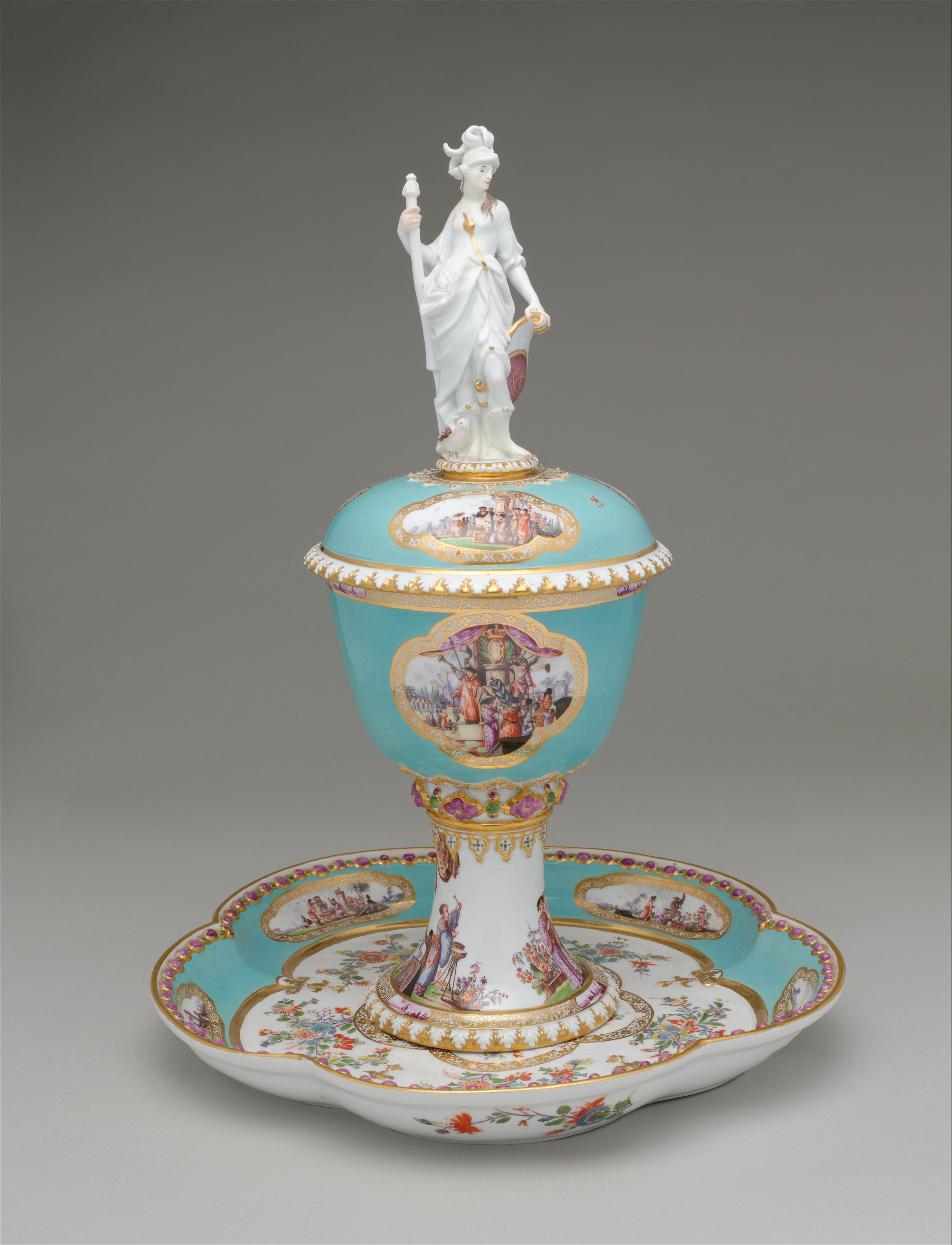
The Porcelain Reliquary: A Couture Analysis of the Standing Cup with Cover and Stand
In the rarefied echelons of haute couture, where fabric is sculpted into architecture and thread becomes narrative, the designer’s eye is perpetually attuned to the unexpected muse. At Katherine Fashion Lab, our analysis transcends the conventional boundaries of textile and silhouette to embrace the object as a primary source of design intelligence. The Standing Cup with Cover and Stand, a masterwork of hard-paste porcelain from the Global Heritage collection, is not merely a ceremonial vessel; it is a three-dimensional treatise on proportion, surface, and the semiotics of luxury. For the discerning couturier, this object—presented here as a standalone study—offers a lexicon of structural principles that translate directly into the language of gowns, tailoring, and accessory design.
I. Structural Anatomy: The Tripartite Silhouette
The cup’s composition is a study in disciplined verticality, divided into three distinct yet harmonious registers: the domed cover, the vessel body, and the elevated stand. This tripartite structure is the first lesson in couture construction—the deliberate articulation of a garment into zones of visual and physical weight. The cover, with its pronounced finial, functions as the apex of the composition, analogous to a couture hat or a dramatic shoulder line that draws the eye upward, creating an elongated, regal posture. In our atelier, this translates to high, structured collars or sculptural headpieces that frame the face with authority.
The vessel body itself presents a subtle, yet profound, ovoid curve. It is not a static cylinder but a living form that swells gently at the equator before tapering to a narrow foot. This contour mirrors the ideal corseted torso—the "S-curve" that has defined feminine elegance from the Belle Époque to contemporary red-carpet dressing. The key here is controlled volume: the porcelain’s expansion is not exaggerated but measured, creating a sense of contained energy. A Katherine Fashion Lab gown would replicate this through meticulous draping, using structured silk gazar or duchess satin to build a skirt that flares with precision, then is cinched with a wasp-waist seam to echo the cup’s transition to its foot.
The stand is the foundational element, elevating the entire piece from mere utility to ritual object. Its flared, splayed base provides a visual counterweight to the dome above, ensuring the silhouette does not topple. This is the couture principle of grounding. Just as a ballgown requires a substantial petticoat or crinoline to achieve its majestic sweep, the stand offers the cup its own "invisible crinoline"—a structural engineering that allows for grandeur without instability. In our interpretation, this becomes a wide, trumpet hem or a train that anchors the wearer, giving her a monumental presence.
II. Materiality and Surface: The Language of Hard-Paste Porcelain
Hard-paste porcelain, a material born from the fusion of kaolin and petuntse at extreme temperatures, is the pinnacle of material integrity. Unlike its softer counterparts, it resists chipping, holds its shape under duress, and possesses a vitreous, almost luminescent quality. For a couture house, this materiality is a direct analogue to our most precious fabrics—think of a crisp, high-twist silk taffeta or a heavy, matte crepe that holds a pleat with architectural permanence. The porcelain’s surface is not merely a covering; it is an integral part of the object’s identity, a skin that both protects and communicates.
The glaze, likely a clear or slightly opalescent coating, imparts a depth that is almost aqueous. Light does not simply reflect off the surface; it enters the glaze, refracts through the body, and emerges with a softened, inner glow. This is the effect we chase with hand-beaded embellishment or layered organza—a luminosity that comes from within, not from a superficial shine. The absence of excessive polychrome decoration, in this particular study, is a masterclass in restraint. The white (or off-white) body becomes a blank canvas, allowing the purity of the form to dominate. In couture, this is the power of the "little black dress" or the pristine white shirt—a reduction to essential form that amplifies the wearer’s own presence.
III. The Semiotics of the Cover: Concealment and Revelation
The cover is not a mere lid; it is a narrative device. In its closed state, it guards the contents, creating an aura of mystery and anticipation. This is the couture art of concealment. A high-necked, closed-back gown or a dramatic cape performs the same function, inviting the observer to imagine what lies beneath. The act of removing the cover—a ritual of revelation—is akin to the slow unzipping of a gown or the fall of a silk scarf from the shoulders. The finial, often sculpted as a fruit or a floral bud, acts as a tactile and visual punctuation mark, a final flourish that demands a second glance.
In our design philosophy, the cover also speaks to the concept of layered dressing. Just as the cup is incomplete without its cover, a couture ensemble is incomplete without its final layer—a bolero, a stole, or a detachable train. This interchangeable architecture allows for transformation, turning a day look into an evening statement. The cover’s presence implies a ceremony, a deliberate pause in the everyday. It elevates the act of drinking (or, in our case, dressing) into a performance.
IV. Global Heritage and the Couture Canon
Attributing this piece to "Global Heritage" is an acknowledgment that such forms—the covered cup on a stand—appear across cultures, from Chinese tea ceremonies to European silver epergnes. This universality is the essence of timeless design. It is not bound by a single geography or epoch but represents a shared human impulse toward ritualized beauty. For Katherine Fashion Lab, this is a call to look beyond seasonal trends and regional aesthetics. The standing cup is a reminder that the most potent design archetypes are those that have been refined over centuries, achieving a state of perfect inevitability—a shape that feels as if it could not be any other way.
This object challenges the couturier to achieve the same. Our sketches must not chase novelty for its own sake but instead seek the essential line that resonates across generations. The cup’s proportions—the height of the stand relative to the body, the curve of the dome relative to the foot—are not arbitrary. They are a mathematical and aesthetic harmony that our pattern cutters must replicate in two dimensions, then coax into three. It is a lesson in proportional rigor: the distance from the waist to the hem, the width of the shoulder to the length of the sleeve—every measurement must serve the whole.
V. A Standalone Manifesto for the Atelier
As a standalone study, this standing cup is not a prop for a historical reenactment but a living blueprint. It instructs us on the importance of verticality in an era of casual, horizontal dressing. It reminds us that structure is not the enemy of fluidity—the porcelain’s hard surface is, paradoxically, a frozen moment of liquid grace. It teaches us that luxury is restraint: the absence of ornament can be the most powerful statement of all.
In the Katherine Fashion Lab, we will translate this object into a capsule collection. The finial becomes a top-handle for a structured handbag. The ovoid body becomes a bias-cut gown in ivory faille, with a fitted underlayer and a floating outer shell that mirrors the glaze’s depth. The stand becomes a sculptural heel for a pump, its splayed base providing both drama and stability. The cover becomes a detachable hooded cape, lined in a contrasting, hidden hue—a secret revealed only upon movement.
Ultimately, the Standing Cup with Cover and Stand is a testament to the fact that couture is not confined to the runway. It exists in the disciplined curve of a ceramic body, in the precise application of a glaze, in the thoughtful engineering of a base. By studying such objects, we do not merely imitate; we internalize their principles, allowing them to infuse our sketches, our drapes, and our final seams with a heritage that is both global and deeply personal. The cup is silent, but for those trained to listen, it speaks a language of perfect form.