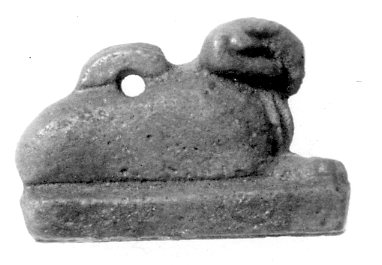
Executive Heritage Brief: The Ram Amulet in Faience
This analysis, prepared for Katherine Fashion Lab’s 2026 strategic collections board, examines the ram amulet as a singular artifact of ancient material culture. The object, rendered in faience—a sintered quartz ceramic prized for its vitreous, turquoise-like sheen—represents a confluence of theological authority, protective magic, and proto-luxury craftsmanship. For a maison positioning itself at the intersection of heritage and avant-garde, the ram amulet offers a potent symbolic lexicon: virility, solar resurrection, and divine guardianship. This paper deconstructs its historical resonance and translates these attributes into a concrete, commercially viable luxury strategy for the 2026 season.
Material and Craft: The Alchemy of Faience
Faience was not a passive medium; it was an alchemical act. The ancient artisan ground quartz or sand, mixed it with alkaline salts and a copper-based colorant, then fired it to achieve a hard, luminous surface. The result was a material that mimicked turquoise and lapis lazuli—stones of celestial and regenerative significance—yet was entirely manufactured. This made faience a "democratized luxury" in antiquity: accessible to the elite but not exclusive to the pharaoh, allowing for widespread distribution of protective amulets.
For the modern luxury house, the strategic resonance is twofold. First, the material’s transformative process—from dull sand to brilliant glaze—mirrors the brand’s own narrative of elevating raw inputs into objects of desire. Second, the color palette (Egyptian blue, malachite green) offers a distinct chromatic departure from the standard gold-and-diamond lexicon of contemporary jewelry. A 2026 collection should therefore feature faience-inspired glazes in high-polish ceramic, paired with recycled gold, to honor the material’s origin while satisfying modern sustainability mandates.
Technical Significance in Adornment
Archaeological evidence places ram amulets in burial contexts and daily wear, often strung on linen thread or incorporated into broad collars (wesekh). The amulet’s small scale (typically 2–4 cm) demanded precision carving, a skill reserved for master artisans attached to temple workshops. This association with institutional craft elevates the amulet from mere trinket to a credentialed object, akin to a hallmark or a certification of origin. Katherine Fashion Lab can adopt this "temple workshop" ethos by introducing a limited, numbered series of ram amulets, each accompanied by a provenance card detailing the artisan’s hand-finishing process—a direct analog to the ancient workshop’s signature.
Symbolic Power and Spiritual Semantics
The ram in ancient civilization—particularly in Egypt, Nubia, and Mesopotamia—was not a passive pastoral animal. It was the earthly incarnation of Amun-Ra, the creator sun god, and of Khnum, the potter god who shaped humanity on his wheel. The ram’s horns, curving in a spiral, symbolized the sun’s cyclical path: death at dusk, rebirth at dawn. Consequently, the amulet was a microcosm of cosmic order (ma'at), carried to ensure the wearer’s alignment with divine will and to guarantee resurrection in the afterlife.
Spiritually, the amulet functioned as a talisman of agency. Unlike passive devotional objects, the ram amulet was believed to activate power upon contact with the skin, channeling the god’s virility and protective force into the wearer’s mundane actions. This is a critical distinction for luxury positioning: the object is not decorative but functional—a wearable technology of spiritual empowerment. In a 2026 market increasingly driven by wellness and intentionality, this narrative offers a compelling alternative to minimalist "quiet luxury." The ram amulet is a loud luxury of meaning, not of logo.
The Horn as a Motif of Authority
The ram’s horn, specifically the curved ammonite-like spiral, is a recurring motif in royal regalia. In ancient iconography, pharaohs donned ram-headed pectorals to visually assert their semi-divine status. The horn’s geometry—a continuous, unbroken arc—also evokes the infinity symbol, suggesting permanence and legacy. For Katherine Fashion Lab, the horn can be abstracted into a signature clasp or a pendant silhouette, serving as a branded icon that communicates heritage without resorting to literal reproduction. This abstraction allows the motif to traverse cultural boundaries, appealing to a global clientele that values symbolic depth over explicit historical citation.
Historical Adornment: From Tomb to Runway
Historical records indicate that ram amulets were often placed over the heart of the deceased, specifically to prevent the heart from testifying against the soul during the Weighing of the Heart ceremony. This placement underscores the amulet’s role as a moral compass—a physical reminder of ethical conduct. In life, the amulet was worn on the chest or wrist, visible to others as a declaration of the wearer’s devotion and social standing. The amulet’s visibility was a form of social currency, signaling access to religious institutions and the financial means to commission sacred objects.
Translating this to contemporary adornment, Katherine Fashion Lab should position the ram amulet not as a necklace or bracelet in the traditional sense, but as a talismanic pendant worn over the heart or at the solar plexus. This placement aligns with modern bioenergetic theories of chakras, creating a bridge between ancient spiritual practice and contemporary wellness culture. The 2026 collection could include a "Heart Guardian" line, featuring the ram amulet in oxidized silver and high-fire ceramic, designed to be worn against the skin, not over clothing—emphasizing the intimate, personal nature of the talisman.
2026 High-End Luxury Strategy: The Amulet as a Cultural Asset
The luxury market of 2026 will be defined by a clientele that is historically literate and semiotically demanding. This consumer rejects empty branding in favor of objects with verifiable cultural provenance. The ram amulet offers Katherine Fashion Lab a distinct advantage: it is a universal archetype (masculine power, solar rebirth) yet possesses specific historical authenticity. The strategy must therefore be threefold:
1. Limited Edition "Sacred Provenance" Series
Produce a run of 500 pieces, each in hand-glazed faience ceramic, set in 18k recycled gold. Each amulet will be accompanied by a digital NFT certificate linking to a high-resolution scan of an original museum artifact, providing irrefutable cultural authenticity. The price point should be set at a premium (€8,000–€12,000) to position the amulet as an investment-grade collectible, not a fashion accessory. This scarcity-driven model mirrors the ancient workshop’s limited output and creates a secondary market of collectors.
2. The "Solar Cycle" Narrative Campaign
Launch a multimedia campaign that eschews traditional advertising in favor of a documentary-style narrative. Feature interviews with Egyptologists, material scientists, and contemporary spiritual leaders, all discussing the ram amulet’s power. The campaign’s tagline, "Wear the Sun’s Return," positions the amulet as a tool for personal renewal—a direct appeal to the post-pandemic desire for resilience and rebirth. This content should be distributed via a dedicated microsite and private client viewings, creating an aura of exclusivity and intellectual rigor.
3. Cross-Category Integration
Extend the ram motif beyond jewelry into a limited home-objects line: a faience-glazed incense burner, a ram-headed letter opener, and a ceremonial box for storing the amulet. This transforms the amulet from a standalone product into the centerpiece of a ritualistic lifestyle system. The consumer is not merely buying a pendant; they are acquiring a daily practice of mindfulness, anchored by a historically validated object. This approach increases average transaction value and deepens brand loyalty, as the amulet becomes a daily companion rather than a seasonal purchase.
Conclusion: Strategic Imperative
The ram amulet in faience is not a nostalgic artifact but a strategic asset. Its symbolic power—solar authority, moral protection, and divine virility—resonates with a 2026 consumer seeking meaning in a fragmented world. By honoring the material’s alchemical origins and the motif’s cosmological weight, Katherine Fashion Lab can launch a collection that is simultaneously historically grounded and commercially avant-garde. The amulet’s journey from ancient tomb to modern neckline is not a dilution of its power but an amplification—a testament to the enduring human need to carry the divine, close to the heart. This is not heritage for heritage’s sake; it is heritage as a competitive moat.