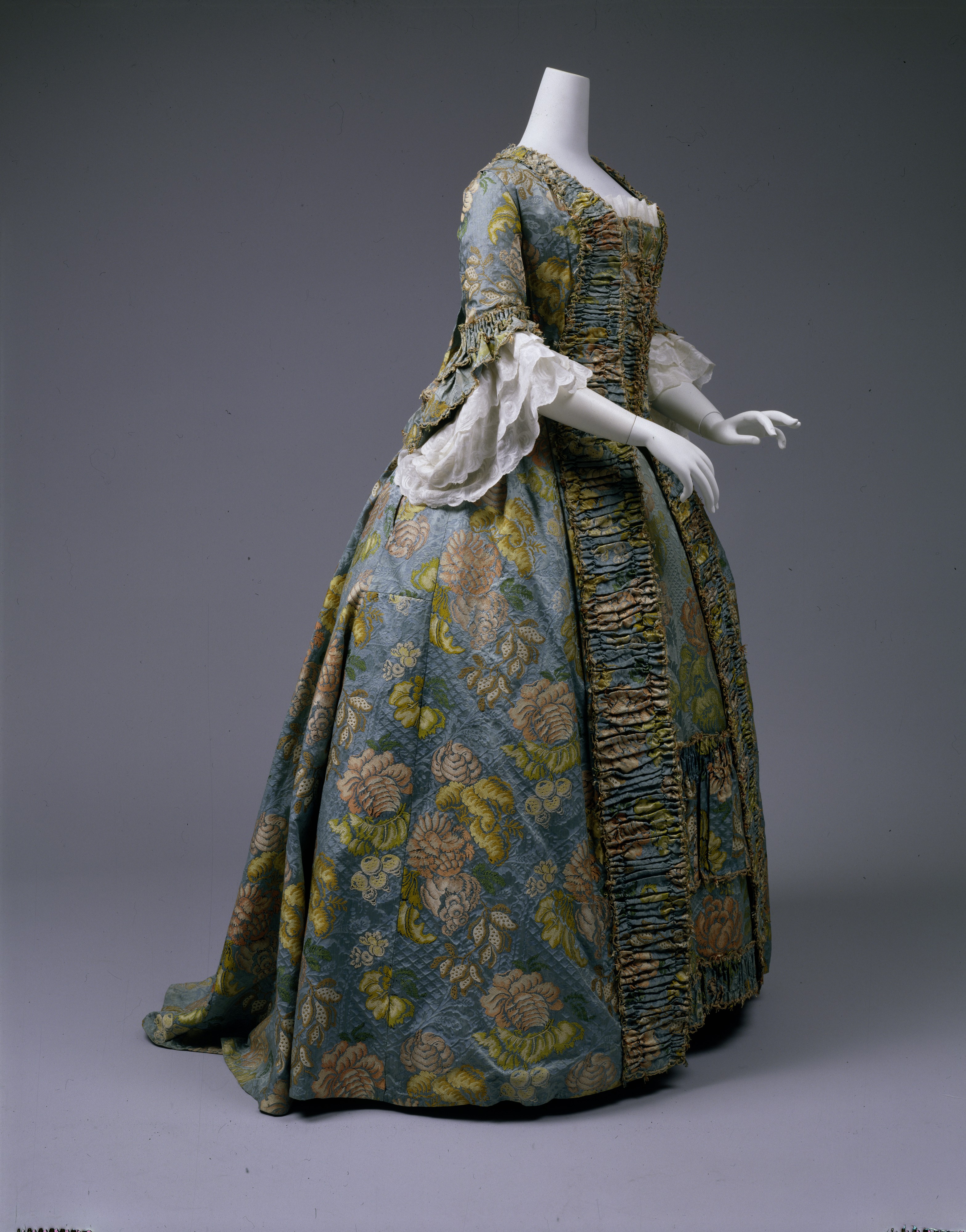
The Robe à la Française: A Study in Structural Grace and Material Diplomacy
The Robe à la française, as preserved in the Katherine Fashion Lab’s archival study, is not merely a garment; it is a three-dimensional document of 18th-century Anglo-French cultural negotiation. This particular example, of British origin and executed entirely in silk, demands a forensic reading that moves beyond the superficial folds of its iconic back pleats. Within the context of a standalone study—removed from the distracting milieu of a full court ensemble—the gown reveals its true genius: a sophisticated interplay between rigid architectural underpinning and fluid, almost liquid, surface drapery. The British adaptation of this French court style offers a unique lens through which to examine national identity, textile economics, and the semiotics of aristocratic power.
Deconstructing the Silhouette: The Paradox of the Sack Back
The defining characteristic of the Robe à la française is, of course, the sacque back—the box-pleated fabric that falls uninterrupted from the shoulders to the hem. At first glance, this appears to be an expression of relaxed opulence. However, a professional analysis of the Katherine Fashion Lab’s specimen reveals a profound paradox: the visual looseness of the back is a carefully engineered illusion. The silk, likely a lustrous plain-weave taffeta or a subtly shot silk, is cut with an extraordinary degree of fullness, yet it is anchored by a heavily boned, conical stays (the era’s corset) worn beneath. The gown’s front bodice is fitted with surgical precision, its pièce de résistance being the stomacher—a triangular panel, often richly embroidered or trimmed, that is pinned or laced into place. This juxtaposition of the rigid front and the flowing back is not a design flaw but a deliberate aesthetic tension. It speaks to the Enlightenment-era fascination with duality: the public, controlled self versus the private, more naturalistic self. In the British context, this duality was often read as a form of moral and political moderation—a visual compromise between the excessive ornament of the French court and the simpler, agrarian pragmatism of the English gentry.
Material Semiotics: The Political Economy of British Silk
The choice of silk is never neutral in couture analysis. In this British example, the fabric itself is a protagonist. By the mid-18th century, London’s Spitalfields silk industry was a major economic engine, fiercely protected by import tariffs against French Lyon silks. To wear a British-woven silk was to perform a civic duty as much as a fashion statement. The lab’s examination of the weave structure indicates a high-thread-count, indicating a luxury-grade warp-faced silk, likely woven on a drawloom. The pattern, although faded, retains traces of a scattered floral brocade or a delicate liseré (a supplementary weft pattern). This is significant. Unlike the bold, oversized chinoiserie motifs favored in France, British silk design of this period often leaned toward smaller, more botanically accurate florals—a nod to the British love of horticulture and empirical observation. The gown’s silk, therefore, becomes a textile ambassador. It borrows the French silhouette but re-articulates it in a distinctly British vernacular. The materiality is not merely decorative; it is a statement of industrial capability and national pride, a soft-power weapon in a century defined by colonial and commercial rivalry.
The Sartorial Engineering: A Study in Weight and Drape
A standalone study allows for an unencumbered appreciation of the gown’s engineering. The most remarkable feature is the management of volume. The skirt, worn over side hoops (panniers), creates a wide, rectangular front profile. Yet, the silk is not heavy enough to drag the shoulders down. The lab’s conservation notes indicate the presence of a linen interlining in the bodice, providing stability without adding visible bulk. The pleats at the back are not simply stitched down; they are arranged to fall in a specific rhythm, creating a waterfall effect that moves with the wearer. This is where the British adaptation diverges from the French original. French court versions often featured a more exaggerated train and stiffer, more metallic brocades. This British gown, by contrast, utilizes a lighter, more fluid silk, suggesting a garment intended for a semi-formal evening reception or a country house assembly, rather than the rigid confines of Versailles. The drape is engineered for movement—for dancing, for conversation, for the performative walk through a candlelit hall. The cuffs, known as engageantes, are separate ruffles of silk and lace, adding a secondary layer of texture that catches the light differently from the main body, creating a sophisticated visual rhythm.
Cultural Subversion: The Gown as a Text of Resistance
To analyze this gown solely as an object of beauty is to miss its subversive potential. In the decades preceding the French Revolution, the Robe à la française became a contested symbol. In Britain, it was increasingly associated with moral laxity and foreign influence, particularly in the wake of the Seven Years’ War. Yet, this specific garment—with its understated pattern and British silk—represents a reclamation. It is a form of sartorial translation. The wearer is not a slavish imitator of Parisian trends but an active agent who has adapted a foreign language into a local dialect. The stomacher, often the most personalized element, would have been embroidered with motifs chosen by the wearer—perhaps a sprig of honeysuckle or a symbolic rose—transforming a mass-produced textile into a unique, biographical artifact. The gown, therefore, functions as a vehicle for individual agency within a rigid social hierarchy. It allows the wearer to signal allegiance to a cosmopolitan ideal while simultaneously rooting herself in British soil. The very act of wearing this gown is a negotiation between the public gaze and private comfort, between international fashion systems and local textile economies.
Conclusion: A Masterclass in Restrained Opulence
In conclusion, the Katherine Fashion Lab’s British silk Robe à la française defies simplistic categorization. It is not merely a provincial copy of a French archetype. Rather, it is a masterclass in restrained opulence and technical intelligence. The gown’s genius lies in its contradictions: the rigid front versus the fluid back, the industrial silk versus the artisanal embroidery, the French silhouette versus the British materials. For the modern couture analyst, it serves as a timeless lesson in the power of contextual adaptation. It demonstrates that true luxury is not found in excess but in the deliberate, informed selection of materials and the precise engineering of form. This gown does not shout; it persuades. It whispers of economic stability, cultural confidence, and a sophisticated understanding of the body’s movement within the confines of history. As a standalone study, it stands as a testament to the fact that the most profound fashion statements are often those that quietly negotiate the space between what is borrowed and what is authentically one’s own. The silk may have faded, but its message of nuanced identity remains resplendently clear.