The Architecture of Silence: A Couture Analysis of the Japanese Inrō
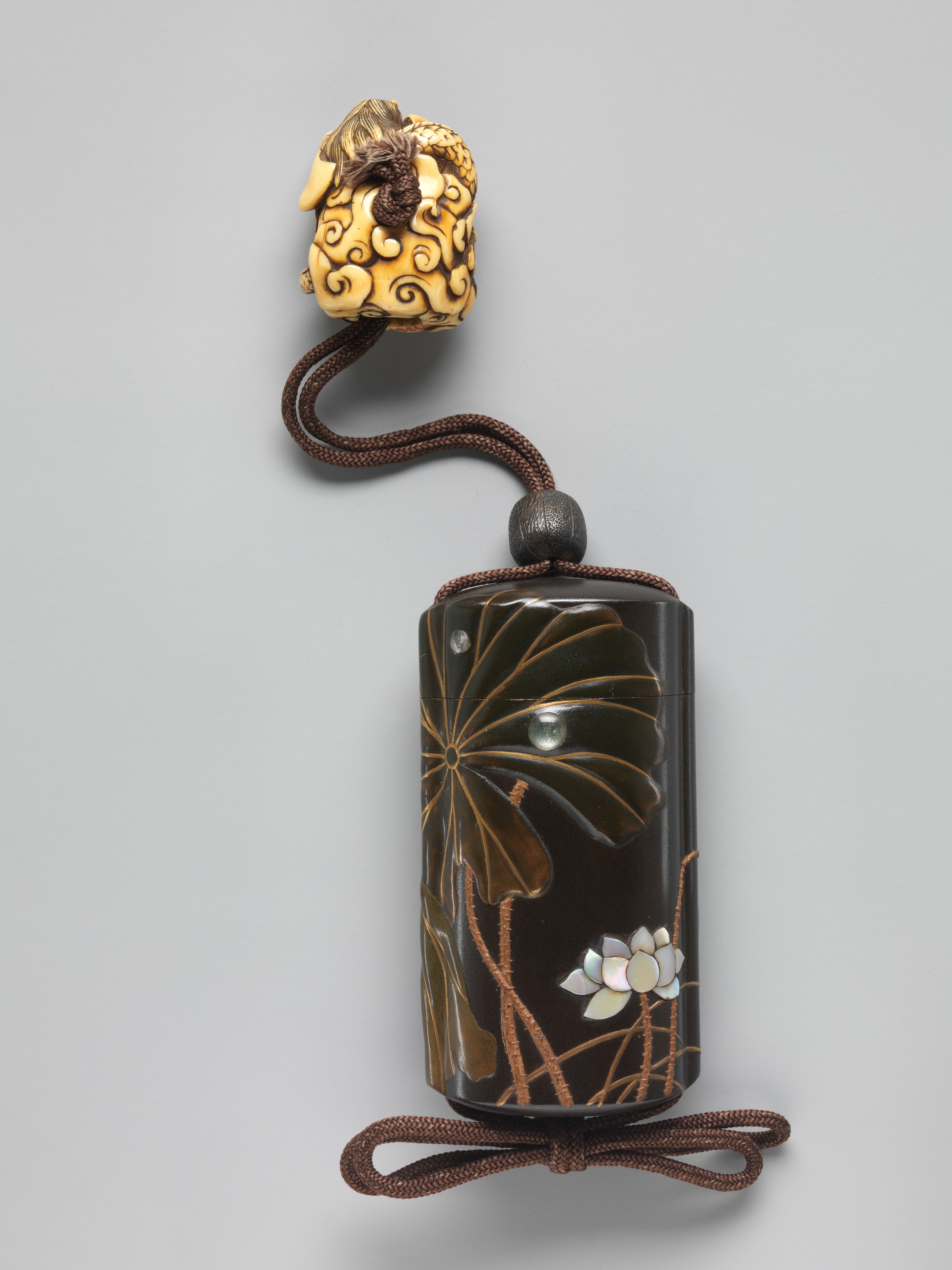
In the rarefied echelons of fashion history, where garment construction transcends mere utility to become a form of sculptural poetry, the Japanese inrō occupies a singular position. It is not a textile, nor a draped silhouette, yet its principles of compartmentalization, tension, and material dialogue resonate profoundly with the language of haute couture. At Katherine Fashion Lab, we approach this 19th-century black lacquer case—adorned with a lotus on the obverse and a lotus-and-bird on the reverse—not as an antiquarian artifact, but as a masterclass in micro-engineering and aesthetic restraint. This standalone study dissects the object through the lens of contemporary couture, revealing a blueprint for structural innovation and symbolic layering that remains startlingly relevant to the modern atelier.
Deconstructing the Silhouette: The Inrō as a Wearable System
The inrō’s fundamental architecture is a lesson in modular design. Comprising multiple stacked compartments, or tiered chambers, it is held together by a single, taut silk cord that runs through the lateral channels. This is not a static form; it is a dynamic system of tension and release. In couture terms, this mirrors the relationship between a precisely cut bodice and its internal boning—the external elegance is contingent upon an invisible, internalized structure of support. The obverse lotus design is not merely painted; it is inlaid with shell and glass, creating a relief that catches light differently with each micro-movement of the wearer. This is the couture equivalent of trompe l’oeil or embellishment architecture, where the surface is engineered to perform, not just to decorate.
The choice of black lacquer (roiro-nuri) is paramount. This deep, mirror-like finish is achieved through dozens of layers of urushi sap, each polished to a flawless sheen. In the fashion atelier, this corresponds to the obsessive pursuit of a perfectly pressed seam or a matte silk faille that absorbs rather than reflects light. The lacquer’s surface is a void—a silent, negative space that amplifies the vibrancy of the inlay. The lotus, rendered in pale shell, appears to float on this abyss. A couturier understands this principle: true luxury is not about maximalism, but about the confident deployment of emptiness to highlight a singular, precious detail.
The Lotus and the Bird: A Study in Contrasting Motifs
Our analysis must bifurcate to address the dual iconography. The obverse presents the lotus, a symbol of purity emerging from murky waters. Its petals are stylized, almost geometric, suggesting a controlled, meditative growth. The inlay technique—likely raden (mother-of-pearl) and cut glass—creates a fragmented, mosaic-like texture. This is not a naturalistic rendering; it is a conceptual one. In couture, this translates to abstracted botanical embroidery, where a floral motif is deconstructed into sequins, bugle beads, and silk threads, losing its literal form to gain a textural and chromatic complexity. The lotus here is a study in controlled asymmetry—each petal is distinct, yet the whole maintains a perfect balance.
The reverse introduces a counter-narrative: a lotus paired with a bird. This is not a static still-life; it is a moment of impending action. The bird, likely a kingfisher or a waterfowl, is poised in a dynamic tension against the lotus’s stillness. This duality—the ephemeral (bird) against the eternal (lotus)—is a classic Japanese aesthetic trope, but its couture application is profound. It speaks to the garment’s ability to hold contradictory states: structure and fluidity, permanence and motion. A couture gown that features a rigid, beaded bodice (the lotus) flowing into a silk chiffon skirt that moves with the wearer (the bird) embodies this same philosophy. The inrō, worn at the obi (sash), was always in motion, its lacquer surface catching the flicker of candlelight or the sun’s glare, making the bird appear to flutter against the stationary lotus.
The Accessory Ecosystem: Netsuke and Ojime as Micro-Couture
No analysis of the inrō is complete without acknowledging its functional companions: the netsuke (toggle) and ojime (bead). The carved ivory netsuke in the shape of a demon is a brilliant counterpoint to the serene lacquer case. This is the rebellious punk element in an otherwise classical composition. The demon, with its contorted features, introduces an element of wabi-sabi—the beauty of imperfection and the grotesque. In couture, this is the unexpected zipper pull, the exposed seam, or the raw edge that disrupts the polished narrative. The juxtaposition of the refined, symmetrical inrō with the chaotic, asymmetrical demon creates a dialectical tension that elevates both objects. It is a reminder that true sophistication often involves a deliberate flaw, a nod to the human hand within the machine-like perfection.
The metal ojime, a tiny bead that tightens the cord, functions as the ultimate closure mechanism. In couture, this is the equivalent of the precision-engineered hook-and-eye or the invisible magnetic clasp. It is a micro-component that dictates the entire drape and fit of the worn object. The ojime’s materiality—metal—contrasts with the organic lacquer and ivory, adding a third textural voice to the conversation. This tripartite material system (lacquer, ivory, metal) is a lesson in sensory curation: the cool touch of metal, the warm patina of ivory, and the glassy smoothness of lacquer offer a tactile experience that a single-material garment could never replicate.
Standalone Study: The Inrō as a Masterclass in Scale and Proportion
In the context of a standalone study, removed from its original function as a pill or seal container, the inrō becomes a pure object of proportional logic. Its dimensions—roughly 8 to 10 centimeters in height—demand a level of precision that is magnified in couture. A single millimeter of error in the lacquer’s edge or the inlay’s seating would be catastrophic. This is the same tolerance required in bespoke tailoring, where a shoulder seam’s placement can alter the entire optical illusion of the garment. The inrō’s compactness forces the designer to edit ruthlessly. Every line, every inlay, every curve must earn its place. This is a stark contrast to the sprawling, maximalist tendencies of fast fashion. The inrō whispers; it does not shout.
Furthermore, the reverse motif’s bird is not merely decorative; it is a spatial marker. Its placement on the back of the object means it was visible to others as the wearer moved, but not to the wearer themselves. This is a profound couture concept: the back-of-the-garment narrative. Think of a couture gown with an intricate, open-back design or a train that reveals a hidden embroidery. The inrō’s reverse is a private message to the observer, a secret layer of storytelling that the wearer can only feel, not see. This dual-sided design philosophy—where the front and back are equally considered but communicate different messages—is a hallmark of advanced couture construction.
Conclusion: A Timeless Blueprint for the Modern Atelier
Katherine Fashion Lab’s analysis concludes that this Japanese inrō is not a historical curiosity but a functional manifesto. Its black lacquer surface teaches us the power of negative space. Its shell and glass inlays demonstrate the transformative potential of material contrast. Its demon netsuke reminds us that perfection is elevated by a deliberate imperfection. And its modular architecture—a series of stacked, independent chambers—offers a prototype for modular fashion, where garments can be reconfigured, layered, and adapted without losing their core integrity.
In an era of digital fast-fashion and disposable trends, the inrō stands as a testament to the slow, deliberate, and intelligent construction. It is a wearable object that compresses an entire philosophy of design—balance, tension, duality, and restraint—into a palm-sized form. For the contemporary couturier, it is not a relic to be replicated, but a lens through which to re-examine our own practice. The question is not how to copy the lotus, but how to achieve its serene precision in a silk organza panel. The challenge is not to carve a demon, but to find the equivalent disruptive element in a cashmere coat. The inrō, in its silent, lacquered glory, offers an eternal answer: true couture is the art of deliberate, meaningful compression—where every element, from the grandest silhouette to the smallest bead, is a necessary part of a unified, poetic whole.