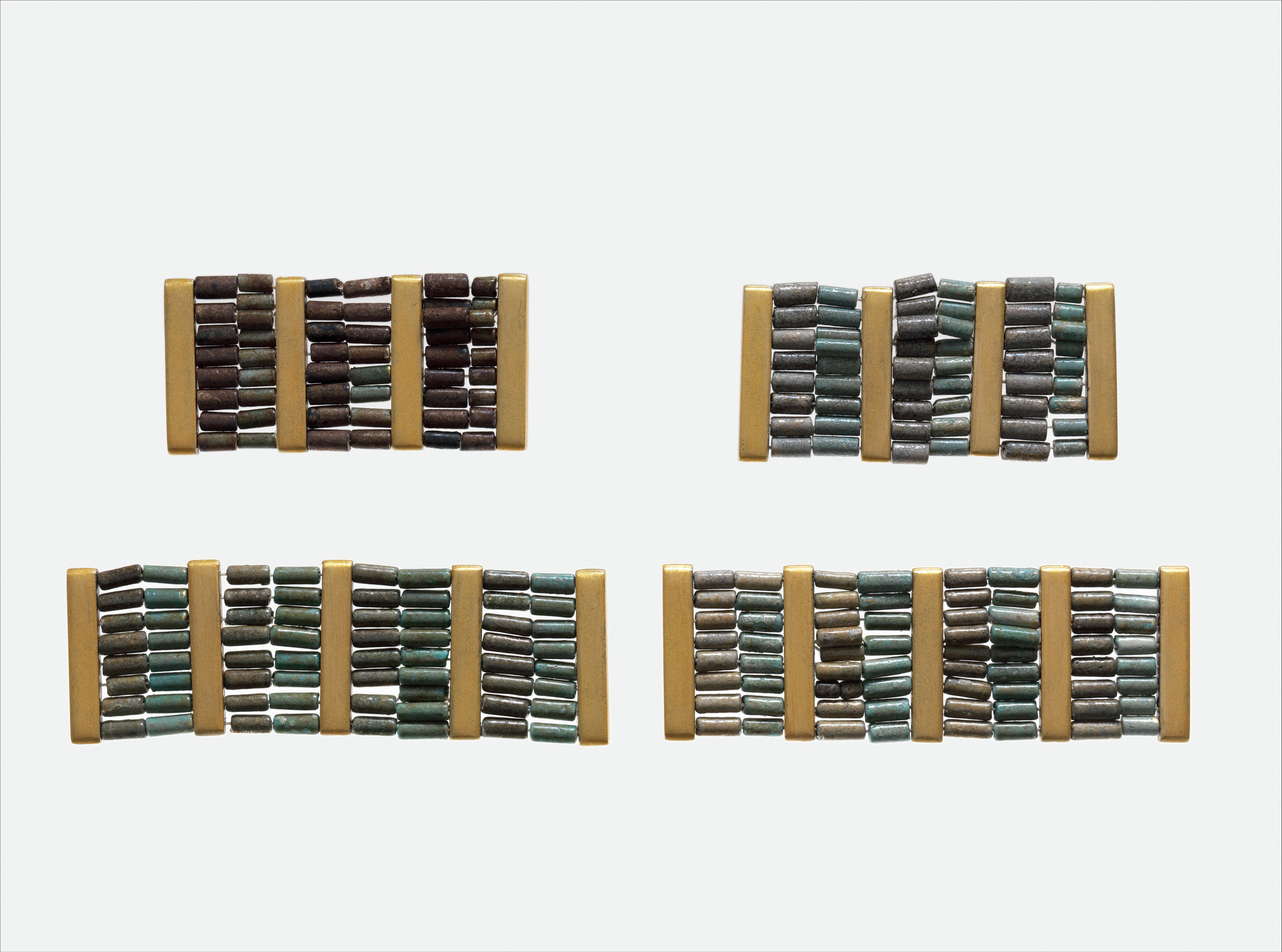
Executive Heritage Assessment: The Bracelets and Anklets of Senebtisi
This strategic standalone research paper examines the bracelets and anklets of Senebtisi, a burial assemblage dating to the Middle Kingdom of Ancient Egypt (circa 1985–1773 BCE). Discovered in a tomb at Lisht, these adornments—crafted from faience and gold—offer a profound case study in the intersection of symbolic power, historical adornment, and spiritual meaning. For Katherine Fashion Lab, the analysis extends beyond archaeological curiosity into a 2026 high-end luxury strategy, where heritage is not merely referenced but re-encoded into contemporary wearable statements. The following sections deconstruct the artifact’s cultural DNA and translate it into a market-ready narrative of exclusivity, protection, and timeless authority.
Symbolic Power: The Body as a Conduit of Divine Authority
In Ancient Egyptian cosmology, the body was not a passive vessel but a charged field of spiritual and social forces. Bracelets and anklets, particularly those of elite women like Senebtisi, functioned as portable amulets of status and protection. The placement on wrists and ankles—joints where the body flexes and where life-force (ka) was believed to pulse—was deliberate. These loci were vulnerable to malevolent forces and, conversely, optimal points for channeling divine energy. The use of faience, a self-glazing quartz ceramic, was not accidental. Its brilliant blue-green hue symbolized regeneration, fertility, and the Nile’s life-giving waters. Gold, in contrast, was the flesh of the gods, imperishable and solar. Together, the materials created a dual-axis power structure: earthly vitality (faience) fused with eternal divinity (gold). For a modern luxury house, this translates into a design principle where material pairing is never decorative but semiotic—each element must carry a distinct, legible meaning.
Historical Adornment: The Grammar of Rank and Ritual
Senebtisi’s jewelry was not casual ornament. It adhered to a strict visual grammar that communicated her social rank, familial lineage, and ritual role. Bracelets were often composed of multiple strands of beads, interspersed with amuletic pendants—such as the wedjat eye or the ankh—while anklets were heavier, grounding the wearer in the earth’s chthonic rhythms. The archaeological record indicates that such pieces were ritually deposited in burial contexts, not merely for aesthetic pleasure but to ensure the deceased’s safe passage into the afterlife. The bracelets and anklets were thus functional instruments in a cosmic transaction, not passive accessories. This historical framing is critical for Katherine Fashion Lab: the brand must position its 2026 collection not as “inspired by Egypt” but as a continuation of a functional lineage—pieces that serve a purpose beyond adornment, whether that purpose is psychological empowerment, social signaling, or spiritual grounding.
Spiritual Meaning: Amuletic Engineering and the Afterlife Imperative
The spiritual dimension of Senebtisi’s jewelry is inseparable from its physical construction. Faience beads were often shaped as specific symbols—lotus petals, papyrus stalks, or scarabs—each carrying a protective spell. Gold was worked into thin sheets, embossed with hieroglyphic invocations or shaped into clasps that mimicked the knot of Isis, a symbol of magical protection. The amuletic engineering of these pieces was precise: the number of beads, their color sequence, and even the direction of their threading could alter their efficacy. For example, a bracelet with 36 beads might correspond to the 36 decans (star groups) used in Egyptian timekeeping, aligning the wearer with cosmic cycles. In a 2026 luxury strategy, this suggests a move toward bespoke, numerological customization—where clients co-create pieces based on personal dates, celestial alignments, or protective symbols, thereby transforming jewelry from a mass-produced commodity into a singular, talismanic object.
Strategic Translation for 2026 High-End Luxury
To operationalize this heritage, Katherine Fashion Lab must adopt a three-tier strategic framework: Material Alchemy, Narrative Architecture, and Ritualized Retail.
Material Alchemy involves sourcing or developing a modern equivalent of faience—perhaps a high-fired ceramic with a lustrous, glazed finish—paired with responsibly mined gold. The contrast between matte ceramic and polished gold should be exaggerated, not subdued, to echo the original’s visual and symbolic tension. This material strategy differentiates the brand in a market saturated with recycled motifs.
Narrative Architecture requires a storytelling platform that educates the consumer on the original function of bracelets and anklets. Each piece in the 2026 “Senebtisi Line” should come with a digital or printed “protection dossier” detailing the specific symbols used, their historical meaning, and the intended psychological or spiritual benefit. This transforms the purchase into an acquisition of knowledge, not just an object.
Ritualized Retail involves designing the buying experience as a ceremony. Private appointments could include a brief, respectful consultation on the client’s “life joints”—the moments of vulnerability or transition they wish to armor. The fitting of the bracelet or anklet becomes a symbolic act, mirroring the ancient ritual of donning protective jewelry. This elevates the brand from a vendor to a custodian of heritage, justifying a premium price point and fostering deep client loyalty.
Conclusion: From Tomb to Runway—A Living Legacy
The bracelets and anklets of Senebtisi are not relics of a dead civilization but a blueprint for enduring luxury. They demonstrate that true luxury is not scarcity of material but density of meaning. For Katherine Fashion Lab, the strategic imperative is clear: do not imitate the form; resurrect the function. By integrating symbolic power, historical grammar, and spiritual purpose into a contemporary design language, the brand can offer a 2026 collection that is at once ancient and avant-garde. The modern wearer, like Senebtisi, seeks armor for the soul and a signal of status. Katherine Fashion Lab, armed with this heritage analysis, is uniquely positioned to provide both—crafting jewelry that is not merely worn but activated, not just seen but felt. This is the final, strategic takeaway: heritage is a competitive advantage, but only when translated into a living, wearable ritual.