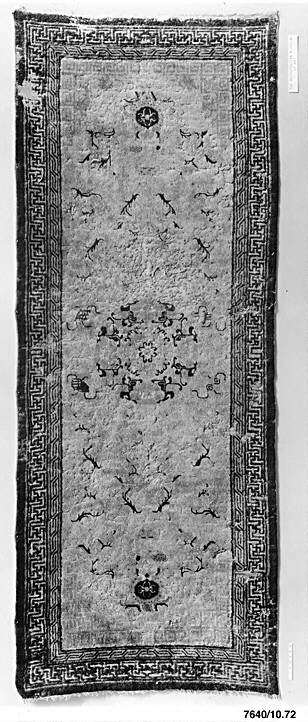
Executive Heritage Analysis: The Chinese Rug as a Symbolic and Strategic Asset
This standalone research paper examines the Chinese rug—specifically those constructed with a cotton warp and weft foundation and wool knotting—as a profound cultural artifact. For Katherine Fashion Lab, the rug is not merely a floor covering but a repository of symbolic power, historical adornment, and spiritual meaning. By decoding these layers, we can formulate a 2026 high-end luxury strategy that positions the rug as a narrative-driven investment piece, aligning with the evolving demands of discerning collectors and culturally literate consumers.
Symbolic Power: The Rug as a Cartography of Status and Cosmic Order
In imperial China, the rug was a deliberate instrument of spatial authority. The symbolic power of these textiles lay in their ability to demarcate hierarchical space. The central medallion, often a stylized lotus or a dragon chasing the flaming pearl, was not decorative but a cosmological map. The dragon, representing the Emperor’s yang energy, was placed at the center to signify the axis mundi—the point where heaven and earth converge. The cotton warp provided structural integrity, while the wool knotting, dense and resilient, allowed for the creation of intricate, raised patterns that could be felt underfoot, reinforcing a tactile hierarchy. For Katherine Fashion Lab, this translates into a strategic narrative: the rug is a tool for spatial sovereignty. In a 2026 luxury context, where clients seek to curate their environments as extensions of their identity, the rug becomes a silent declaration of personal dominion, a grounded anchor in a digitally fragmented world.
Historical Adornment: From Palace Floors to Wearable Heritage
Historically, the Chinese rug served a dual function of insulation and adornment. In the cold northern palaces, these rugs were layered over stone floors, their wool pile providing warmth while their cotton foundation prevented moisture damage. However, their adornment value transcended utility. The patterns—cloud scrolls (xiangyun), the swastika (wan) for ten thousand years of good fortune, and the bat (fu) for blessings—were meticulously knotted to mimic the brushwork of court painters. This is a critical distinction: the rug was not a lesser art form but a three-dimensional painting executed in fiber. The historical adornment of these pieces was a sign of the patron’s cultural fluency; to commission a rug was to understand the nuances of auspicious iconography. Katherine Fashion Lab can leverage this by reframing the rug as wearable architecture. In 2026, high-end strategy should explore translating these rug motifs into textile accessories—scarves, shawls, or even coat linings—where the cotton-warp strength and wool-knot density inspire structural tailoring. This creates a bridge between the floor and the body, allowing clients to literally carry a piece of historical adornment.
Spiritual Meaning: The Knot as a Meditation on Impermanence and Devotion
The spiritual dimension of the Chinese rug is embedded in its very construction. Each wool knot tied onto the cotton warp is a discrete act of devotion, often performed by artisans who viewed their work as a form of prayer. The spiritual meaning is dual-layered. First, the repetitive knotting is a meditative practice, instilling the rug with a palpable sense of patience and intentionality—a stark contrast to machine-made imitations. Second, the iconography itself is protective. The Eight Buddhist Treasures, the Five Sacred Peaks, and the endless knot (panchang) were woven to shield the household from negative energy and invite spiritual prosperity. The cotton foundation, being a plant fiber, grounds the piece in earthly vitality, while the wool, an animal fiber, introduces a layer of sentient warmth. This duality—earth and animal, structure and softness—creates a holistic talisman. For Katherine Fashion Lab’s 2026 luxury strategy, this spiritual resonance is a key differentiator. The modern luxury consumer is increasingly seeking objects with aura. We must position the rug not as a commodity but as a sanctuary object. Marketing collateral should emphasize the artisan’s meditative process, the specific count of knots per square inch as a measure of spiritual investment, and the rug’s role in creating a "quiet zone" in high-stress urban environments. This moves the product from aesthetic purchase to a wellness-aligned investment.
2026 High-End Luxury Strategy: The Rug as a Collectible Asset
To integrate this heritage analysis into a viable 2026 strategy, Katherine Fashion Lab must adopt a three-pillar approach: Provenance as Premium, Cross-Medium Adaptation, and Bespoke Commissioning.
Provenance as Premium: The 2026 luxury market will be defined by radical transparency. We will offer a digital "knot ledger" for each rug, documenting the region of origin, the specific wool lot, and the artisan’s lineage. This transforms the cotton warp and wool knotting from raw materials into a verifiable chain of cultural custody. The rug becomes a blue-chip asset, appreciating in value not just for its material worth but for its documented historical narrative.
Cross-Medium Adaptation: Leveraging the historical adornment aspect, we will launch a capsule collection titled "Ground to Garment." Here, the rug’s geometric patterns and knot density inspire a line of structured outerwear and handbags. The bags will use a wool-blend fabric woven to mimic the rug’s pile, with a cotton twill interior echoing the foundation. This creates a signature tactile language unique to Katherine Fashion Lab, allowing clients to wear the symbolic power of the rug in a portable, modern format.
Bespoke Commissioning: For the ultra-high-net-worth segment, we will offer a "Spiritual Cartography" service. Clients commission a rug where the central medallion is replaced by a personal monogram or a family crest, woven using the same wool knotting techniques. The spiritual meaning is personalized: we will consult with the client to select protective motifs based on their birth year (zodiac) and desired energies (wealth, health, legacy). This service positions Katherine Fashion Lab not as a retailer but as a custodian of personal heritage, creating heirloom pieces that will be passed down through generations.
Conclusion: From Floor to Future
The Chinese rug, with its cotton warp and wool knotting, is a masterclass in material storytelling. Its symbolic power lies in its ability to order space, its historical adornment in its painterly precision, and its spiritual meaning in its meditative construction. For Katherine Fashion Lab, this is not a historical curiosity but a strategic blueprint. By 2026, we will not simply sell rugs; we will offer grounded sovereignty—objects that anchor the spirit, adorn the body, and appreciate as cultural assets. This is the future of high-end luxury: heritage, not as nostalgia, but as a living, investable, and wearable form of power.