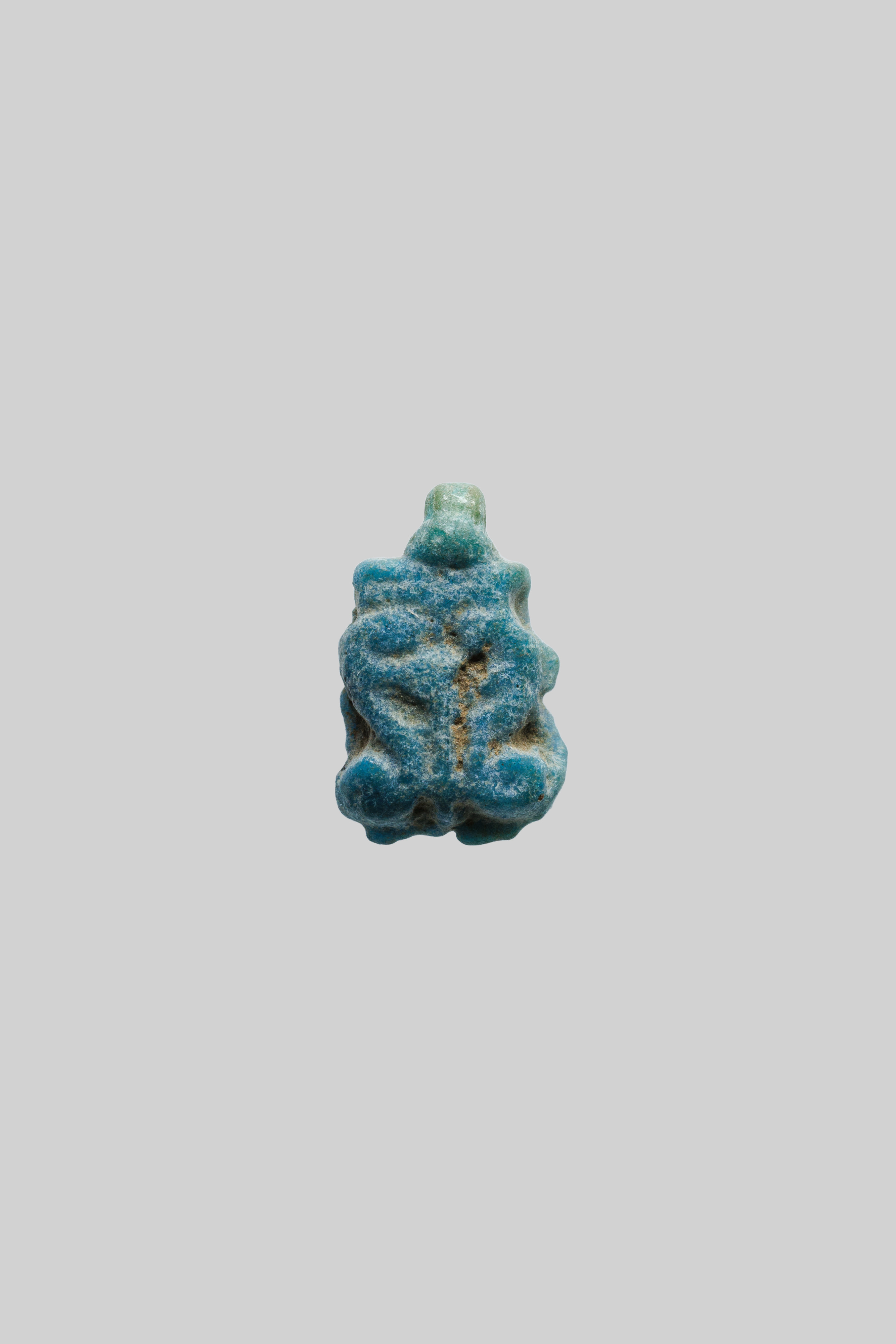
Executive Heritage Analysis: The Hathor Head Amulet
This strategic research paper, commissioned by Katherine Fashion Lab, presents a comprehensive heritage analysis of the Hathor head amulet, an artifact of profound symbolic power from the ancient Nile Valley. Crafted in vivid blue-green faience, this amulet represents a convergence of theological doctrine, royal ideology, and personal adornment. The analysis will dissect its historical and spiritual resonance, evaluate its material significance, and propose a 2026 high-end luxury strategy that leverages its potent iconography for a discerning contemporary clientele.
Historical Provenance and Material Culture
The Hathor head amulet, originating from the Late Period of Ancient Egypt (circa 664–332 BCE), is a masterclass in miniaturized sacred art. Faience, a self-glazing quartz composite, was not merely a ceramic body; it was a material of cosmic consequence. Its signature turquoise or deep blue hue was intentionally chosen to mimic lapis lazuli and turquoise, stones associated with the heavens, rebirth, and the regenerative waters of the Nile. In the context of ancient adornment, such amulets were not decorative trinkets. They were functional talismans, placed on the body or within mummy wrappings to activate specific protective spells from the *Book of the Dead*. The Hathor head, specifically, was invoked to ensure the deceased’s access to nourishment, music, and erotic vitality in the afterlife, while simultaneously warding off malevolent forces. Her iconography—the cow ears, the solar disk, and the intricate wig—serves as a visual lexicon of divine maternity and cosmic order.
Deconstructing Symbolic Power and Spiritual Meaning
To understand the amulet’s enduring value, one must deconstruct its layered symbolic architecture. Hathor was the “Mistress of the West,” the welcoming goddess who received the setting sun and, by extension, the souls of the departed. Her head, therefore, is not merely a portrait but a threshold marker between the mortal realm and the divine. The cow ears are emblematic of her role as the celestial cow who birthed the sun, representing nurturing strength and the primal life force. The solar disk and uraeus (cobra) atop her head assert her dominion over solar cycles and royal authority. For the ancient wearer, this amulet was a portable shrine. It provided the bearer with a direct line to the goddess’s protective energy, ensuring that their *ka* (vital essence) would be sustained. This spiritual meaning transcends mere superstition; it represents a sophisticated psychological framework for managing mortality and asserting one’s place within a divinely ordained cosmos. The amulet’s power lay in its ability to condense an entire theological system into a single, wearable object—a concept that holds immense strategic relevance for modern luxury.
Historical Adornment and the Aesthetics of Power
In the context of historical adornment, the Hathor head amulet exemplifies the principle of “conspicuous sanctity.” It was worn by both the living and the dead, often strung with other amulets on gold wire or linen thread. The choice of faience over precious metal for the masses, and its replication in gold and carnelian for the elite, speaks to a democratization of divine access. However, the material itself was not secondary. The luminous, glassy surface of faience was believed to reflect evil, acting as a mirror to deflect negativity. The aesthetic of the amulet—its precision, its symmetry, and its vibrant color—was a form of non-verbal communication. It signaled the wearer’s piety, their knowledge of esoteric rites, and their social standing. This historical precedent establishes a crucial blueprint for high-end strategy: that aesthetic beauty is a vehicle for deeper, intangible value. The amulet was not just an accessory; it was a statement of metaphysical wealth.
Strategic Framework for 2026: The "Hathor Protocol"
For Katherine Fashion Lab, the Hathor head amulet presents a unique opportunity to pivot from trend-driven design to meaning-driven curation. The 2026 luxury consumer is increasingly disillusioned with overt branding and seeks objects with narrative density and spiritual resonance. The “Hathor Protocol” is a proposed strategy built on three pillars: Archeological Authenticity, Sacred Materiality, and Ritualistic Engagement.
Pillar One: Archeological Authenticity and Limited Provenance
Our strategy will not replicate the amulet; it will re-contextualize it. We propose a limited-edition capsule collection titled “Mistress of the West,” featuring high-jewelry interpretations of the Hathor head in responsibly sourced gold, set with Paraíba tourmalines to mimic faience’s electric blue. Crucially, each piece will be accompanied by a digital provenance certificate, tracing its design lineage to specific museum collections and referencing the exact Book of the Dead spell associated with the motif. This is not about mass production; it is about scarcity as a form of respect. By limiting the run to 100 pieces globally, we position the collection not as fashion, but as modern relics. The client is not buying a necklace; they are acquiring a fragment of metaphysical history.
Pillar Two: Sacred Materiality and Tactile Luxury
The faience medium offers a lesson in surface treatment. The ancient artisans achieved a lustrous, glazed finish that felt both cool and alive. For 2026, we will innovate with a proprietary enamel technique, developed in-house, that replicates the micro-crackled surface of ancient faience. This “Living Stone” finish will be applied to solid 18k gold bases, creating a tactile experience that invites touch and contemplation. This focus on material alchemy aligns with the luxury sector’s shift towards craft and haptic value. The jewelry must feel like an artifact—heavy, cool, and imbued with a sense of permanence that is antithetical to fast fashion. We will also introduce a unisex line in matte black ceramic with gold inlay, referencing the amulet’s role as a protective amulet for all genders.
Pillar Three: Ritualistic Engagement and the Modern Amulet
The final pillar addresses the consumer’s desire for ritual. Historically, amulets were activated by spoken spells. We will revive this through a bespoke “Activation Ceremony” for clients. Upon purchase, the client is invited to a private consultation where a brand historian narrates the amulet’s specific protective properties—be it for creativity (Hathor’s patronage of music) or resilience (her role as the eye of Ra). The piece will be handed over in a custom-made, book-like case containing a facsimile of the original papyrus text. This transforms the purchase from a transactional event into a transformative experience. In a 2026 market where wellness and spirituality are converging with luxury, this ritualistic engagement offers a powerful differentiator against competitors who merely sell aesthetics.
Conclusion and Strategic Outlook
The Hathor head amulet is more than a historical artifact; it is a strategic blueprint for the future of luxury. Its power lies in its synthesis of material excellence, profound symbolism, and functional purpose. By adopting the “Hathor Protocol,” Katherine Fashion Lab can transcend the ephemeral nature of seasonal trends, offering a collection that speaks to the eternal human desire for protection, identity, and transcendence. This strategy positions the brand not merely as a fashion house, but as a custodian of cultural memory, translating ancient power into contemporary prestige. The amulet’s journey from the tombs of Thebes to the ateliers of Katherine Fashion Lab is not a story of appropriation, but of elevation—a testament to the enduring authority of symbolic adornment.