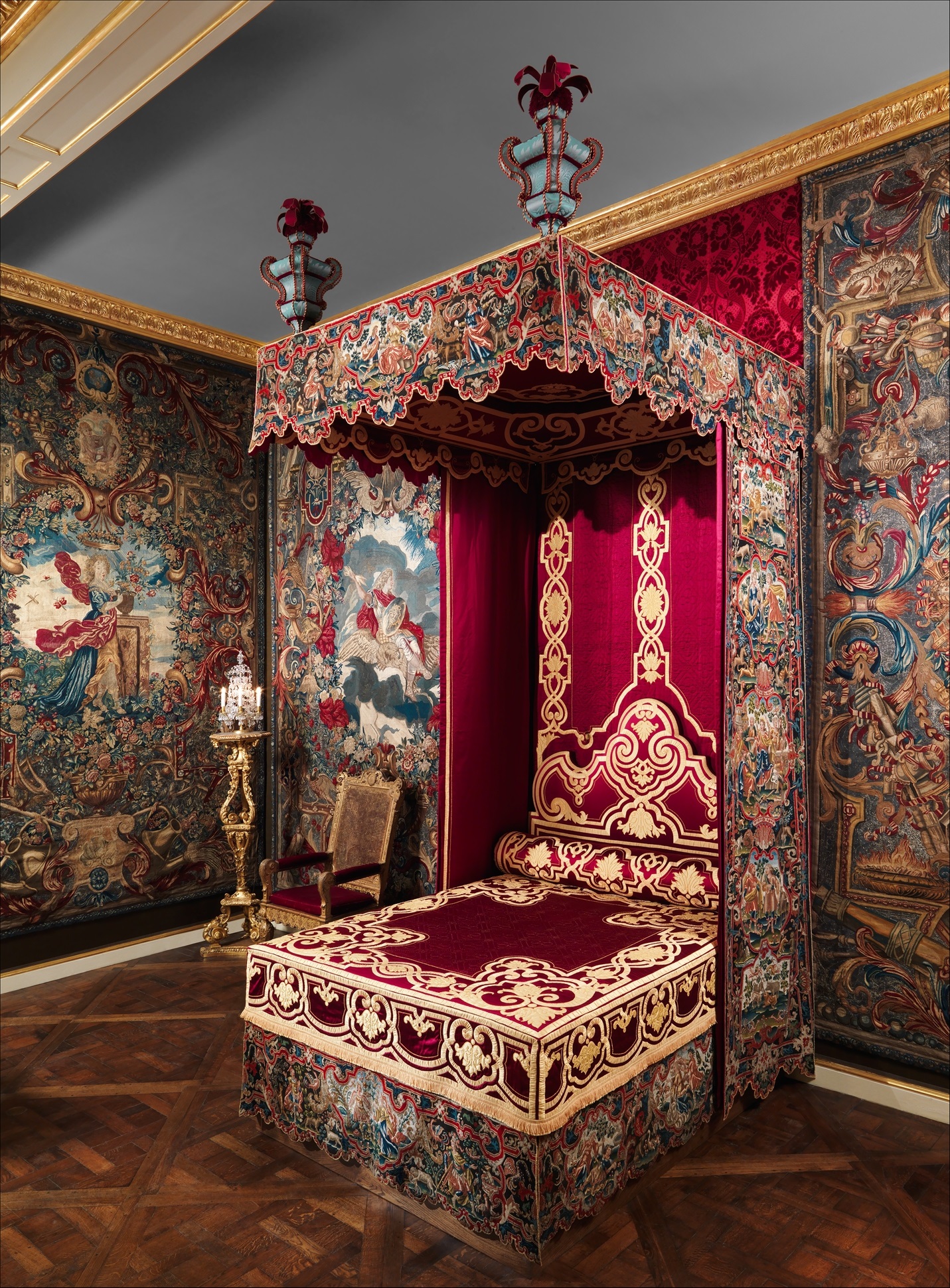
The Architectural Elegance of the Enclosed Bed: A Couture Analysis of Katherine Fashion Lab’s Valance and Curtain Ensemble
In the rarefied sphere of high interior design, few objects command the same synthesis of historical gravitas and textile artistry as the enclosed bed. Katherine Fashion Lab’s latest offering—a standalone study in bed valances and side curtains—transcends mere furnishing to become a sculptural statement of global heritage. Drawing from a lineage that spans European aristocratic chambers, Ottoman tent pavilions, and Mughal imperial courts, this ensemble reinterprets the concept of the lit clos (enclosed bed) for the contemporary connoisseur. The piece is not a nostalgic reproduction but a deliberate, intellectual exercise in material storytelling, where canvas, silk, and wool converge in a dialogue of texture, tension, and tradition.
Material Alchemy: The Structural Poetics of Canvas and Silk
The foundation of this ensemble lies in its unexpected primary substrate: heavyweight, unbleached canvas. In conventional couture drapery, one might expect a damask or a velvet to dominate. However, Katherine Fashion Lab’s choice of canvas is a masterstroke of conceptual rigor. The canvas serves as a neutral, architectural ground—akin to the toile in a couturier’s atelier—upon which the narrative of global heritage is embroidered. This is not the coarse, utilitarian canvas of sailcloth; rather, it is a tightly woven, garment-grade canvas whose subtle, natural undulation provides a tactile counterpoint to the opulence layered above it. The canvas’s inherent stiffness allows the valance to maintain a crisp, architectural silhouette, standing away from the bed frame with the precision of a cornice, rather than collapsing into soft, romantic folds.
Against this austere backdrop, the embroidery in silk and wool performs a dramatic ballet. The use of gros point (a large, diagonal stitch) and petit point (a fine, tent stitch) is not merely decorative; it is a study in scale and depth. The gros point, executed in lustrous silk, creates bold, raised motifs that catch ambient light with a sheen reminiscent of polished metal. Conversely, the petit point, worked in matte wool, provides a dense, velvety ground that absorbs light, creating a chiaroscuro effect that gives the surface a three-dimensional, almost topographical quality. The juxtaposition of these two techniques within a single valance suggests a cartographic layering—each stitch a coordinate in a map of cross-cultural aesthetics.
Global Heritage: A Cartography of Motifs
The iconographic program of the valance and curtains is where the “Global Heritage” origin becomes most explicit. Rather than a pastiche of random symbols, the design is a curated lexicon of intercontinental motifs, each rendered with the precision of a museum-grade textile. The central valance features a repeating palmette-and-vine border, a motif that traces its lineage from ancient Persia through Byzantine silk-weaving centers. This is interlaced with a subtle, geometric girih pattern—reminiscent of Islamic architectural tilework—executed in the petit point wool. The effect is a rhythmic, mathematical harmony that speaks to the Islamic world’s influence on European decorative arts.
Yet, the ensemble does not stop at the Mediterranean. Fringing the lower edge of the valance, one discovers a sequence of embroidered chintz-inspired florals, drawn from the Coromandel Coast of India, which were famously traded to Europe in the 17th century. These flowers, rendered in silk gros point, are not delicate or airy; instead, they are bold, almost heraldic, their stems and petals stylized into a pattern that feels both botanical and architectural. This deliberate inclusion of South Asian aesthetics alongside Near Eastern geometry and European canvas construction creates a narrative of trade, conquest, and cultural exchange. The bed, once a private retreat, becomes a miniature globe, a testament to the Silk Road and the maritime spice routes that connected disparate civilizations.
The Standalone Study: Context as Composition
The specification of a standalone study is crucial to the ensemble’s success. In a typical bedroom, the bed is the focal point, but it competes with armoires, windows, and seating. In a study—a room dedicated to intellect, reflection, and solitary work—the bed assumes a different role. It is not a site of passive rest but of active contemplation, a place to read, sketch, or meditate. Katherine Fashion Lab has designed the valance and side curtains to honor this function. The side curtains, which hang with a slight, controlled flare, are engineered to be partially drawn, creating a sense of enclosure without full occlusion. This allows the occupant to glimpse the surrounding bookshelves or a fireplace, maintaining a connection to the intellectual environment while being physically cocooned.
Furthermore, the canvas substrate is a deliberate nod to the study’s utilitarian ethos. Unlike the fragile silks of a Rococo boudoir, this canvas is durable, resistant to the wear of daily use, and its natural, unbleached tone does not dominate the room’s palette. Instead, it acts as a neutral anchor, allowing the embroidered panels to serve as the room’s objet d’art. The valance, in particular, is designed to be viewed at eye level when standing, its intricate stitching inviting close inspection—a tactile pleasure for a scholar or collector accustomed to examining fine bindings or manuscripts.
Couture Construction: From Atelier to Bedpost
From a technical standpoint, the construction of this ensemble rivals that of a haute couture gown. The valance is not simply a gathered rectangle; it is tailored with darts and gussets to fit the specific dimensions of a four-poster bed, with mitered corners that allow the fabric to turn cleanly around the posts. The embroidery is executed on a separate silk ground and then applied to the canvas using a technique akin to appliqué, ensuring that the tension of the canvas does not pucker or distort the fine stitches. The side curtains are weighted at the hem with a discreet chain enclosed in a canvas casing, allowing them to hang with a perfect, uninterrupted vertical line—a detail that speaks to the atelier’s obsession with gravity and drape.
The color palette is deliberately restrained: the canvas is ecru, the silk embroidery in shades of antique gold, deep madder red, and verdigris green, while the wool petit point uses a range of indigo and charcoal. This is not a palette of vibrant display but of aged patina, evoking the faded splendor of a 17th-century Flemish tapestry or a well-worn Persian rug. The restraint is a sign of confidence; the piece does not need to shout to be heard. It whispers, and in the quiet of a study, that whisper is deafening.
A Synthesis of Past and Present
In conclusion, Katherine Fashion Lab’s bed valance and side curtain ensemble is a triumph of couture textile design operating at the intersection of history, art, and function. It challenges the modern tendency toward minimalist, disposable decor by insisting on the value of slow, hand-worked luxury. The canvas provides a democratic, sturdy base, while the silk and wool embroidery elevates it to a level of aristocratic refinement. The global heritage motifs are not mere decoration but a scholarly homage to the interconnectedness of human craft. In the standalone study, this bed becomes more than furniture; it is a monument to the enduring power of textile artistry—a piece that demands to be studied as much as it invites rest. For the discerning collector, it is not merely an acquisition but a conversation, one that spans continents and centuries, stitched together with an unerring hand.