The Handle as Sovereign Instrument: A Heritage Analysis for Katherine Fashion Lab
Provenance and Materiality: The Bronze Handle in Ancient Civilization
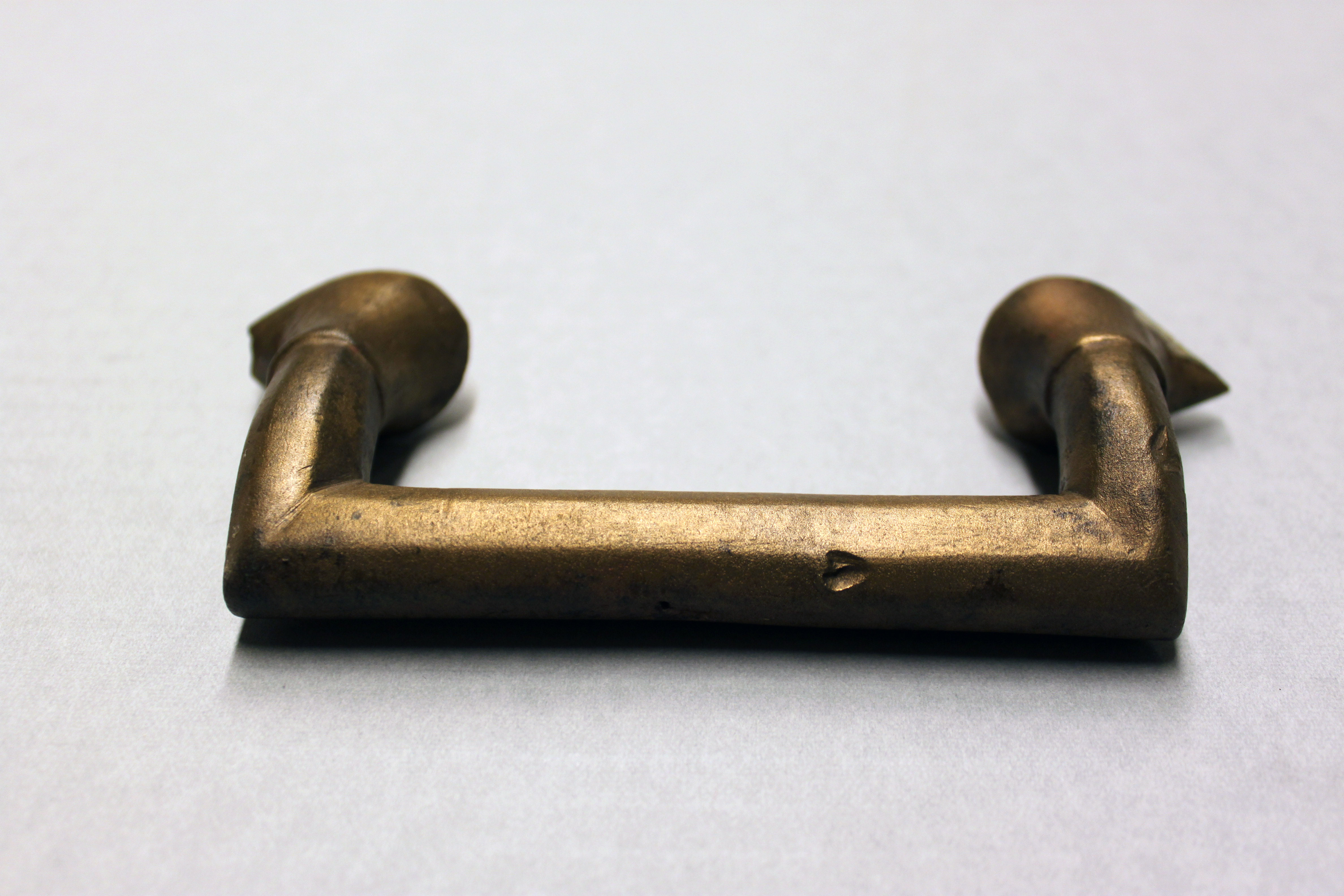
The object under examination—a cast bronze handle from an ancient civilization—transcends its utilitarian classification as a mere gripping device. In the archaeological record, handles affixed to ceremonial vessels, doors of sanctums, or portable ritual implements were never passive components. They were the threshold of contact between the mortal hand and the divine or sovereign will. The choice of bronze, an alloy of copper and tin, is itself a statement of technological mastery and cosmological significance. In ancient Mesopotamia, Egypt, and the Shang dynasty of China, bronze was not merely a metal; it was a material imbued with life-force and permanence, often reserved for objects of statecraft, ancestor veneration, and military command. A cast handle, therefore, was the physical extrusion of authority—the point where power becomes graspable.
For Katherine Fashion Lab, the strategic extraction of this artifact’s DNA is not about replication but about translating metallurgical gravity into wearable form. The handle’s ergonomic curve, its patinated surface, and its structural integrity offer a lexicon of strength that modern luxury consumers subconsciously crave: the sensation of holding something that cannot be broken, that has survived centuries, and that once mediated between the earthly and the eternal.
Symbolic Power: The Handle as a Scepter of Command
In ancient iconography, the handle is frequently depicted as an extension of the ruler’s arm. Consider the Egyptian was scepter, often rendered with a forked or curved top, or the Mesopotamian mace handle held by priest-kings. These objects were not carried passively; they were gripped with intent. The handle’s form—whether cylindrical, fluted, or adorned with zoomorphic terminals—communicated the bearer’s role. A lion-headed handle signified martial ferocity; a lotus-shaped handle denoted ritual purity. The act of grasping was a performative assertion of control over chaos, a micro-ritual of dominion.
In the 2026 luxury context, this symbolic power translates into what we may term “grip authority.” Katherine Fashion Lab’s design philosophy should position the handle motif not as a decorative afterthought but as the central protagonist of a collection. A handbag’s top handle, a coat’s clasp, or a boot’s pull-tab can be reimagined as a modern scepter. The consumer, by gripping a piece that echoes this ancient lineage, participates in a silent act of self-sovereignty. The strategic messaging must emphasize that the handle is not where you hold the object—it is where the object holds you to a legacy of command.
Historical Adornment: The Handle as a Site of Ornamentation
Ancient artisans understood that the handle was the most frequently touched and viewed element of a ceremonial object. Consequently, it became a canvas for micro-ornamentation. Granulation, filigree, inlaid lapis lazuli, or chased geometric patterns were concentrated precisely where the hand would rest. This was not mere decoration; it was a haptic language. The ridges and textures served a dual purpose: functional grip and sensory storytelling. A warrior’s dagger handle was ribbed to prevent slippage in blood, but those ribs were also carved to mimic the sinews of a lion’s leg—imbuing the wielder with that animal’s strength.
For Katherine Fashion Lab’s 2026 high-end strategy, this principle demands a return to tactile opulence. The brand should commission handles—whether on leather goods, jewelry, or architectural hardware for flagship stores—that are not smooth and sterile but deliberately textured. Cast bronze, with its inherent porosity and ability to hold fine detail, offers a unique opportunity for “adornment that whispers.” The lab should develop a signature “Heritage Grip” pattern: a repeating motif derived from ancient cuneiform or geometric lattice, cast in miniature. This pattern becomes a brand code, visible only upon close inspection—a luxury signal for the discerning connoisseur, not the casual observer.
Spiritual Meaning: The Handle as a Conduit of Blessing
Beyond physical utility, the ancient handle often served a sacramental function. In temple rituals, the handle of a censer or libation vessel was the only part the priest was permitted to touch, as the vessel itself was considered too holy for direct contact. The handle thus became a mediator—a sanctified buffer between the profane and the sacred. In funerary contexts, handles on canopic jars or offering tables were oriented toward the cardinal points, guiding the deceased’s spirit. The act of opening a sealed handle was synonymous with unlocking a blessing or a curse.
The 2026 luxury strategy for Katherine Fashion Lab should harness this spiritual resonance through ritualized product experiences. Consider a limited-edition “Conduit Collection” where each handbag or jewelry piece features a cast bronze handle that must be “unsealed” by the owner—perhaps via a wax cord or a magnetic lock that requires a specific twisting motion. This transforms the unboxing into a ceremony. The marketing narrative should frame the handle as a point of blessing: “When you hold this, you hold the key to ancestral protection.” In a secular age, luxury consumers increasingly seek meaning beyond materiality. By imbuing the handle with a quasi-spiritual provenance, Katherine Fashion Lab positions itself not as a seller of goods, but as a curator of talismans.
2026 High-End Luxury Strategy: From Artifact to Archetype
Strategic integration of this heritage analysis requires a multi-tiered approach. First, product architecture: The handle should appear as a recurring silhouette across categories—from a rigid top-handle bag (evoking a ceremonial vessel) to a sculptural bracelet that mimics a cast handle’s curve. The material must be authentic: investment-cast bronze with a matte, aged patina, perhaps with a 24-karat gold vermeil interior for a hidden luxury reveal. This juxtaposition of ancient exterior and precious interior speaks to the modern collector’s desire for depth.
Second, brand storytelling and pricing: Each piece should be accompanied by a “Handle Provenance Card” detailing the specific ancient civilization that inspired its form—be it the Ur dynasty, the New Kingdom, or the Zhou dynasty. This elevates the product from fashion to collectible art, justifying a price point at the upper echelon of the market. The lab should host private “Grip Rituals” in flagship stores, where clients are guided through the historical significance of the handle before making a purchase, thereby embedding the spiritual meaning into the sales process.
Third, collaborative and editorial strategy: Katherine Fashion Lab should commission a short film titled The Grip, featuring a modern woman in a power suit, grasping a bronze-handled bag, intercut with archival footage of ancient hands gripping ceremonial objects. The tagline: “Authority is not worn. It is held.” This campaign positions the handle as the ultimate symbol of quiet, unyielding power—a counterpoint to the loud logos of contemporary luxury.
Conclusion: The Handle as a Strategic Imperative
In conclusion, the cast bronze handle from an ancient civilization is not a relic; it is a strategic blueprint. Its symbolic power lies in its mediation of control, its historical adornment offers a tactile language of exclusivity, and its spiritual meaning provides a pathway to consumer devotion. For Katherine Fashion Lab’s 2026 high-end strategy, the handle must be elevated from a functional component to the brand’s philosophical keystone. By casting this ancient form into modern luxury objects, the lab does not merely reference history—it reactivates a dormant archetype of human sovereignty. The result is a collection that feels both timeless and urgently relevant, offering clients not just a product, but a graspable inheritance of power.