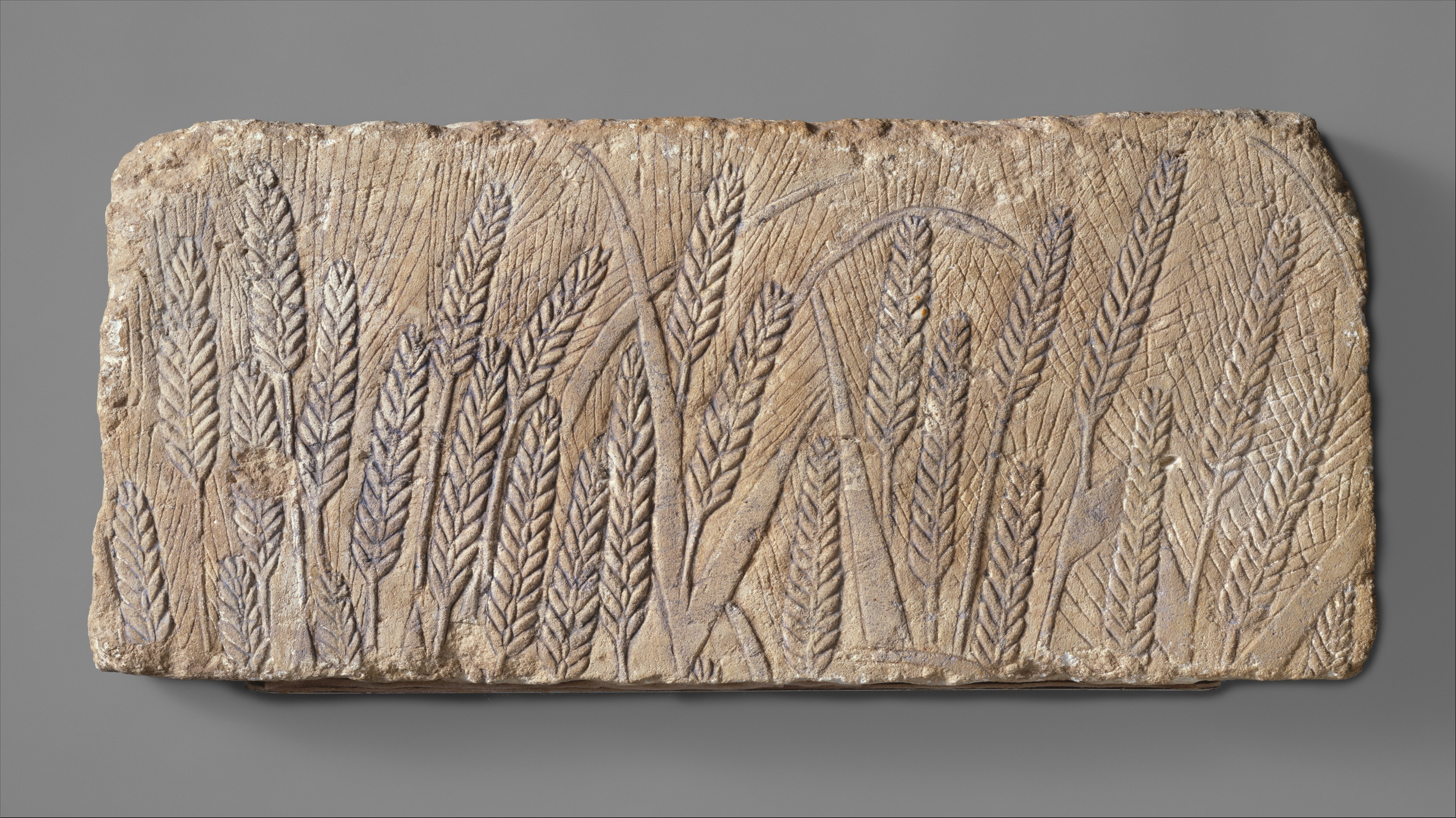
Heritage Analysis: Ripe Barley in Limestone and Paint
Contextual Provenance and Material Significance
The motif of ripe barley, rendered in limestone with traces of mineral paint, emerges from the agrarian heartlands of the ancient Near East, specifically the Fertile Crescent civilizations of Mesopotamia and the Levant (circa 3500–2000 BCE). As a strategic standalone research subject, this artifact transcends mere botanical representation. The choice of limestone—a sedimentary rock associated with permanence and monumental architecture—anchors the barley in a discourse of durability. The application of paint, likely derived from ochre and malachite, introduces a chromatic language of vitality, suggesting that the object was not merely decorative but ritualistically charged. For Katherine Fashion Lab, this pairing of humble grain with enduring stone offers a foundational metaphor: luxury as the elevation of the essential into the eternal.
Symbolic Power and Agrarian Sovereignty
In ancient civilizations, ripe barley was not a passive agricultural commodity; it was a symbol of sovereign abundance and cyclical renewal. The Sumerian myth of Inanna and Dumuzid explicitly links barley to the dying-and-rising god, where the grain’s ripening phase represented the peak of divine favor. Archaeological evidence from temple granaries at Uruk and Ur indicates that barley was used as a standard of value, a precursor to currency, and a measure of tribute. Thus, the ripe ear of barley in limestone becomes a political emblem—a declaration of territorial fertility and centralized power. For a 2026 luxury strategy, this symbolic power translates into a narrative of controlled scarcity and curated abundance. Katherine Fashion Lab can position ripe barley as a visual shorthand for “harvested excellence,” wherein each garment or accessory is presented as the culmination of a meticulous, almost sacred, production cycle.
Historical Adornment and the Body as Field
Historically, barley motifs were integrated into personal adornment through cylinder seals, amulets, and headdresses worn by priestly elites. The grain’s vertical, linear form lent itself to frieze-like repetition, creating a rhythm of growth across textile borders and metal diadems. Notably, the “Barley Goddess” Nisaba was invoked in rituals where priests wore belts of woven grain, blurring the line between human body and cultivated field. This practice of adornment was not ornamental but performative—it enacted a metaphysical harvest upon the wearer. In translating this to contemporary high-end fashion, Katherine Fashion Lab should consider the body as a living field. The 2026 collection could feature elongated, stalk-like silhouettes, with embroidered or beaded barley ears cascading asymmetrically, mimicking the natural sway of ripe crops. The use of metallic threads (gold, bronze) on raw silk or organza would echo the limestone’s painted surface, offering a textural dialogue between antiquity and modernity.
Spiritual Meaning and the Cycle of Sacrifice
The spiritual dimension of ripe barley is inextricably tied to the concept of sacrifice and rebirth. In Egyptian funerary contexts, barley was placed in Osiris beds—linen-wrapped figures planted with grain to symbolize resurrection. The ripened ear, therefore, was not an end but a threshold; its golden hue represented the soul’s transition into the afterlife. This eschatological layer adds profound depth to the motif. For Katherine Fashion Lab, the 2026 strategy should not shy away from this sacred gravity. Instead, the brand can invoke a “ritual of wearing” where the customer participates in a symbolic cycle: acquisition as planting, wearing as growth, and passing down as harvest. Limited-edition pieces, each numbered and accompanied by a provenance card detailing the ancient harvest mythology, would transform a luxury purchase into a spiritual inheritance. The color palette—sun-bleached gold, limestone white, and oxidized verdigris—should evoke the patina of ancient temples, suggesting that true luxury is timeless rather than transient.
2026 High-End Luxury Strategy: From Artifact to Aesthetic
To operationalize this heritage analysis, Katherine Fashion Lab must adopt a three-pillar strategic approach for 2026: Narrative Authenticity, Material Alchemy, and Experiential Transcendence.
Narrative Authenticity demands that the ripe barley motif is not used as a generic print but as a storytelling device. Each campaign should reference its archaeological origin—perhaps a short documentary on the excavation of a barley-adorned sarcophagus or a collaboration with a museum for a capsule collection. This provenance-based marketing appeals to the ultra-high-net-worth consumer who seeks meaning beyond logos. The brand should craft a “Barley Manifesto” that positions the wearer as a custodian of agrarian wisdom, not merely a fashion consumer.
Material Alchemy involves the literal translation of limestone and paint into fabric and finish. Consider developing a proprietary jacquard that mimics the granular texture of limestone, woven with recycled gold thread to replicate the mineral paint’s shimmer. Alternatively, a capsule line of “stone-washed” leather goods, where the surface is hand-rubbed with natural pigments to achieve a mottled, ancient patina, would directly reference the artifact’s painted surface. This tactile fidelity creates a sensory bridge between the museum case and the runway, elevating the product from apparel to collectible art.
Experiential Transcendence focuses on the retail environment. The 2026 flagship store could be designed as a “Temple of Harvest,” with limestone-clad walls, ambient sounds of wind through grain, and a scent profile of toasted barley and myrrh. Private client appointments would include a guided meditation on the cycle of growth and sacrifice, culminating in the unveiling of the barley collection. This transforms the purchase into a pilgrimage, aligning with the spiritual meaning of the original artifact. Furthermore, a digital twin of the artifact could be offered as an NFT, granting holders access to exclusive harvest-themed events, thereby merging ancient ritual with Web3 luxury.
Strategic Implications and Competitive Positioning
In the competitive landscape of 2026 luxury, where sustainability and cultural depth are paramount, ripe barley offers a distinct advantage. Unlike overtly floral or faunal motifs, barley is understated yet historically dense, allowing Katherine Fashion Lab to occupy a niche of “agrarian minimalism.” Competitors may use generic botanical prints; this research enables the brand to claim a specific, authenticated lineage. The limestone medium further differentiates the offering, as it implies permanence and weight—qualities that counter the ephemerality of fast fashion. By integrating the spiritual meaning of sacrifice, the brand can also appeal to the growing demographic seeking conscious consumption, framing each purchase as a responsible act of cultural preservation.
Conclusion: Harvesting the Future
Ripe barley, immortalized in limestone and paint, is far more than an ancient decorative motif. It is a repository of symbolic power, a testament to historical adornment, and a vessel of profound spiritual meaning. For Katherine Fashion Lab, this heritage analysis provides a robust foundation for a 2026 high-end luxury strategy that is both culturally reverent and commercially innovative. By translating the artifact’s materiality, narrative, and ritualistic essence into a cohesive brand experience, the lab can harvest not only commercial success but also a lasting legacy of meaningful luxury. The barley is ripe; the time to reap is now.