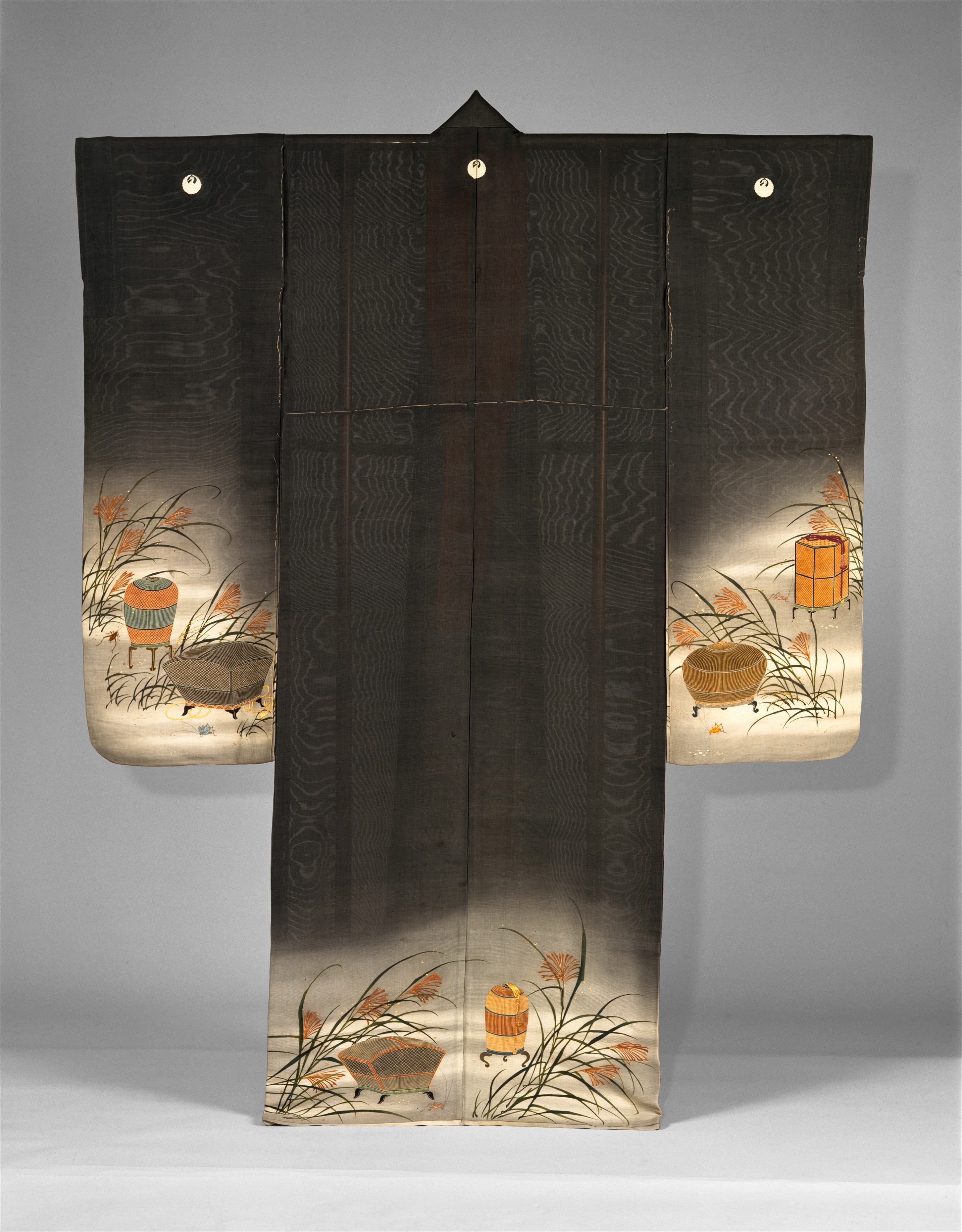
The Ephemeral Chorus: Deconstructing the Unlined Summer Kimono (Hito-e)
In the rarefied sphere of haute couture, where garments transcend utility to become wearable philosophy, the Unlined Summer Kimono (Hito-e) from Katherine Fashion Lab’s Japanese archive stands as a masterclass in controlled ephemerality. This is not merely a garment; it is a frozen sonnet to a Japanese summer evening—a deliberate study in transience, rendered through the most demanding of textile arts. The kimono’s subject matter—crickets, grasshoppers, cricket cages, and pampas grass—immediately signals a sophisticated engagement with aki no yo (autumn nights), yet its physical form is quintessentially summer. This dichotomy is the crux of its couture-level genius.
Materiality and the Art of Weightlessness
The foundational choice of silk gauze (ro or sha) is the first act of defiance against conventional garment construction. In Western couture, structure is often achieved through interlinings, boning, and heavy fabrics. Here, the hito-e—literally “one-layer” garment—rejects all such scaffolding. The fabric is a diaphanous, open-weave silk that possesses an almost architectural tensile strength despite its apparent fragility. When worn, it does not drape; it floats. The air moves through the weave, creating a microclimate of coolness against the skin. This is not a passive choice but a functional, aesthetic, and philosophical one. The unlined construction is a statement of purity, a rejection of excess that aligns with the Zen-influenced aesthetics of wabi-sabi, finding beauty in imperfection and simplicity. The gauze’s transparency is the canvas upon which the artist’s skill becomes a study in optical illusion.
The Yūzen Alchemy: Paste-Resist as Narrative
The garment’s narrative is executed through paste-resist dyeing (yūzen), a technique that elevates the kimono from textile to painting. This is not a printed fabric; it is a hand-drawn artwork, where each brushstroke of rice-paste resist dictates the flow of indigo and muted pigments. The process demands an almost inhuman level of precision. The artisan first sketches the design in a fugitive dye, then applies the resist paste through a kakemaru (a tube with a fine tip), tracing every cricket leg, every blade of pampas grass. The cloth is then dyed, and the paste is washed away, revealing white or pale ground where the resist was applied.
In this specific hito-e, the crickets and grasshoppers are not rendered as static illustrations. They are depicted mid-motion—antennae quivering, legs tensed for a leap. The yūzen technique allows for subtle tonal gradations (bokashi) that give the insects a three-dimensional, almost sculptural quality against the flat, translucent ground. The cricket cages, typically woven from fine bamboo or wood, are rendered with a geometric precision that contrasts sharply with the organic, free-flowing forms of the pampas grass (susuki). This juxtaposition is deliberate: the cage represents human intervention, the desire to capture and possess the fleeting song of summer; the pampas grass, with its feathery plumes, represents the untamed, wild edge of the season. It is a visual dialogue between control and chaos, between the domestic and the wild.
Painted Details and the Embroidered Accent
What truly distinguishes this piece for the connoisseur is the combination of painted details and embroidery. While yūzen provides the broad chromatic field, the artist has augmented the design with hand-painted accents—perhaps a touch of gofun (shell-white pigment) to highlight a cricket’s eye or a delicate wash of beni (safflower pink) on the pampas plume. These painted touches are almost invisible at a distance, revealing themselves only upon intimate inspection—a hallmark of true luxury.
Then, the embroidery. In a garment of such sheer materiality, the introduction of silk and metallic thread is a bold, almost subversive act. The embroidery is not used to fill space but to create tension. A single, meticulously knotted silk thread may trace the wing of a grasshopper, catching the light and creating a shimmering, iridescent effect that the flat dye cannot achieve. The metallic threads, likely gold or silver, are used sparingly—perhaps to outline the delicate lattice of a cricket cage or to suggest the glint of morning dew on a blade of grass. This is the couture equivalent of a whispered secret. The embroidery adds a tactile, dimensional layer that contradicts the fabric’s transparency, creating a surface of extraordinary complexity. It forces the viewer to question what is real and what is illusion—is the cricket’s chirp we imagine coming from the painted insect or the embroidered one?
Compositional Rhythm and Negative Space
The placement of the motifs is a lesson in ma (negative space). The kimono is not a chaotic collage. The design is asymmetrical, flowing diagonally from the right shoulder across the back and down to the left hem. The pampas grass sways in a gentle arc, its plumes acting as a visual anchor. The cricket cages are clustered near the lower hem, grounding the composition, while the grasshoppers seem to leap upward, drawing the eye toward the collar. This dynamic flow is balanced by vast, untouched areas of silk gauze—the ma—which allow the eye to rest and the mind to wander. In this emptiness, the viewer’s imagination completes the scene: the sound of the insects, the rustle of the grass, the humid stillness of a summer night. The garment is not a complete statement; it is an invitation to participate in its creation.
Couture Context: The Standalone Study as Artifact
As a standalone study, this hito-e is liberated from the constraints of a full trousseau or a matching obi. It exists purely for aesthetic contemplation. In a contemporary couture context, this piece challenges the Western notion of the "little black dress" as the ultimate statement of minimalism. Here, minimalism is not about the absence of detail but the concentration of it. Every brushstroke, every thread, every square inch of silk is loaded with intention. The garment is a testament to the idea that luxury is not about excess, but about the time and mastery required to achieve such deceptive simplicity.
Furthermore, the subject matter—insects and grasses—is a conscious rejection of the grandeur of Western floral motifs. It is a quiet, intimate subject, one that requires a certain cultural literacy to fully appreciate. This is not a garment for a ballroom; it is a garment for a moonlit veranda, for a moment of personal reflection. In choosing this subject, Katherine Fashion Lab positions the kimono not as a costume but as a philosophical instrument, a tool for experiencing the world with heightened sensitivity.
In conclusion, this Unlined Summer Kimono is an extraordinary synthesis of material, technique, and concept. The silk gauze provides the breath of life; the yūzen provides the soul; the painting and embroidery provide the voice. It is a masterwork that does not shout but sings—a soft, insistent chirp that lingers long after the garment is out of sight, a true hallmark of enduring couture.