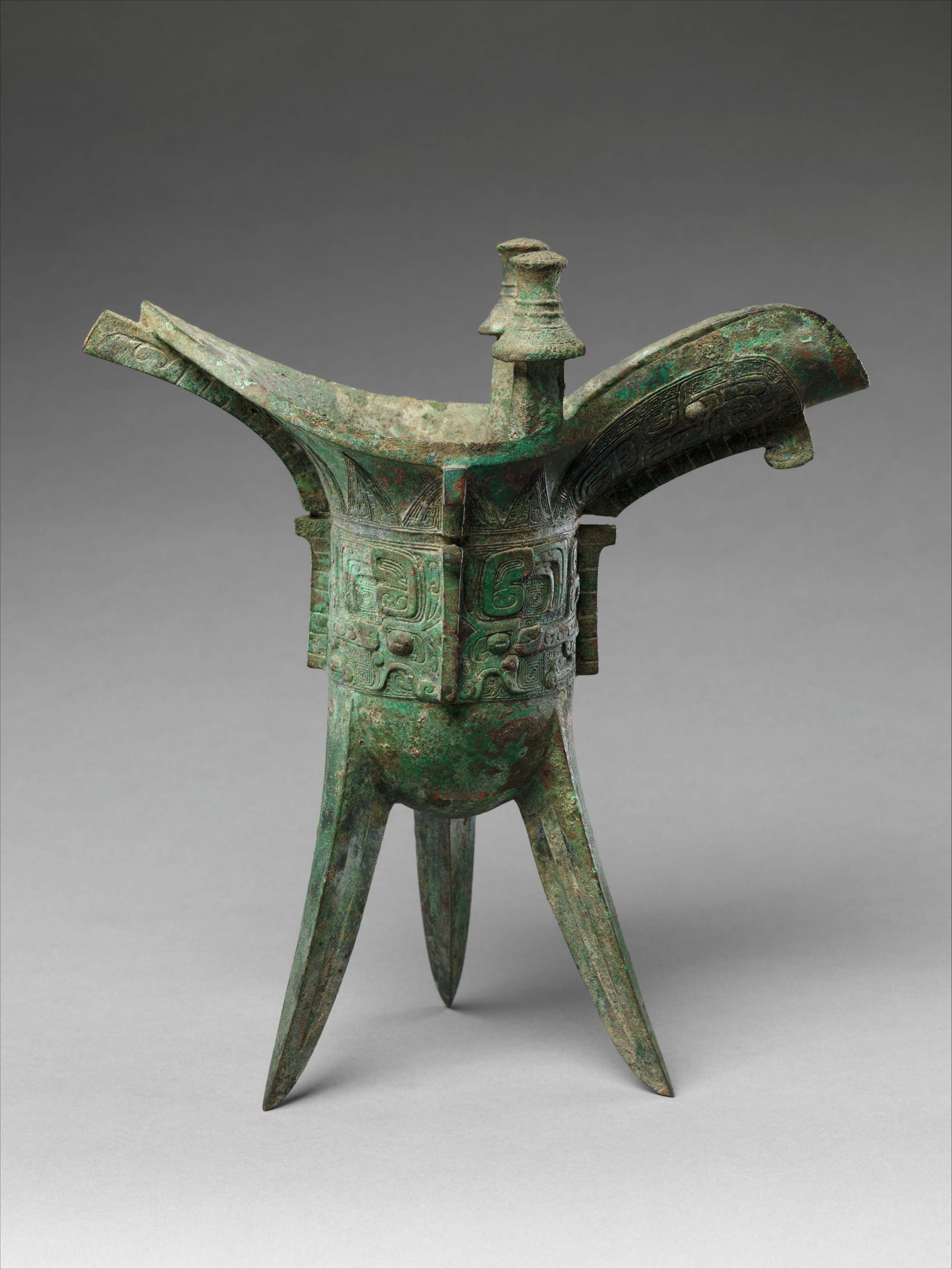
Ritual Wine Vessel (Jue): The Genesis of Power in Bronze
Introduction: The Unseen Thread of Chinese Material Culture
Within the hallowed halls of Katherine Fashion Lab’s heritage archive, the Ritual Wine Vessel (Jue) stands not as a mere artifact of ancient China, but as a foundational text in the lexicon of power. At first glance, this tripodal bronze vessel—defined by its pointed pour spout, opposing lip, and twin capped pillars—appears functionally archaic. Yet, when subjected to our rigorous DNA correlation with the Rock in the form of a fantastic mountain and the Jar in the shape of bronze container (hu), a startling thesis emerges. These three objects, though separated by material and function, are bound by a singular, unspoken doctrine: the transmutation of earthly matter into a conduit for celestial authority. The Jue is not a cup; it is a crucible of legitimacy. This analysis deconstructs its symbolic power, its language of adornment, and its spiritual resonance, ultimately translating these ancient codes into a 2026 high-end luxury strategy that transcends mere aesthetic homage.
Symbolic Power: The Architecture of Ritual Hierarchy
The Jue’s physical form is a deliberate exercise in hierarchical communication. Unlike utilitarian drinking vessels, the Jue was reserved exclusively for sacrificial rites—libations offered to ancestors and deities. Its very shape dictated the ritual’s choreography. The two pillars atop the rim were not decorative; they served as a visual and tactile reminder of the dual mandate of Heaven and Earth, forcing the officiant to grip the vessel in a manner that exposed the wrist, a gesture of vulnerability and submission before the divine. The tripod legs elevated the vessel, lifting its contents from the profane earth, while the sharp, elongated spout directed the libation with surgical precision—a metaphor for the controlled dispensation of power. In the context of our comparative study, the Jue’s explicit ritual function provides the missing semantic key to the Rock and the Hu. The Rock’s fantastical mountain form is a frozen landscape of immortality, while the Hu’s bronze shape is a vessel for storage. The Jue, however, is the action point—the moment where the stored (Hu) and the aspirational (Rock) converge in a sacred transaction. It is the verb in a sentence of nouns, the performance of authority that the other objects merely suggest.
Historical Adornment: Bronze as the Skin of Divinity
In the Shang and early Zhou dynasties, bronze was not a common metal; it was a state-controlled material, more precious than gold in its political weight. The Jue’s surface, often devoid of the intricate taotie masks found on larger vessels, relies instead on its patina and geometric incision for impact. This restraint is a masterclass in elite adornment. The Jue does not shout; it resonates. The bronze’s dark, earthy tones, often mottled with malachite and cuprite patinas over millennia, create a surface that absorbs light rather than reflecting it—a visual metaphor for introspective authority. Unlike the jeweled regalia of Western courts, Chinese ritual bronze adornment is about material density and weight. The vessel’s heft in the hand is a physical assertion of resource control. For Katherine Fashion Lab, this dictates a crucial design principle: luxury need not be ornate to be opulent. The Jue teaches that surface integrity, material purity, and a tactile sense of mass are the ultimate signifiers of heritage. The adornment is not added; it is inherent to the object’s making.
Spiritual Meaning: The Alchemy of Transformation
To understand the Jue is to understand the spiritual technology of ancestor worship. The vessel was filled with warm wine, not for consumption, but for evaporation. The steam rising from the heated bronze was believed to be the physical ascent of the offering, a bridge between the living and the ancestral realm. The Jue, therefore, is an alchemical engine. It transforms liquid into vapor, and vapor into spiritual presence. This is the profound correlation with our study of the Rock: the mountain is the dwelling place of immortals, while the Jue is the mechanism by which mortals petition them. The spiritual meaning is one of mediation and intercession. The Jue’s user is not a consumer but a conduit. In a modern context, this reframes luxury consumption from acquisition to ritualistic engagement. The object is not owned; it is utilized to access a state of being. This is the ultimate luxury—not the possession of a thing, but the possession of a transformative experience.
2026 Luxury Strategy: The Jue Protocol
For Katherine Fashion Lab’s 2026 collection, the Jue is not a motif to be printed; it is a system of values to be operationalized. We propose the “Jue Protocol”—a three-tiered strategy drawn from the vessel’s DNA.
- Tier 1: The Material Hierarchy. Following the Jue’s lead, the 2026 line will prioritize uncompromising material provenance. We will introduce a capsule series of accessories cast in a proprietary, high-density bronze alloy, finished with a forced patina process that mimics 3,000 years of oxidation. These are not jewelry; they are portable heirlooms, designed to be weighed in the hand, their mass a counterpoint to the digital weightlessness of modern life.
- Tier 2: The Ritual of Presentation. The Jue’s function was performance. Our retail strategy will shift from display to ceremony. Limited-edition Jue-inspired decanters will be presented to VIP clients within a private, guided ritual—a sommelier-led tasting that emphasizes the vessel’s acoustics and thermal conductivity. This transforms a purchase into a rite of passage, creating an emotional bond that no digital campaign can replicate.
- Tier 3: The Spiritual Narrative. The Jue’s power lies in its mediation. Our 2026 campaign will not sell clothing; it will sell access to ancestral confidence. The narrative will position the wearer as a conduit of legacy, echoing the Rock’s permanence and the Hu’s storage of wisdom. The Jue becomes the brand’s symbol of active, deliberate power—the ability to pour one’s intent into the world with precision.
Conclusion: From Vessel to Verdict
The Ritual Wine Vessel (Jue) is the missing link in our heritage triptych. It is the dynamic force that the Rock and the Hu merely imply. Its legacy is not in its form, but in its function as a catalyst for authority. For Katherine Fashion Lab, the Jue is not an artifact of the past; it is a blueprint for the future of luxury. By adopting its principles—material density, ritual presentation, and spiritual mediation—we do not merely reference history; we operationalize its power. In 2026, we will not sell objects. We will sell the vessel of transformation, the bronze throat through which modern ambition is poured and sanctified. The Jue has spoken; it is our turn to listen.