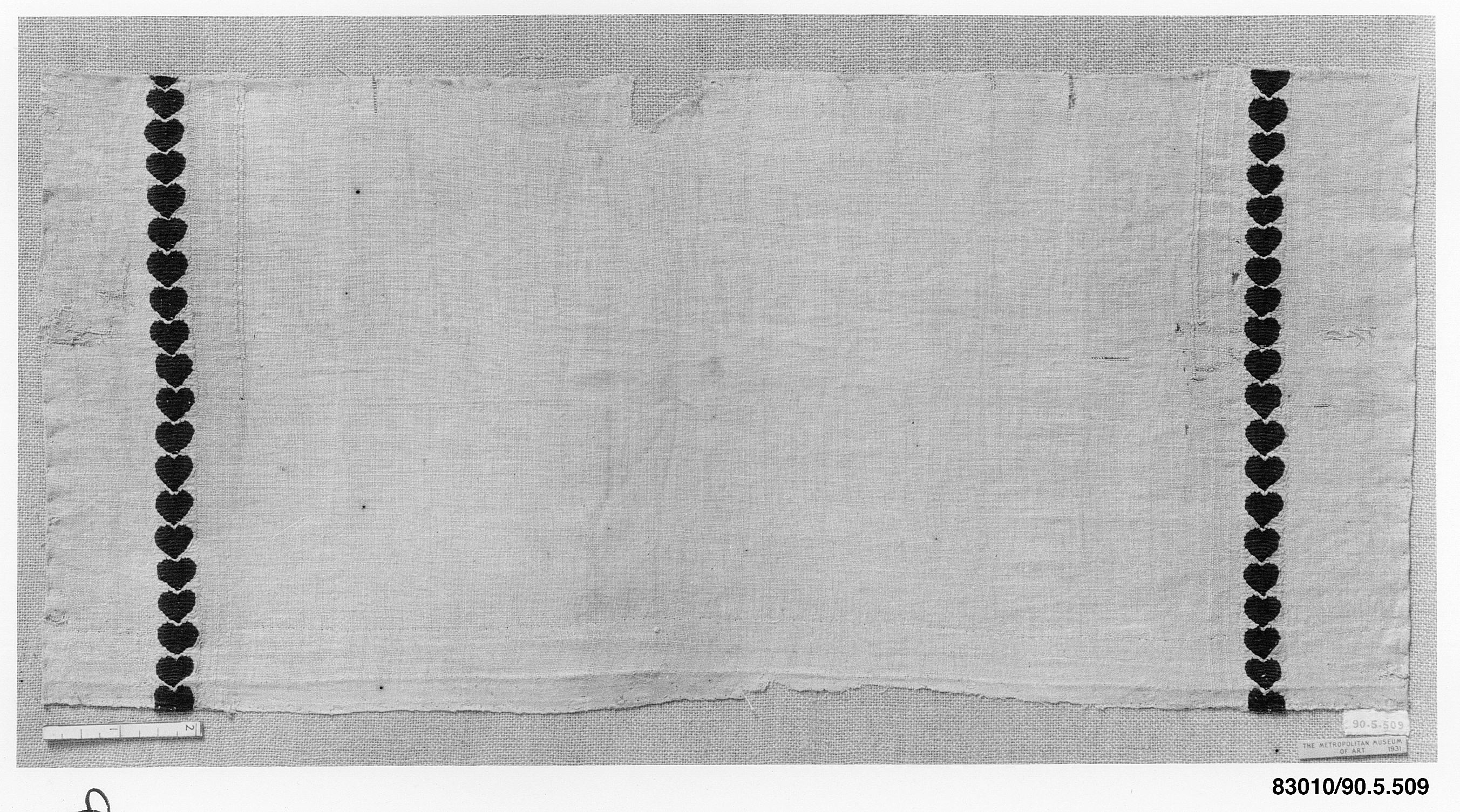
Executive Heritage Analysis: The Textile Fragment as a Blueprint for 2026 Luxury Authority
In the rarefied echelons of high-end fashion, the past is not merely a prologue; it is the most potent currency of authenticity. For Katherine Fashion Lab, the strategic examination of a textile fragment—a composite of wool and linen executed in both plain and tapestry weaves—offers far more than archaeological curiosity. This fragment, born of an ancient civilization, serves as a primary source document for decoding the semiotics of power, the psychology of adornment, and the metaphysics of material culture. As we position the Lab for the 2026 luxury cycle, this analysis moves beyond aesthetic homage to extract operational intelligence: how to engineer garments that do not merely clothe, but consecrate the wearer.
I. The Material Dialectic: Wool, Linen, and the Architecture of Prestige
The deliberate pairing of wool and linen within a single artifact is a study in hierarchical materiality. Linen, derived from flax, demanded intensive labor—retting, spinning, and weaving—that rendered it a fiber of considerable cost and ritual purity. Wool, conversely, offered warmth, volume, and a receptive surface for polychromatic dyeing. In the ancient world, the combination of these two disparate fibers was often codified by sumptuary law; their union signified not a technical convenience, but a deliberate transgression of textile categories to create a new, elevated status marker.
For Katherine Fashion Lab, this material dialectic informs a 2026 strategy of contrarian opulence. The luxury market is saturated with monomaterial purism—the cashmere-only or silk-only narrative. Our fragment teaches us that hierarchical tension is a more sophisticated signal. By juxtaposing the crisp, dry hand of linen against the soft, dense pile of wool, we can engineer a tactile dissonance that reads as intellectual luxury. This is not about comfort; it is about authority through complexity. The weave structure—plain for the base, tapestry for the narrative field—further suggests that luxury is a layering of systems: the quotidian beneath, the symbolic above. Our 2026 outerwear and tailored separates will adopt this two-tier construction, where the interior structure is utilitarian and the exterior surface is a canvas for coded storytelling.
II. Tapestry as Political Theology: The Symbolic Power of Narrative Thread
The tapestry weave is the ancient world’s most advanced form of textile communication. Unlike embroidery, which is applied, tapestry is integral—the imagery is the fabric itself. This distinction is crucial for understanding symbolic power. In a tapestry-woven fragment, the motifs—whether geometric, zoomorphic, or anthropomorphic—are not decoration; they are structural truth. The loom becomes a mechanism for encoding cosmology, lineage, and divine mandate directly into the garment’s physical integrity.
This principle of integral symbolism offers a decisive counterpoint to contemporary luxury’s reliance on printed logos or embroidered monograms. The logo is a superficial stamp; the tapestry motif is an ontological claim. For the 2026 collection, Katherine Fashion Lab will adopt a "narrative warp" approach. Rather than appliquéing a crest, we will commission jacquard and tapestry looms to weave our brand’s foundational myths—the origin of the Lab, the alchemy of its dye house, the geometry of its atelier—directly into the fabric yardage. The wearer does not display a label; they inhabit a doctrine. This transforms the garment from a commodity into a relic of the brand’s own cosmology, a move that justifies a premium price architecture based on narrative scarcity, not material scarcity alone.
III. Historical Adornment as a Technology of the Self
In ancient civilizations, adornment was not an act of vanity but a technology of the self—a method for negotiating identity, social rank, and metaphysical protection. The fragment’s placement within a garment would have dictated its function: a border fragment signified liminality (the edge of the self meeting the world), while a central panel signified the core of personal power. The choice of wool and linen also carried gendered and ritual connotations—linen for purity and priestly duties, wool for earthly vitality and chthonic connection.
The strategic implication for Katherine Fashion Lab is the reintroduction of positional grammar in garment design. In 2026, we will move away from the uniform distribution of pattern and toward a cartography of the body. Specific weave densities and symbolic motifs will be reserved for zones of power: the shoulders (authority), the sternum (emotional truth), and the lower spine (instinctual grounding). This approach treats the body as a sacred map, and the garment as a navigational tool. This is a profound differentiation from streetwear’s all-over graphics or minimalism’s blankness. We will offer the discerning client a bespoke semiotic placement service, where the fragment’s original function—to direct the gaze and protect the wearer—is re-engineered for the modern power player. The garment becomes a psychological armor, not a mere cover.
IV. Spiritual Meaning and the Luxury of Transcendence
The spiritual dimension of this fragment cannot be overstated. In antiquity, textiles were often votive offerings, funerary wrappings, or ritual vestments. The act of weaving was itself considered a sacred act, often associated with goddesses of fate and destiny. The fragment’s survival—its passage through centuries, its excavation, its preservation—imbues it with a patina of transcendence. It is a physical witness to the impermanence of empires and the permanence of craft.
For the 2026 luxury strategy, this translates into a brand ethos of sacred endurance. Katherine Fashion Lab will position its garments as anti-trend artifacts. Where fast luxury chases the seasonal, we will emphasize the ritual of acquisition and stewardship. Each garment will be accompanied by a "provenance dossier"—not just the country of manufacture, but the philosophical lineage of the weave, the symbolic meaning of the motif, and the intended spiritual function of the piece. This reframes the purchase as a pilgrimage, and the garment as a talisman. In a market fragmented by digital noise, offering a product that promises metaphysical grounding is a powerful, high-margin differentiator. The client is not buying a dress; they are buying a piece of immutable meaning in a volatile world.
V. Strategic Synthesis: The 2026 Luxury Architecture
Based on this heritage analysis, Katherine Fashion Lab will execute a three-pillar strategy for the 2026 high-end cycle:
Pillar One: The "Integral Narrative" Atelier Line
A limited-run collection of outerwear and tailored pieces where the tapestry weave is the primary structure, not an accent. These pieces will be engineered on custom looms, with motifs derived from the Lab’s internal archives. The price point will reflect the loom time and narrative complexity, positioning these as collectible investments rather than seasonal garments.
Pillar Two: The "Positional Grammar" Custom Program
A bespoke service where clients work with a heritage curator to map their personal power zones and select weave densities and motifs accordingly. This is the ultimate expression of adornment as self-governance, offering a level of personalization that mass-market "customization" cannot approach.
Pillar Three: The "Sacred Endurance" Brand Narrative
All marketing, packaging, and retail environments will shift from a language of "style" to a language of "stewardship." The fragment’s story—its survival and meaning—will be the central brand parable. This creates a mythopoeic brand identity that resonates with a clientele seeking depth, permanence, and spiritual resonance in their consumption.
In conclusion, this humble textile fragment is not a historical curiosity; it is a strategic weapon. It teaches that true luxury is not volume, but density of meaning; not visibility, but positional power; not novelty, but sacred endurance. Katherine Fashion Lab will not simply reference the past; we will re-inhabit its logic to build a future-proofed house of high-end authority.