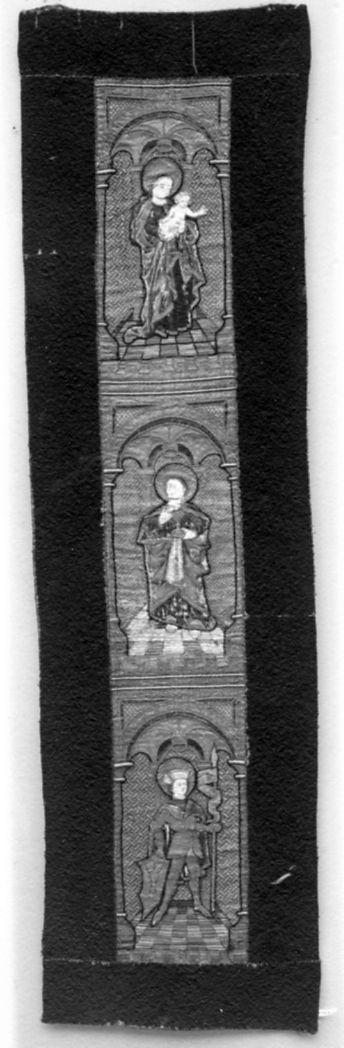
The Gilded Thread: A Couture Analysis of Katherine Fashion Lab's Orphrey Study
In the rarefied echelons of haute couture, where innovation often masquerades as rupture, Katherine Fashion Lab (KFL) offers a compelling counter-narrative: that the future of luxury lies in the profound re-reading of its past. The subject of this analysis—a standalone study titled Orphrey—is a masterclass in this philosophy. Derived from the German tradition of ecclesiastical and aristocratic embellishment, the piece is a meticulous deconstruction and reconstruction of a medieval technique, elevated into a contemporary statement of textile artistry. Constructed from silk and silver thread, the study is not merely a garment or an accessory; it is a wearable thesis on the intersection of material science, historical memory, and sculptural form.
Historical Provenance: The Orphrey Recontextualized
The term "orphrey" historically refers to the richly embroidered bands or borders adorning ecclesiastical vestments, particularly the chasuble and cope. Originating in the workshops of medieval Germany, these bands were not decorative afterthoughts but rather the most valuable components of the vestment, often crafted from gold, silver, and silk. They served a dual purpose: liturgical demarcation and a display of institutional wealth and artistic prowess. In the German tradition, specifically, the orphrey evolved from simple woven strips to complex, narrative embroidery, depicting saints and biblical scenes with a level of detail that rivaled manuscript illumination.
KFL’s intervention is to sever the orphrey from its liturgical anchor while preserving its structural DNA. The study does not imitate a band; it becomes the band, but scaled and re-proportioned for the contemporary body. This is not appropriation but analytical homage. The designer has isolated the essential grammar of the orphrey—its verticality, its density, its luminosity—and translated it into a standalone object that functions as a modern cuirass or a sculptural collar. The result is a piece that carries the weight of history without the burden of its dogma.
Material Dialectics: Silk and Silver as Foundational Logic
The material selection in Orphrey is not arbitrary; it is a deliberate dialogue between opposing tactile and visual properties. The silk base—likely a duchesse or a heavy faille—provides a matte, pliable foundation. Its drape is fluid, yet its density offers structural support. This is not the flimsy silk of a summer dress; it is a silk with architectural intent. The fabric’s natural luster is understated, allowing the silver to dominate the visual field.
Conversely, the silver thread—likely a combination of pure silver-plated wire and silver-gilt thread—introduces a rigid, reflective counterpoint. The thread is not simply embroidered on the surface; it is integrated into the weave and then further manipulated through a process of raised embroidery (or Hochstickerei), a technique perfected in German convents. This creates a topographical relief, where the silver rises from the silk in undulating ridges. The effect is a play of light that shifts from a blinding, mirror-like flash to a subtle, shadowed glimmer, depending on the angle of the viewer. This is not merely decorative; it is a study in the phenomenology of light on the body.
Couture Construction: Technique as Narrative
The construction of the standalone study reveals KFL’s commitment to artisanal rigor, a hallmark of true couture. Unlike mass-produced embellishment, where motifs are printed or machine-applied, Orphrey employs a labor-intensive process that echoes the slow production of medieval workshops. The silver thread is laid in parallel, overlapping rows—a technique known as couching—where each thread is secured by a finer silk filament in a tiny, invisible stitch. This process, executed by hand, can take upwards of 400 hours for a piece of this scale. The result is a surface that is not flat but possesses a micro-architecture of ridges and valleys, a tactile experience that invites closer inspection.
Furthermore, the study’s silhouette is a feat of material engineering. The piece is structured to stand away from the body in certain areas, creating a negative space that frames the wearer’s collarbone and neck. To achieve this, KFL has integrated a hidden substructure of horsehair canvas and fine steel boning, hand-molded to the body’s contours. This internal architecture is invisible from the exterior, yet it is the skeleton that allows the silk and silver to hold their sculptural form. The edge of the piece is finished with a hand-rolled silk organza binding, a detail that, while unseen, signifies the obsessive attention to finish that separates couture from ready-to-wear.
Silhouette and Body: The Wearable Reliquary
The silhouette of Orphrey is best described as a modern reliquary. It envelops the upper torso like a protective casing, yet it is open and airy, suggesting both armor and vulnerability. The piece is designed to be worn over a bare collarbone or a high-necked, minimalist base layer, allowing the metallic surface to act as the primary visual anchor. The vertical orientation of the silver threads elongates the torso, creating an imposing, almost regal posture. This is not a garment for passive wear; it demands a certain carriage, a deliberate stillness that allows the light to play across its surface.
KFL’s decision to present this as a standalone study is significant. It removes the piece from the context of a full collection, where it might be viewed as a component of a larger narrative. Instead, the standalone format forces the viewer to engage with the object in its entirety, as a complete artistic statement. It is a curatorial choice that elevates the piece from clothing to objets d’art, inviting a level of scrutiny typically reserved for sculpture or painting. The absence of a garment beneath emphasizes the technical prowess of the construction; the piece is not a decoration on a dress, but the dress itself, in a radical redefinition of what constitutes a garment.
Comparative Analysis: Orphrey in the Contemporary Canon
To fully appreciate KFL’s achievement, one must situate Orphrey within the broader landscape of contemporary couture. Designers like Alexander McQueen and Iris van Herpen have explored the intersection of structure and ethereality, but their approaches differ fundamentally. McQueen’s work often employed historical references with a gothic, romantic violence; van Herpen’s is futuristic, using 3D printing and silicone to mimic organic forms. KFL’s Orphrey occupies a distinct third space: it is archaeological in its methodology, yet minimalist in its aesthetic.
Unlike van Herpen’s overtly technological futurism, KFL’s futurism is implicit, derived from the hyper-accuracy of historical technique. The silver thread is not a futuristic polymer; it is an ancient material, yet its application here—in a sculptural, non-functional form—reads as avant-garde. Similarly, unlike McQueen’s theatricality, KFL’s piece is austere. There is no blood-red lining, no dramatic train. The drama is internal, residing in the tension between the rigid silver and the supple silk, between the historical weight and the modern silhouette. This restraint is a sign of confident design; it does not need spectacle to command attention.
The Economic and Symbolic Value of Craft
In an era of fast fashion and digital replication, the economic logic of Orphrey is defiantly anti-commercial. The hours of hand-stitching, the cost of pure silver thread, and the use of high-grade silk render the piece prohibitively expensive, placing it firmly in the realm of investment art. Yet, this is precisely its value proposition. KFL is not selling a covering; it is selling time, skill, and cultural memory. The piece functions as a tangible asset, a repository of human labor that will appreciate in value, both financially and symbolically. It is a counter-argument to the disposability of contemporary fashion, asserting that true luxury is a measure of the maker’s devotion, not the brand’s marketing budget.
Furthermore, the German origin of the technique carries a specific symbolic resonance. German textile art has long been associated with precision, engineering, and a certain philosophical weight—think of the Bauhaus or the rigorous weaving of the Anni Albers tradition. By invoking the German orphrey, KFL taps into this lineage of systematic creativity. The piece is not a whimsical fancy; it is a calculated, rational exploration of form, executed with the precision of a watchmaker. This intellectual rigor is what separates KFL from mere aestheticists; the piece invites analysis, not just admiration.
Conclusion: A Study in Perpetual Relevance
In conclusion, Katherine Fashion Lab’s Orphrey is a triumph of conceptual couture. It successfully bridges the chasm between historical technique and contemporary expression, proving that innovation does not require the abandonment of tradition but rather its intelligent re-interpretation. The choice of silk and silver is not merely material but metaphorical—the silk representing the soft, mutable body, and the silver representing the enduring, immutable spirit of craft.
As a standalone study, it functions as a manifesto for a new kind of luxury: one that values depth over surface, process over product, and history over novelty. It is a piece that will not date, precisely because it is not of a specific moment; it is a dialogue with the eternal. For the collector, the curator, or the connoisseur, Orphrey represents the pinnacle of what fashion can achieve when it treats the body as a canvas for intellectual and material exploration. Katherine Fashion Lab has not just made a garment; it has made a compelling argument for the enduring power of the hand, the thread, and the idea.