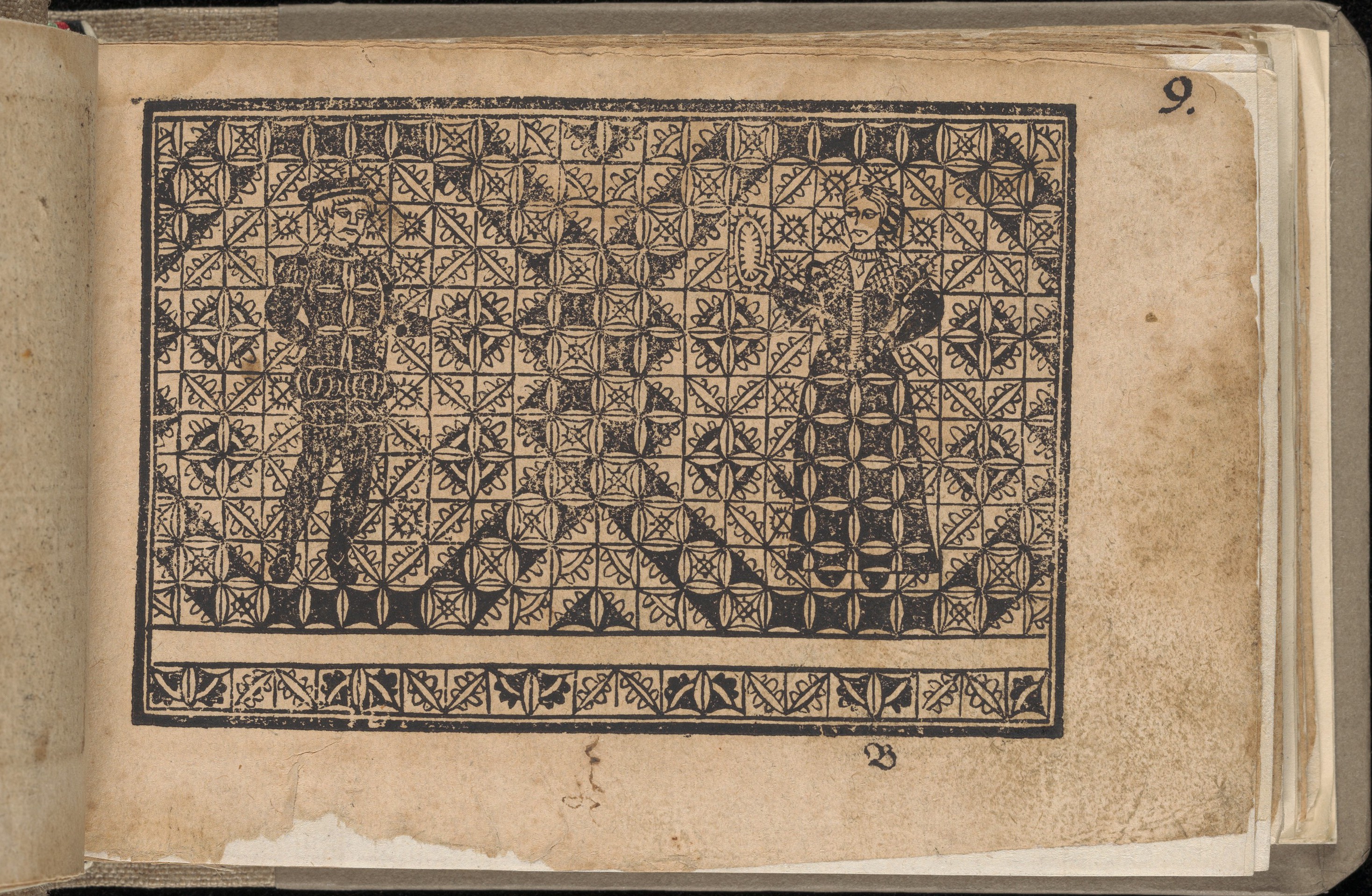
A Cartography of Craft: Reading Schön’s *newes Modelbuch* (Page 9r) as a Global Heritage Artifact
In the rarefied echelons of fashion scholarship, the printed pattern book occupies a paradoxical space: it is at once a utilitarian manual and a profound cultural document. To encounter a single leaf—Page 9r from the *Schön newes Modelbuch*—is to hold a fragment of a larger cartography, one that maps the transmission of style, skill, and status across early modern Europe and beyond. For Katherine Fashion Lab, this woodcut is not merely an antique curiosity; it is a foundational text in the genealogy of design, a silent progenitor of the very systems of replication and innovation that define contemporary couture. This analysis seeks to deconstruct Page 9r as a material object, a pedagogical tool, and a global heritage artifact, arguing that its aesthetic economy—its deliberate balance of ornament and restraint—offers a prescient blueprint for today’s luxury market.
Materiality and the Woodcut’s Tactile Intelligence
The medium of the woodcut is decisive. Unlike the fluid, error-prone stroke of a pen, the woodblock demands a decisive, irreversible cut. Each line on Page 9r is a study in negative space, a carved relief that yields a positive image only through pressure and ink. This process imparts a distinctive visual grammar: sharp, angular contours; a flattened perspective; and a reliance on pattern over tonal gradation. For the early modern reader, this was not a limitation but a virtue. The woodcut’s crispness enabled mass reproduction, yet its very materiality—the grain of the wood, the slight unevenness of the inking—ensured that no two impressions were identical. This tension between mechanical reproducibility and artisanal variance is a precursor to the haute couture paradox: a garment designed for a unique body, yet conceived within a system of repeatable patterns.
Examining Page 9r’s specific motifs, one observes a deliberate orchestration of line. The figures, likely depicting a noblewoman and her attendant, are rendered with a verticality that elongates the silhouette—a visual echo of the era’s rigid bodices and trailing gowns. The woodcut’s strokes do not merely outline fabric; they *suggest* its weight, its sheen, its internal architecture. The repetitive, parallel hatching across a skirt panel reads as the nap of velvet; the delicate cross-hatching at a collar implies the crispness of starched linen. This is not naive illustration but a sophisticated semiotic system, where the density of marks communicates the cost of the textile. A modern couturier reading this page understands that the woodcut is a form of *technical drawing avant la lettre*, encoding drape and construction within a two-dimensional grid.
The Pedagogical Imperative: From Pattern to Prototype
The *Modelbuch*—literally “pattern book”—served a dual pedagogical function. For the professional tailor or embroiderer, it was a repository of sanctioned designs, a way to access the latest court fashions without direct access to the court itself. For the domestic needleworker, it was a tool of social aspiration, enabling the replication of aristocratic style within a bourgeois household. Page 9r, in this context, is not a passive image but an active instruction set. Its composition—often featuring a central figure flanked by smaller, isolated motifs of floral or geometric ornament—operates as a modular system. The reader could extract a single sleeve treatment or a collar detail and integrate it into an existing garment, effectively remixing the designer’s original intent.
This modularity is the true genius of the *Modelbuch*, and it resonates with Katherine Fashion Lab’s own design philosophy. The contemporary practice of “look books” and digital pattern libraries is a direct descendant of this early modern innovation. Yet, there is a critical difference. In the woodcut, the pattern is inseparable from its cultural context—the specific cut of a sleeve signifies a particular regional identity, a courtly allegiance, or a religious modesty. Page 9r, likely originating from a German or Swiss press, carries the stylistic DNA of the Holy Roman Empire’s mercantile cities: a preference for structured, geometric ornament over the softer, more fluid lines of Italian or French fashion. To copy this pattern was to adopt a specific cultural *habitus*, a silent declaration of one’s place in a pan-European network of taste.
Global Heritage: The Silk Road in a Single Leaf
To label Page 9r as “Global Heritage” is to resist a Eurocentric reading. While the woodcut’s technique is distinctly European, its visual vocabulary is profoundly cosmopolitan. The floral motifs—the pomegranate, the carnation, the stylized acanthus—are not indigenous to Nuremberg or Augsburg. They are the distilled essences of Ottoman silk weaves, Persian manuscript illuminations, and even Indian chintz patterns that traveled along the Silk Road and through Venetian trading posts. The early modern European textile industry was a voracious consumer of foreign aesthetics, and the *Modelbuch* served as a translation device, converting exotic, expensive imports into localized, affordable woodcut notation.
Consider the intricate border patterns that frame the central figures on Page 9r. Their rhythmic, interlaced geometry bears a striking resemblance to Islamic *girih* tiles, a connection that underscores the complex cultural exchanges of the 16th century. By engraving these “foreign” motifs into a woodblock, the publisher was not merely copying a design; he was claiming it for a European audience, domesticating its alien elegance. This act of appropriation is a double-edged sword. On one hand, it demonstrates the vitality of cross-cultural pollination, the very essence of what we now call “fusion.” On the other, it reveals a colonial impulse—the extraction of aesthetic value without acknowledgment of its source. For a contemporary luxury house, Page 9r serves as a cautionary tale and a challenge: how do we borrow from global traditions with ethical reciprocity, rather than predatory extraction?
Couture Implications: The Modernity of the Antique
What, then, does a 16th-century woodcut offer the 21st-century couture atelier? The answer lies in its radical economy of means. In an age of digital rendering and AI-generated design, Page 9r reminds us that constraint breeds creativity. The woodcutter’s limited palette—black ink, white paper, and a finite set of marks—forced a distillation of form to its essential signifiers. This is the same discipline that governs a Chanel tweed or a Dior bar jacket: the reduction of a silhouette to a single, unassailable line.
Moreover, the *Modelbuch*’s emphasis on pattern recognition and replication prefigures the modern franchise of a fashion house. A couture garment is, in essence, a highly complex pattern, and its value lies in the precision of its execution. Page 9r, with its visible seams and construction lines, demystifies the garment-making process, offering a transparent view of how a flat surface becomes a three-dimensional form. This transparency is a luxury in itself—a rejection of the opaque, fast-fashion supply chain in favor of a visible, tactile logic.
Finally, the woodcut’s status as a *multiple*—an artwork existing in many impressions—challenges the modern fetishization of the unique. Each impression of Page 9r is slightly different, bearing the trace of its production. This is a powerful metaphor for couture: a design may be reproduced, but each garment, each fitting, each hand-stitched seam renders it unique. The *Modelbuch* teaches us that heritage is not a static archive but a dynamic process of re-interpretation. To study Page 9r is to engage in a dialogue with a maker who, centuries ago, faced the same fundamental question as any designer today: how to capture the fleeting essence of style in a permanent, reproducible form.
In conclusion, the *Schön newes Modelbuch* (Page 9r) is far more than a historical footnote. It is a masterclass in visual communication, a testament to the enduring power of the pattern, and a mirror reflecting our own contemporary anxieties about authenticity, appropriation, and the artisanal versus the industrial. For Katherine Fashion Lab, this artifact serves as a foundational text—a reminder that the most innovative couture is often a sophisticated re-reading of the past, a conversation with the woodcut’s decisive line, and a commitment to the global, entangled history of cloth.