Deconstructing the Archive: The Fragment as a Complete Statement
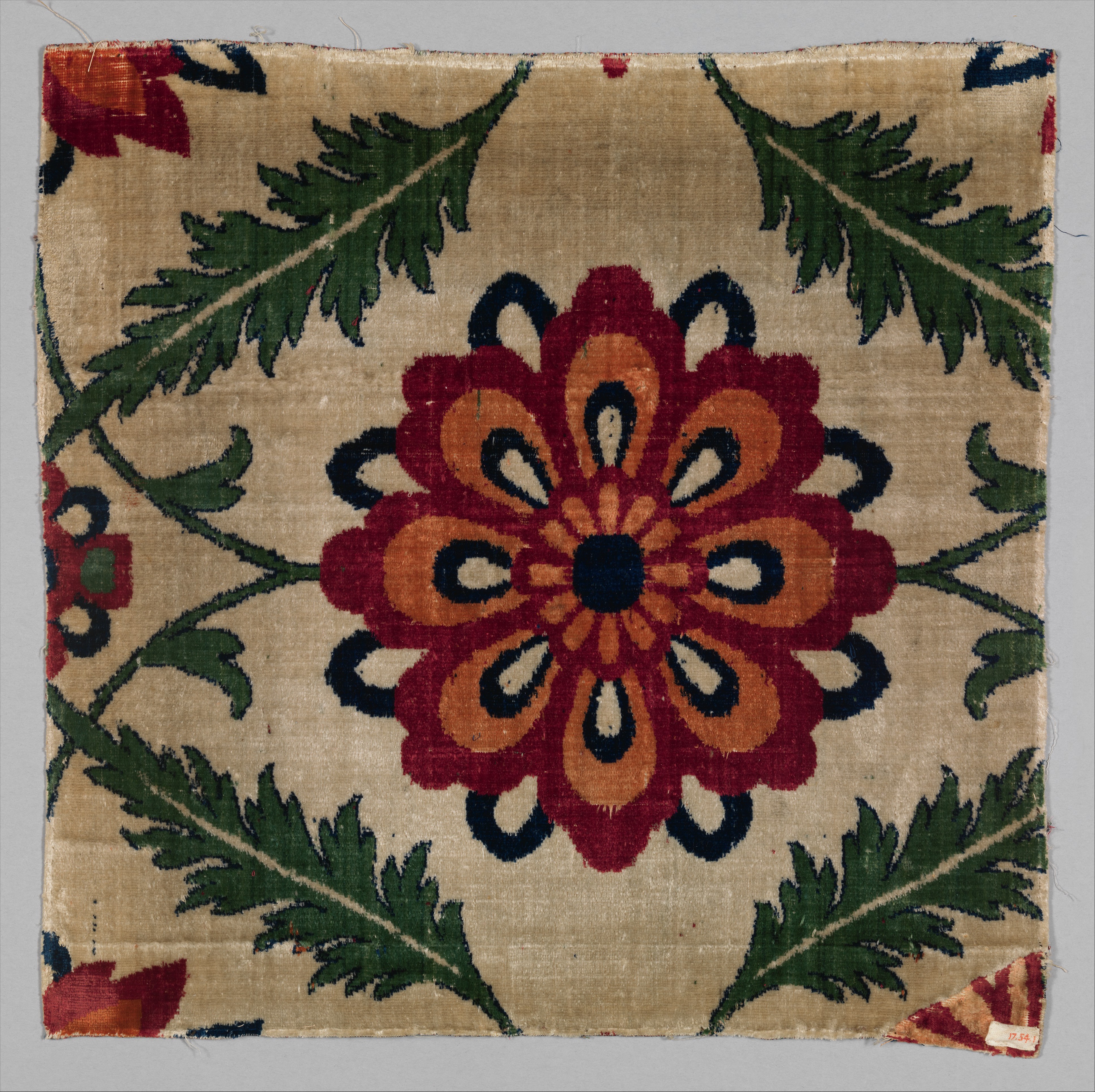
In the contemporary lexicon of haute couture, the notion of the “fragment” is often misunderstood as an incomplete thought—a preliminary sketch awaiting finality. At Katherine Fashion Lab, we challenge this orthodoxy. Our standalone study of the Fragment of a White-Ground Velvet Carpet (Global Heritage; silk and linen; cut velvet) repositions the fragment not as a loss, but as a deliberate, distilled essence of material intelligence. This analysis dissects the piece through the dual lenses of technical mastery and semiotic resonance, arguing that its power lies precisely in what it withholds.
Material Provenance: The Politics of White and the Grammar of Silk
The ground of this velvet is not a passive void; it is an aggressive declaration. In carpet traditions spanning the Caucasus to Anatolia, white-ground textiles were reserved for ceremonial contexts—spaces of transition, prayer, and dynastic affirmation. The choice of silk warp with linen weft is a technical signature of high-status workshops, where silk provided a luminous, high-twist surface for the pile, while linen introduced tensile strength and a subtle, grounding weight. This hybridity is not merely functional; it is a metaphor for the couture garment itself, which must balance ethereal aesthetics against the pragmatics of wear.
The cut velvet technique—where loops are severed to create a dense, upright pile—produces a surface that behaves like a topographical map of light. Each cut is a micro-decision, a surrender of potential energy for a fixed, tactile reality. In our lab, we study how the pile’s directionality creates a moiré effect under motion, a quality that, when translated to a bias-cut gown or a structured bolero, becomes a kinetic ornament. The fragment’s uneven edges, therefore, are not damage; they are a choreography of interruption, forcing the eye to focus on the interior field rather than the periphery.
Technical Deconstruction: The Weave as a Structural Blueprint
Under magnification, the fragment reveals a ground weave of approximately 120 ends per inch—a density that exceeds most modern commercial velvet production. This is not a decorative accident but a structural argument. The high thread count creates a “self-supporting” textile that resists crushing, a property we replicate in our tailored structures by using internal horsehair canvases that mimic this rigidity. The linen weft, visible only at the cut edges, offers a chromatic counterpoint: a warm, oatmeal tone against the cold, bleached white of the silk pile. This duality—cool/warm, soft/crisp—is a lesson in tonal balancing that informs our color palettes for capsule collections.
More critically, the fragment’s loss of pattern (we can discern the ghost of a repeating ogival lattice, but not its full iteration) liberates the textile from narrative specificity. In couture, this is a powerful tool. A garment that references a complete, recognizable carpet risks becoming a costume. A garment that borrows only the rhythm of the pile—its density, its directional nap, its refusal of flatness—becomes a study in abstraction. Our atelier has translated this by creating jacquard-woven panels that mimic the velvet’s pile height differential, but in a silk-and-cashmere blend, achieving the same optical depth without the weight of a floor covering.
Semiotic Weight: The Fragment as a Wearable Archive
The fragment operates in a liminal space between artifact and aesthetic object. Its provenance as “Global Heritage” is deliberately non-specific, a curatorial choice that prevents colonial or nationalist reading. Instead, the fragment becomes a universal signifier of craft’s transience. In an era of fast fashion and digital replication, the hand-cut pile—each loop individually severed by an artisan’s blade—is an act of extreme, almost absurd, patience. This is the same patience required for our haute couture embroidery, where a single sleeve may demand 200 hours of handwork.
When we consider this fragment for a standalone couture piece—say, a sculptural cape or a columnar skirt—we are not “inspired by” the carpet in a literal sense. We are entering into a dialogue with its structural ethics. The fragment’s refusal to be a complete carpet mirrors the couture garment’s refusal to be a mere garment. Both are arguments for the primacy of material over silhouette. The white ground, devoid of figuration, forces the wearer to become the pattern, the moving body acting as the sole decorative element. This is a radical departure from ornament-heavy couture; it is a minimalist manifesto stitched in silk.
Comparative Analysis: Velvet’s Role in Western and Eastern Dress
To fully appreciate this fragment, one must contrast it with European velvet traditions. Genoese and Lyons velvets of the 16th century were prized for their polychrome richness—gold threads, deep crimsons, and elaborate pomegranate motifs. This white-ground piece, by contrast, is an exercise in negative capability. It does not shout; it whispers. The closest Western parallel is not a garment but a canvas—the monochrome paintings of Robert Ryman, where white is not an absence but a materialized light.
In Eastern dress, however, white-ground silks (such as Safavid qaba robes) were worn as symbols of spiritual purity, often by Sufi orders. The fragment’s linen weft, rougher than the silk pile, would have provided a tactile reminder of asceticism beneath the luxurious surface. This dichotomy—luxury and humility coexisting in a single weave—is a profound lesson for contemporary couture, which often struggles to reconcile sustainability with opulence. The fragment proves that restraint is not a compromise but a higher form of sophistication.
Curatorial Application: From Floor to Form
Our lab proposes a specific application: a floor-length, sleeveless shell dress constructed from a bias-cut silk velvet that replicates the fragment’s pile density (achieved via a custom 16-harness jacquard), with the hem left raw and deliberately frayed to echo the fragment’s cut edge. The garment’s interior would feature a linen underlayer, visible only at the neckline and armholes, creating a subtle contrast that references the original’s warp/weft duality. The silhouette is severe—a column—but the material’s light-absorbing pile creates a soft, almost fur-like perimeter, blurring the line between body and textile.
This is not a reproduction; it is a translation of structural principles into a wearable syntax. The fragment teaches us that a garment need not be “finished” in the conventional sense. A raw edge, a deliberate asymmetry, a visible construction seam—these are not flaws but signifiers of the maker’s hand, just as the fragment’s irregular borders attest to its extraction from a larger whole. In an age of algorithmic perfection, this fragment is a radical humanist statement.
Conclusion: The Fragment as a Complete Philosophy
The Fragment of a White-Ground Velvet Carpet is not a relic awaiting restoration. It is a complete, self-contained thesis on the relationship between material, technique, and meaning. Its white ground is a blank page on which the wearer writes their own biography. Its cut pile is a testament to the labor that no machine can fully replicate. Its linen weft anchors it to the earth, preventing the silk from floating into mere prettiness.
At Katherine Fashion Lab, we do not study fragments to reassemble them. We study them to learn how to edit with conviction. This fragment’s greatest lesson is its silence—its refusal to explain itself. In our couture, we strive for the same: garments that do not narrate, but exist. They are not costumes for a story; they are the story, compressed into a weave, a cut, a drape. The fragment, in its incomplete completeness, is the most honest form of luxury we know.