Deconstructing the Undulating Ribbon: A Study in Textural Dialectics
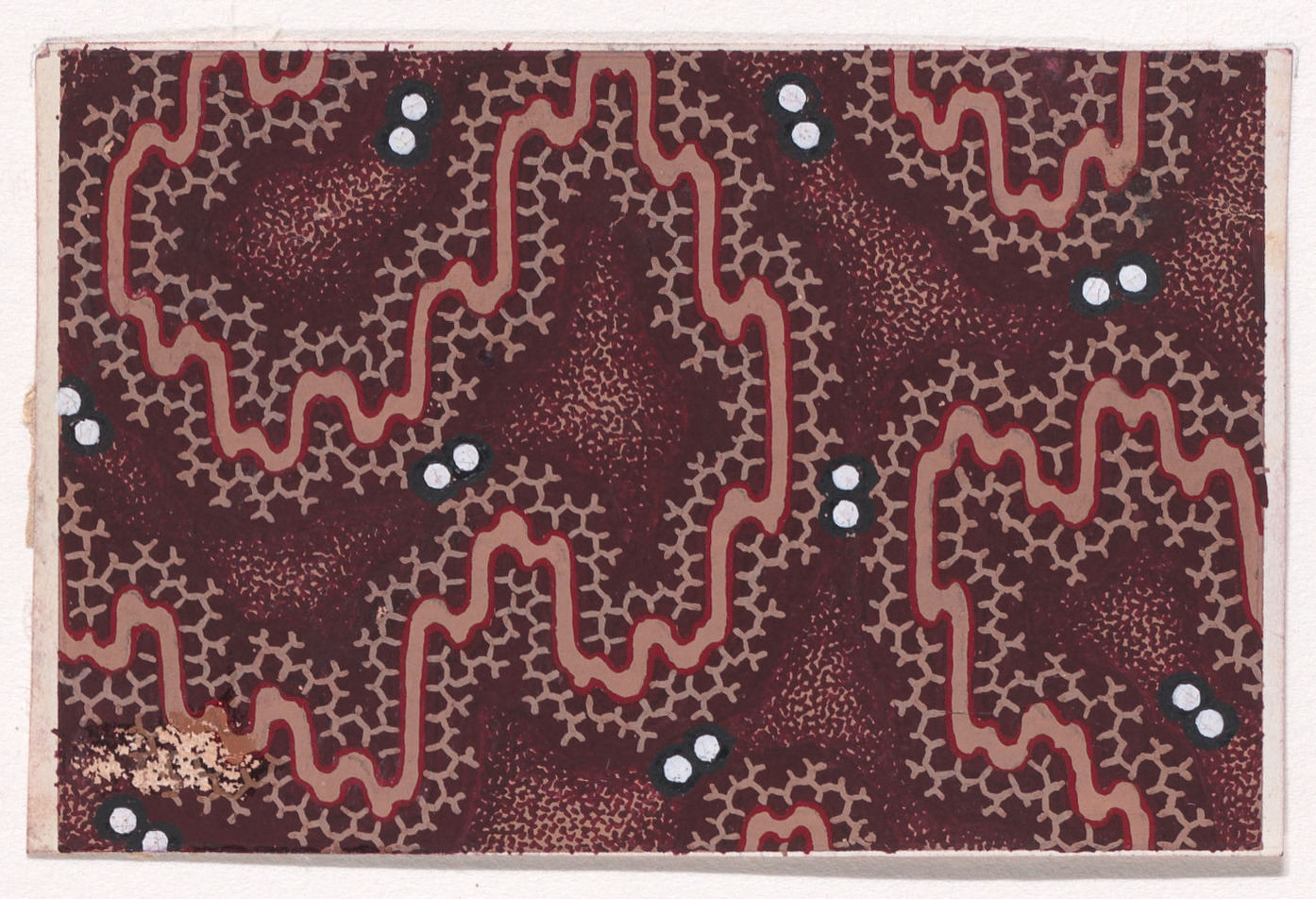
Within the hallowed confines of Katherine Fashion Lab’s archive, a standalone gouache study emerges not as a mere preparatory sketch, but as a complete manifesto on the poetics of surface. The subject—an undulating ribbon woven with a honeycomb pattern, offset by a constellation of pearls against a stippled ground—transcends its two-dimensional medium to propose a radical reimagining of textile architecture. This is not a design for fabric; it is a philosophy of fabric, rendered in pigment. The work’s genius lies in its orchestration of three distinct textural voices—the rhythmic ribbon, the punctuating pearl, and the atmospheric stipple—each conversing in a dialect of light and shadow, ultimately coalescing into a symphony of global heritage and avant-garde sensibility.
The Ribbon as Rhythmic Skeleton
The central motif, the undulating ribbon, serves as the composition’s kinetic spine. Its serpentine path is not arbitrary; it is a deliberate study in controlled chaos, echoing the natural drape and fall of couture fabrics. The honeycomb pattern offset within the ribbon is the critical innovation. Traditionally, honeycomb—or waffle—weave is synonymous with structure and utility, a geometric grid of thermal efficiency. Here, Katherine Fashion Lab subverts that expectation. By offsetting the hexagonal cells, the designer introduces a deliberate visual dissonance, a syncopated rhythm that prevents the eye from settling into a monotonous pattern. This offset creates a shimmering moiré effect, a subtle optical illusion that suggests movement even in stillness. The ribbon, therefore, becomes a metaphor for the human form in motion—a continuous, fluid line disrupted by internal complexities.
The choice of gouache is pivotal in executing this vision. Unlike watercolor’s translucency or oil’s unctuous depth, gouache offers an opaque, matte finish that allows for precise, flat applications of color. This enables the artist to render the honeycomb’s facets with architectural clarity, each cell a discrete plane of light and shadow. The medium’s quick-drying nature also permits the layering of delicate tonal shifts, creating a three-dimensional relief effect that mimics the tactile reality of a woven textile. The ribbon is not painted; it is constructed, cell by cell, in a process that mirrors the hand of a master weaver at a Jacquard loom.
The Pearl: A Study in Contrast and Continuity
Interspersed along the ribbon’s undulating path are pearls, rendered with a luminous, almost ethereal precision. In the lexicon of global heritage, the pearl is a universal signifier of purity, wealth, and organic perfection. Yet, in this context, the pearls are not mere decorative appendages. They function as a counterpoint to the honeycomb’s geometric rigidity. Where the honeycomb is angular, the pearl is spherical; where the pattern is repetitive, the pearl is singular; where the structure is man-made, the pearl is a biological accident of grace.
This juxtaposition creates a profound dialectic. The pearls act as anchors, grounding the ribbon’s restless energy. They are placed with mathematical intent—not randomly, but at the apex of each undulation, or at the point of maximum curvature. This placement suggests a gravitational pull, as if the pearls are weights that give the ribbon its drape. In a couture garment, these pearls would not be sewn flat; they would be wired or suspended, creating a micro-movement that catches light with every gesture of the wearer. The study thus anticipates the kinetic jewelry of the 21st century, where adornment is not static but interactive. The pearls are the voice of restraint in a composition that otherwise celebrates exuberance.
The Stippled Ground: An Atmospheric Veil
The background, rendered in a delicate stipple technique, is the work’s most subversive element. Stippling—the application of countless tiny dots—is often relegated to the role of shading or texture. Here, Katherine Fashion Lab elevates it to a primary narrative device. The stippled ground is not a void; it is a living atmosphere, a particulate haze that evokes everything from the grit of desert sand to the sparkle of night sky. This technique creates a visual vibration, a subtle tremble that makes the ribbon appear to hover above the surface rather than rest upon it.
This choice is a direct reference to pointillism, yet it diverges in purpose. Where Seurat sought optical blending, the Lab seeks optical separation. The stipple does not merge with the ribbon; it holds it in suspension. The dots vary in density and tone, creating a gradient that suggests a light source from the upper left. This directional lighting is crucial—it casts the honeycomb’s edges into sharp relief and gives the pearls their specular highlights. The stippled ground, therefore, is not a background but a field of potential. It is the raw material from which the ribbon and pearls emerge, a primordial textile dust waiting to be woven. In a garment, this would translate to a base fabric of raw silk or organza with a heavily textured, almost granular surface—perhaps a crepe de chine with a sandwashed finish—that provides a tactile counterpoint to the smooth ribbon and glossy pearls.
Global Heritage: A Cartography of Influence
The "Global Heritage" origin is not a marketing tagline but a deeply embedded structural principle. The honeycomb pattern, in its offset form, recalls the intricate zellige tilework of Morocco, where geometric perfection is deliberately fractured to create infinite visual complexity. The undulating ribbon echoes the ikat dyeing traditions of Southeast Asia, where resist-dyed threads create blurred, wave-like patterns. The pearls invoke the opulent courtly attire of Mughal India, where pearl embroidery was a symbol of imperial power. Finally, the stippled ground pays homage to the shibori tie-dye techniques of Japan, where the fabric’s surface is manipulated into a three-dimensional topography.
What emerges is not a pastiche but a synthesis. The Lab’s methodology is to deconstruct these global motifs to their elemental geometry and then reconstruct them through a contemporary, almost algorithmic lens. The offset honeycomb is a nod to the Islamic principle of tessellation—the idea that a pattern can be infinite without repetition—while the pearls provide the singular, meditative focus found in Zen aesthetics. This is heritage not as nostalgia, but as a living language, spoken with a new accent.
Couture Implications: From Study to Spectacle
As a standalone study, this work is complete in itself. Yet, its translation into couture is inevitable and thrilling. Imagine this design rendered in a bias-cut gown of ivory double-faced satin. The ribbon would be a separate panel of jacquard-woven silk, its honeycomb cells created through a combination of weaving and laser-cut perforation, backed by a nude illusion to create shadow. The pearls would be hand-knotted on micro-suede cords, allowing them to roll along the ribbon’s path with every step. The stippled background would be achieved through a process of chemical pleating or crinkling, creating a permanent, three-dimensional texture that catches light like a field of tiny mirrors.
The garment would be heavy, deliberate, and architectural—a piece of wearable sculpture. It would demand a wearer of confidence, someone who understands that couture is not about comfort but about transformation. The visual weight of the honeycomb, the tactile gravity of the pearls, and the atmospheric depth of the stipple would combine to create a silhouette that is both ancient and futuristic, a relic from a civilization that has yet to exist.
In conclusion, this gouache study is a masterclass in restraint and excess. It proves that true innovation lies not in the invention of new motifs, but in the radical recontextualization of existing ones. The undulating ribbon is a line of poetry; the honeycomb is its internal rhyme; the pearls are its punctuation; and the stippled ground is the silence that gives the poem its power. Katherine Fashion Lab has not merely designed a textile. It has composed a treatise on the nature of adornment itself—one that will resonate in the annals of fashion history as a benchmark of intellectual and artisanal rigor.