Heritage Analysis: Sovereignty and Devotion in the Deccan Court
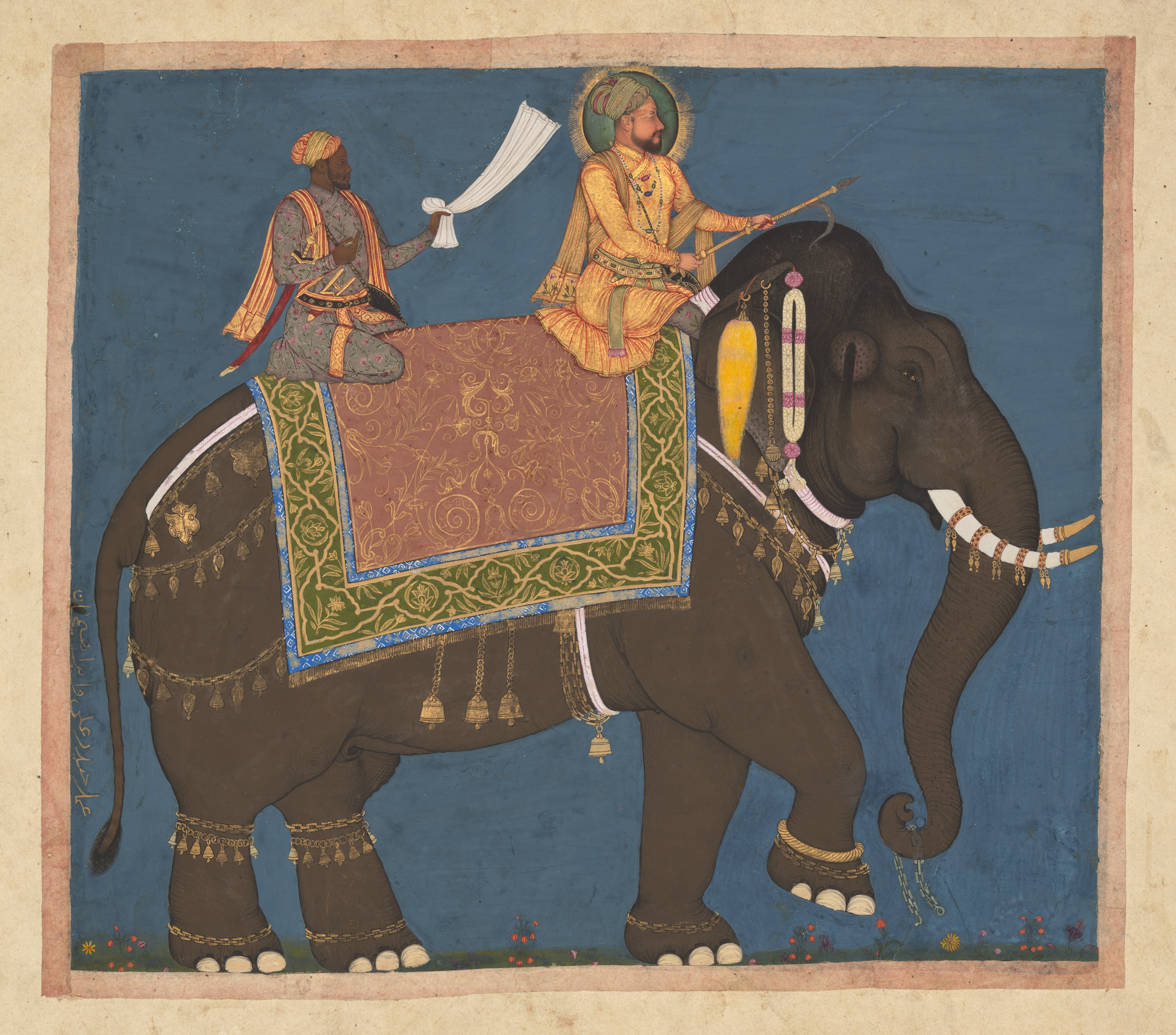
The painting Sultan Muhammad 'Adil Shah and Ikhlas Khan Riding an Elephant is not merely a visual record of a royal procession; it is a complex semiotic document of power, hierarchy, and divine favor. Executed in ink, opaque watercolor, and gold on paper, this work originates from the Bijapur Sultanate, a jewel of the Deccan plateau, during the early 17th century. For Katherine Fashion Lab, this artifact offers a profound lexicon of authority and intimacy that can be translated into a 2026 luxury strategy centered on layered sovereignty and sacred companionship.
Symbolic Power: The Elephant as a Mobile Throne
In the visual grammar of ancient and early modern Indic courts, the elephant was not a mere mount but a living embodiment of cosmic stability and imperial might. The sheer scale of the pachyderm in this composition dwarfs the human figures, immediately communicating that the ruler’s authority is terrestrial yet amplified by a force of nature. The elephant’s caparison, likely adorned with gold brocade and jeweled trappings, transforms the animal into a mobile throne. This is a deliberate strategy of spectacular governance: the ruler does not merely sit; he levitates above the masses, commanding a panoramic view that metaphorically represents his omniscient oversight of the realm.
Strategically, this iconography of elevation is critical for Katherine Fashion Lab’s 2026 positioning. The brand can adopt a “raised platform” ethos in its collection narratives—not through literal height, but through the use of voluminous silhouettes, structured shoulders, and trains that create an aura of unapproachable grandeur. The elephant’s strength, combined with the ruler’s stillness, suggests a form of power that is effortless and immutable. In a luxury market saturated with overt logos, the 2026 strategy should pivot to this quiet dominance: garments that command attention through material weight and architectural form rather than explicit branding.
Historical Adornment: The Grammar of Gold and Textile
The medium itself—opaque watercolor and gold on paper—is a testament to the value placed on permanent luminosity. Gold leaf was not a background element but a highlight reserved for the most sacred and powerful components: the ruler’s jewels, the elephant’s ornaments, and the edges of the royal parasol. This selective application of precious metal creates a hierarchy of light, guiding the viewer’s eye from the mundane to the divine.
Adornment in this period was a calculated language. The turban ornaments, pearl necklaces, and armbands worn by Sultan Adil Shah were not mere vanity; they were portable treasuries and markers of allegiance. Each gemstone held astrological and protective properties. For instance, the emerald was associated with wisdom and victory, while the ruby symbolized invincibility. The textile patterns, visible on the sultan’s jama (robe), likely featured floral motifs that referenced the gardens of paradise, positioning the ruler as an intermediary between the earthly and the heavenly.
For Katherine Fashion Lab, the 2026 heritage translation must involve material storytelling. The brand should source or commission hand-loomed silks and velvets that mimic the depth of opaque watercolor, with metallic threads woven in as strategic accents—not all-over embellishment, but precise placement at the collar, cuffs, and hem. This mirrors the painting’s technique of gold application. The 2026 collection should introduce a “Bijapur Gilt” capsule, featuring garments where the metallic thread is used exclusively to outline seams and structural lines, echoing the artist’s hand in defining the elephant’s harness and the royal silhouette.
Spiritual Meaning: The Mystic’s Gaze and the Sufi Ethos
The inclusion of Ikhlas Khan, a Habshi (African-Indian) nobleman and close confidant of the Sultan, riding atop the same elephant, is a radical iconographic choice. This is not a depiction of a servant; it is a portrait of spiritual brotherhood. Ikhlas Khan, whose name translates to “sincere servant,” was a senior statesman and a devotee of the Sufi saint. His proximity to the Sultan on the same mount signifies that spiritual devotion transcends ethnic and social boundaries. The Sultan, by sharing his seat, is publicly acknowledging that his temporal power is incomplete without spiritual counsel.
This duality—the ruler and the mystic—introduces a theme of complementary leadership. The Sultan represents the zahir (the external, exoteric law), while Ikhlas Khan represents the batin (the internal, esoteric truth). The elephant, as a beast that must be guided, becomes a metaphor for the state itself: it requires both the firm hand of the king and the whispered wisdom of the sage to navigate.
In a 2026 luxury context, Katherine Fashion Lab can internalize this as a duality in design. The collection should feature “companion pieces”—garments designed for two individuals, not in a romantic sense, but in a mentor-protégé or sovereign-advisor dynamic. For example, a structured, gold-embroidered outer coat (the Sultan) paired with a minimalist, unadorned inner robe in raw silk (the Khan). The strategy is to market “power pairs” where the absence of adornment is equally as powerful as its presence. This speaks to a high-net-worth clientele who value discretion and intellectual symbolism over overt display.
Strategic Imperatives for 2026: From Artifact to Aesthetic
1. The “Elevated Procession” Runway Format
For the 2026 presentation, Katherine Fashion Lab should eschew the traditional straight runway. Instead, the models should move in a cortege, with staggered heights and a central figure on a raised platform. The choreography should evoke the slow, deliberate gait of an elephant, emphasizing the weight and drape of the fabrics. This is a sensory immersion into the painting’s world, allowing clients to experience the sensation of being elevated above the crowd.
2. Material Alchemy: The “Opaque Gold” Finish
Collaborate with textile artisans to develop a fabric finish that mimics the matte, opaque quality of watercolor rather than the high-shine of modern metallic foils. This can be achieved through a technique of hand-painting mica and gold dust into the weave, creating a surface that shifts in light but never reflects harshly. This aligns with the 2026 luxury trend of “quiet opulence”—wealth that is felt through texture and weight, not seen through glare.
3. The “Ikhlas” Line: Unadorned Power
Introduce a sub-line named after Ikhlas Khan, characterized by severe minimalism. These are garments with zero embellishment, relying instead on impeccable tailoring and high-twist, high-density cotton or wool. The marketing narrative will position this line as the “inner court”—the essential underlayer that gives structure to the outer show. This creates a compelling price architecture: the “Adil” outer pieces are high-ticket, while the “Ikhlas” underpieces are entry-level luxury, encouraging clients to purchase the full ensemble.
4. Bespoke Consultation as a “Royal Durbar”
Reframe the private styling appointment as a “Durbar”—an audience where the client is the sovereign and the stylist is the trusted advisor. The consultation should include a tactile presentation of the painting’s history, allowing the client to handle swatches that correspond to the elephant’s harness (leather and brass), the Sultan’s robe (silk and gold), and the sky’s background (indigo-dyed wool). This transforms a transaction into a ritual of inheritance.
Conclusion: The Legacy of Shared Sovereignty
Sultan Muhammad 'Adil Shah and Ikhlas Khan Riding an Elephant remains a masterclass in hierarchical intimacy. It proves that true power is not solitary; it is a partnership between the visible and the unseen, the decorated and the plain. For Katherine Fashion Lab, the 2026 strategy is not about replicating Mughal or Deccan motifs, but about harnessing the psychological architecture of this painting. The brand will sell more than clothing; it will sell a position in a procession, a place on the platform. By honoring the spiritual bond between the Sultan and his Khan, the lab can offer a luxury experience that is both historically profound and commercially avant-garde, appealing to a clientele that seeks meaning as much as material. The heritage is not in the past; it is a blueprint for the future of sovereign dressing.