The Fan as Sovereign Artefact: A Heritage Analysis for Katherine Fashion Lab
Introduction: The Fan Beyond Function
The fan, frequently dismissed as a mere instrument of thermal relief, is in fact one of humanity’s most enduring and sophisticated objects of symbolic power. For Katherine Fashion Lab, the fan presents a unique opportunity to bridge ancient ritual with contemporary luxury. This heritage analysis examines the fan’s journey from sacred ceremonial object in ancient civilizations to a potent signifier of status, and proposes a strategic framework for its recontextualization in the 2026 high-end market. By understanding the fan’s historical role as a mediator of air, spirit, and social hierarchy, the Lab can position itself not merely as a purveyor of accessories, but as a curator of sovereign narratives.
Symbolic Power: The Breath of Divinity and Authority
In ancient civilizations, particularly Egypt, Mesopotamia, and China, the fan was not a secular convenience but a divine instrument. The Egyptian flabellum, often crafted with ostrich feathers and mounted on long poles, was carried behind pharaohs and high priests. Its primary function was not to cool the body but to create a sacred microclimate—a moving barrier of air that separated the divine ruler from the profane masses. The fan’s movement was believed to generate life-giving breath, the same ka that animated the gods. To be fanned was to be acknowledged as a conduit of celestial energy. In this context, the fan’s symbolic power lies in its ability to manipulate invisible forces: air, attention, and reverence. For a modern luxury brand, this translates into a product that does not simply exist in space but actively claims it. The 2026 consumer is not purchasing a tool; they are purchasing the capacity to define their own atmospheric authority.
Historical Adornment: The Materiality of Prestige
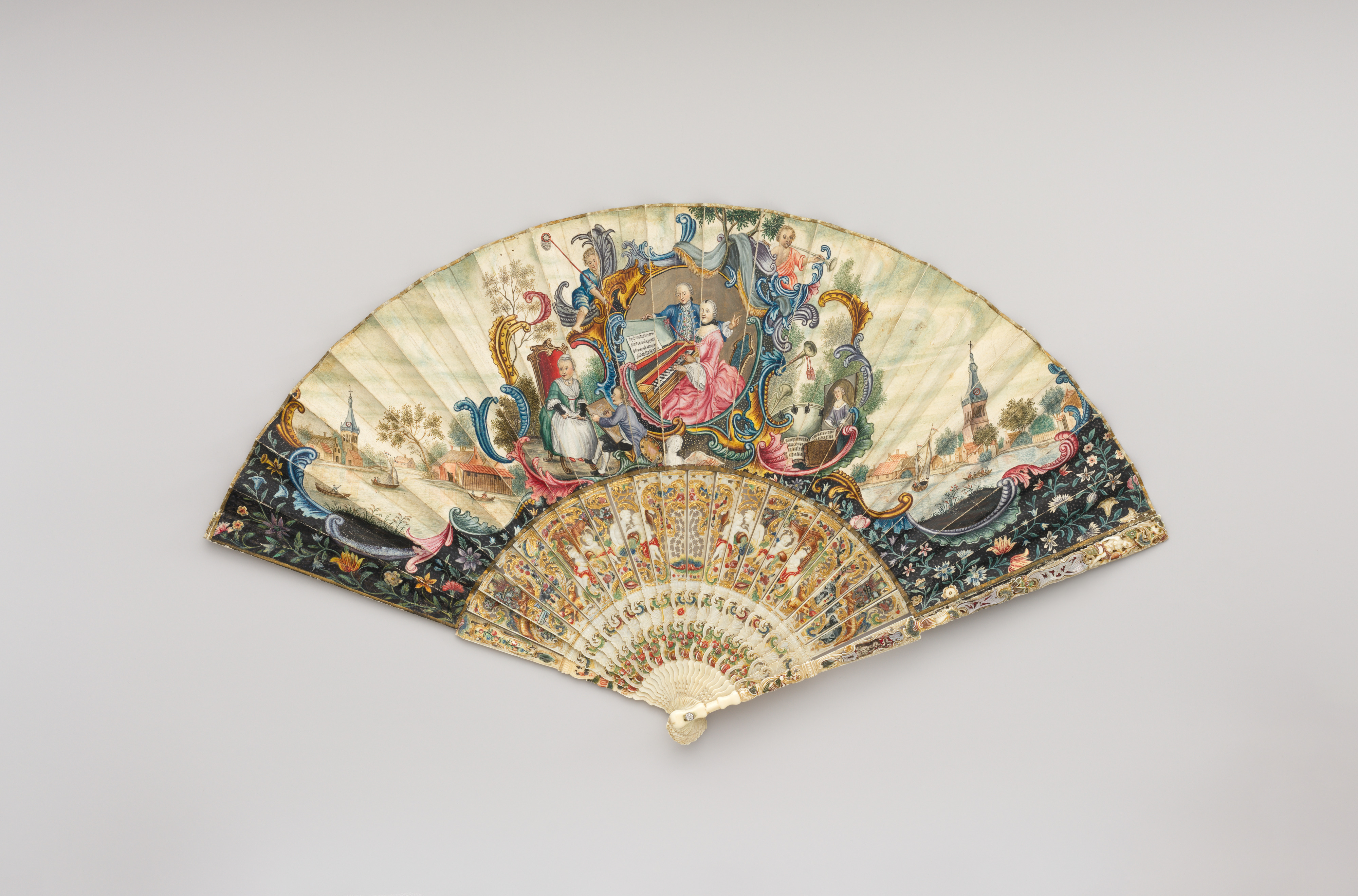
The materials specified—paper, ivory, mother-of-pearl, paint, gilt, and glass—are not arbitrary. Each element historically served as a declaration of economic and cultural capital. Ivory, sourced from distant lands, signified access to global trade networks. Mother-of-pearl, with its iridescent, nacreous surface, captured light in a way that mimicked the moon’s reflection on water, tying the bearer to aquatic deities and lunar cycles. Gilt (gold leaf) was reserved for the most sacred or royal contexts, as gold was considered the flesh of the sun. The painted panels, often executed by court artists, transformed the fan into a portable gallery of mythological scenes, botanical studies, or calligraphic poetry. The inclusion of glass, likely as decorative inlays or tiny mirrors, served a dual purpose: to deflect malevolent gazes (the evil eye) and to allow the bearer to observe others without being observed—a precursor to the modern sunglasses. For Katherine Fashion Lab, this material lexicon offers a strategic palette. The 2026 strategy should not mimic these materials but reinterpret their semiotic weight. For instance, using sustainably sourced, fossilized palm ivory or lab-grown nacre can maintain the visual prestige while aligning with modern ethical imperatives.
Spiritual Meaning: The Fan as Ritual Intermediary
Beyond social status, the fan held profound spiritual agency. In ancient China, the shan was integral to Daoist and Confucian rites. The folding fan, a later innovation, was believed to represent the unfolding of the cosmos—each rib a ray of the sun or a path of the soul. In funerary contexts, fans were placed in tombs to guide the deceased’s spirit through the underworld, their painted landscapes serving as spiritual maps. The act of fanning was also a form of prayer; the rhythmic movement was thought to disperse negative energy and invite benevolent spirits. In Mesoamerican cultures, the fan was used in rituals to honor the wind god Ehecatl, who cleared the path for rain. Thus, the fan is a liminal object, existing at the threshold between the physical and the ethereal. For Katherine Fashion Lab, this spiritual dimension offers a profound differentiation point. A 2026 luxury fan should not be marketed as a "cooling device" but as a ritual object for the modern self—a tool for mindfulness, for creating a personal sanctuary in a hyper-stimulated world. The brand can position the fan as a meditation aid, a physical anchor for breathwork, or a ceremonial object for daily intention-setting.
Historical Adornment: The Language of Gesture and Concealment
The fan’s role in historical adornment extends beyond the object itself to the choreography of the body. In the courts of Byzantium and later Renaissance Europe, the fan became a silent language. A slow, deliberate fanning indicated confidence; a rapid flutter signified agitation; placing the fan against the left cheek signaled "no." This fan language allowed women, in particular, to communicate in spaces where verbal expression was restricted. The fan was thus an instrument of subversive agency—a tool for negotiation, flirtation, and political intrigue. The materials of ivory and mother-of-pearl were not merely decorative; they were chosen for their weight and balance, allowing for precise, controlled gestures. The painted scenes often contained hidden messages—a butterfly for transformation, a rose for secret love—that only the initiated could read. For Katherine Fashion Lab, this suggests a strategic opportunity: the 2026 collection could reintroduce the concept of encoded aesthetics. Each fan could feature a unique, subtle motif—perhaps in UV-reactive ink or micro-embroidery—that only the owner understands. This creates a private narrative, a sense of exclusivity that transcends mere visual branding.
Strategic Framework for 2026: The Sovereign Accessory
To successfully integrate the fan into a 2026 high-end luxury strategy, Katherine Fashion Lab must move beyond nostalgia and embrace a neo-ritualistic design philosophy. The following strategic pillars are proposed:
Pillar One: Material Alchemy
Utilize the specified mediums—paper, ivory, mother-of-pearl, paint, gilt, glass—but re-engineer them for the modern era. Replace traditional ivory with certified Tagua nut or recycled fossilized mammoth ivory, which offers the same creamy density and carving precision without ethical compromise. Mother-of-pearl can be sourced from sustainable pearl farms, and its natural iridescence can be enhanced with a nano-coating for durability. The paper should be a handmade, cotton-based kozo or washi paper, chosen for its strength and ability to hold pigment. The gilt should be applied using a cold-gilding technique to reduce energy consumption, while the glass can be integrated as tiny, polished obsidian or sapphire cabochons, adding a tactile, jewel-like quality.
Pillar Two: The Ritual of Unfolding
The 2026 consumer craves experiences, not just products. The fan’s folding mechanism offers a unique tactile ritual. The Lab should design the fan’s opening to produce a specific, satisfying click or whisper—an acoustic signature that signals the transition from the mundane to the personal. The packaging should be a rigid, cloth-covered case with a magnetic closure, designed to be kept on a desk or altar, not hidden in a drawer. The fan itself should be accompanied by a small, leather-bound booklet explaining its symbolic motifs and the ancient cultures that inspired them, transforming the purchase into an educational and spiritual journey.
Pillar Three: The Language of Air
Branding should emphasize the fan’s ability to curate personal atmosphere. Marketing copy should avoid words like "cooling" or "accessory" and instead use terms like "atmospheric sovereignty," "a portable sanctuary," and "an instrument of presence." The 2026 campaign could feature short films of the fan being used in various settings—a boardroom, a desert landscape, a minimalist apartment—each time demonstrating how the fan creates a visible, physical boundary between the bearer and the environment. The fan becomes a symbol of controlled energy, a tool for those who refuse to be passive recipients of the world’s chaos.
Pillar Four: Limited Hermetic Editions
To maintain exclusivity, each fan should be produced in limited editions of no more than 100 pieces, each individually numbered and signed by the artisan. The painted panels should be commissioned from contemporary artists who work in the style of ancient miniature painting, ensuring that each piece is a unique work of art. The price point should reflect this: not a mere accessory, but a collectible artefact with potential appreciation value. The Lab can also offer a "commissioning service" where clients can request a custom fan with personal iconography, reviving the ancient practice of the personalized court fan.
Conclusion: The Fan as Future Heirloom
The fan, in its ancient context, was never merely an object; it was a condensed expression of power, spirituality, and personal agency. For Katherine Fashion Lab, the fan offers a strategic vehicle to differentiate in a saturated luxury market. By honoring the material integrity and symbolic depth of the original artefacts, while reimagining them for contemporary ethics and aesthetics, the Lab can create a product that is not only beautiful but deeply meaningful. The 2026 fan should be positioned as an heirloom for the future—an object that carries the weight of history while being utterly of its time. In a world of disposable trends, the fan stands as a testament to the enduring power of crafted, intentional, and symbolic adornment. It is time to reclaim the fan as a sovereign artefact, and Katherine Fashion Lab is uniquely positioned to lead this renaissance.