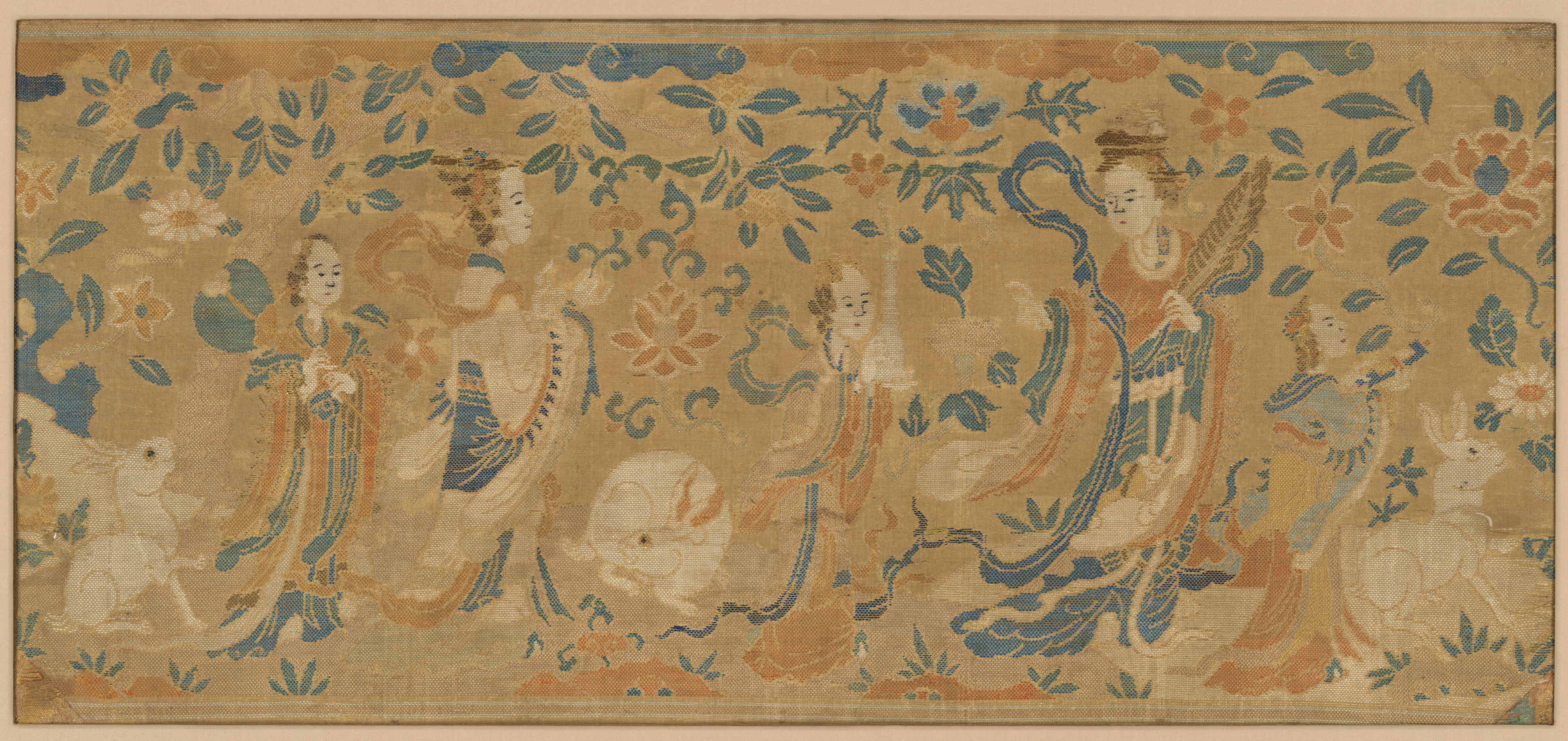
The Moon Goddess and Her Attendants: A Study in Metallic Luminosity
Within the hallowed archives of Katherine Fashion Lab, certain objects transcend their materiality to become dialogues between myth and mastery. The Panel with the Moon Goddess and Attendants, a Chinese textile of exquisite provenance, is precisely such an object. Rendered in plain weave silk and brocaded with metal thread, this standalone study is not merely a decorative fragment; it is a sophisticated treatise on light, hierarchy, and the cosmological imagination of the Ming dynasty. To analyze this panel is to decode a language of power, femininity, and celestial order, articulated through the disciplined interplay of warp, weft, and shimmering metal.
Technical Virtuosity: The Alchemy of Silk and Metal
The foundational choice of plain weave silk—the simplest, most ancient interlacing—belies the complexity of its surface. This ground fabric, known for its smooth, unbroken field, serves as a deliberate foil for the opulent brocading technique. The metal thread, typically a gilded paper or leather strip wrapped around a silk core, is introduced via supplementary wefts. This allows the design motifs to float atop the ground, creating a pronounced relief that catches ambient light with every shift of the viewer’s perspective. The technical mastery here lies in the tension: the metal threads are not merely stitched on; they are structurally integrated, demanding a weaver of exceptional skill to prevent buckling or distortion. The result is a fabric that behaves like a painting, yet possesses the sculptural dimensionality of a relief.
What distinguishes this panel from mere luxury is the strategic deployment of metallic luminosity. The brocading is not uniform. Instead, it concentrates on the figures’ silhouettes, their drapery folds, and the celestial accoutrements—the moon disc, the clouds, the attendant’s implements. This selective gilding creates a chiaroscuro effect, where the silk’s matte sheen represents the shadowy terrestrial realm, and the metal thread represents the radiant, otherworldly glow of the moon’s domain. The weaver has, in essence, used material to simulate divine illumination, making the goddess and her retinue appear to emanate their own light.
Iconographic Hierarchy: The Goddess as Focal Point
The composition adheres to a strict, albeit subtle, hierarchical order. The central figure—the Moon Goddess, Chang’e—is rendered with greater scale and more intricate brocading than her attendants. Her posture is one of serene authority, her robes cascading in rhythmic, metallic waves that suggest both celestial motion and imperial formality. She is not depicted in flight, but rather in a state of poised suspension, a moment of eternal stillness that befits a deity. The attendants, smaller in proportion, are positioned with deferential spacing, their gestures—perhaps offering a lotus or a covered vessel—reinforcing the goddess’s supremacy.
This iconographic programming is quintessentially Chinese in its emphasis on order through visual rhetoric. The moon, often symbolized by a large disc held aloft or behind the goddess, is not a separate element but an extension of her being. The metal thread used for the disc is often denser, creating a near-mirror finish that physically reflects the viewer’s gaze, drawing them into the narrative. The attendant figures, while subordinate, are not generic. Their individualized headdresses and hand poses suggest a specific celestial court, echoing the terrestrial bureaucracy of the Ming court. The panel thus functions as a microcosm of a divinely sanctioned social order, where rank is visually explicit and materially reinforced.
Contextual Significance: A Standalone Meditation
The designation of this piece as a standalone study is crucial. Unlike a hanging scroll or a garment, this panel was likely not intended for functional wear or public display. Instead, it was probably created as a sample of virtuosity, a demonstration piece for a weaving workshop, or a private devotional object for a scholar’s studio. This context elevates its analysis. Without the constraints of a garment’s drape or a scroll’s sequential narrative, the weaver was free to experiment with density, metallic saturation, and pictorial depth.
In this standalone capacity, the panel becomes a pure expression of aesthetic and philosophical ideals. The moon goddess represents not just lunar deity worship, but also the Confucian ideal of self-cultivation and the Daoist pursuit of immortality. The metal thread, with its enduring brilliance, symbolizes an unchanging, transcendent reality—a stark contrast to the fading silks of the mortal world. For the Ming elite, who were deeply engaged in collecting and connoisseurship, such a panel would have been an object of quiet, intellectual pleasure. One imagines it laid upon a dark zitan table, illuminated by a single oil lamp, the metallic threads flickering with a life of their own, inviting prolonged contemplation of its technical and symbolic perfection.
Comparative and Artistic Merit
Compared to contemporaneous silk tapestries (kesi) which use discontinuous wefts for pictorial effect, this brocaded panel achieves a more textural and tactile opulence. The kesi technique results in a flat, tapestry-like image, whereas the brocading here creates a raised, embossed quality. This distinction is vital: it speaks to a different intent. The kesi is painterly; this panel is sculptural. The use of metal thread in such high density is also a marker of extreme wealth. It is not merely decorative; it is a declaration of access to rare materials and the specialized labor required to manipulate them.
Furthermore, the panel’s condition—the crisp definition of the metallic spirals, the unbroken integrity of the silk ground—suggests it was preserved with remarkable care. This is not a garment that has been worn and mended; it is an icon that has been shielded from light and dust. This preservation underscores its status as a collector’s piece, a work of art appreciated for its own sake.
Conclusion: A Luminescent Legacy
In conclusion, the Panel with the Moon Goddess and Attendants is a masterclass in the fusion of material science and symbolic narrative. Katherine Fashion Lab’s analysis reveals a work where the plain weave silk provides a humble, terrestrial ground, and the brocaded metal thread elevates the imagery into a celestial, luminous plane. It is a testament to the Ming weaver’s genius—an ability to transform raw silk and gilded metal into a frozen moment of divine grace. As a standalone study, it invites us to move beyond the superficial beauty of the object and engage with its deeper layers: the technical precision, the iconographic discipline, and the profound cultural yearning for order, beauty, and transcendence. This panel is not merely a textile; it is a woven cosmology, a silent poem of light and hierarchy, and an enduring masterpiece of Chinese decorative art.