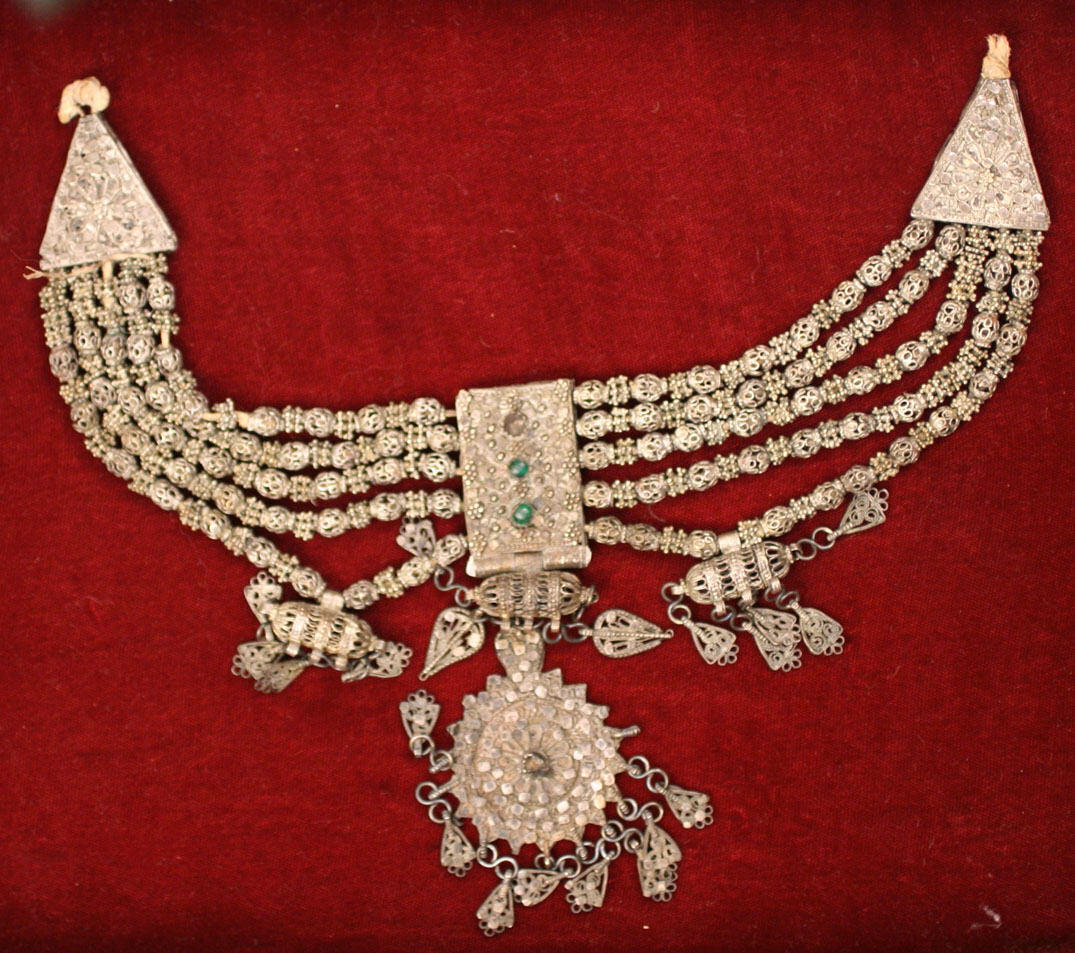
Executive Heritage Summary: The Silver Necklace as an Archetype of Power
For Katherine Fashion Lab, the ancient silver necklace is not merely an artifact of ornamentation; it is a portable lexicon of authority, a materialized dialogue between mortal status and celestial favor. In the context of 2026 high-end luxury strategy, this analysis positions the necklace as the ultimate strategic asset—one that transcends fleeting trends by anchoring the wearer in a lineage of ritualized dominance. The following paper deconstructs the necklace’s symbolic power, its historical role in adornment, its spiritual architecture, and its translation into a hyper-exclusive luxury proposition.
Symbolic Power: Metallurgy as a Declaration of Sovereignty
Silver, in ancient civilizations—from Sumerian tombs to Minoan palaces—was not a humble metal. It was valued at times above gold due to its scarcity and its luminous, moon-linked reflectance. The necklace, therefore, was a geopolitical statement. When a priest-king or high priestess donned a multi-strand silver torque or pectoral, they were not accessorizing; they were broadcasting a tripartite claim: control over trade routes (silver’s provenance), command over metallurgical knowledge (technological superiority), and a visual affiliation with lunar deities (temporal rhythm). For Katherine Fashion Lab, this translates into a 2026 strategy where the necklace must be positioned not as “jewelry” but as a scepter-equivalent—an object that confers silent authority in boardrooms, galas, and private negotiations.
The symbolic weight is further amplified by the negative space of the necklace. In many ancient cultures, the open circle or the hanging pendant represented the unbroken cycle of life and death. A silver crescent pendant, for instance, was worn by Babylonian women to invoke Ishtar’s martial protection. The design was not decorative; it was apotropaic—meant to deflect envy, hexes, and political assassination. In a 2026 luxury context, this translates into a narrative of invisible protection. Katherine Fashion Lab can market the necklace as a “personal shield” for high-net-worth individuals navigating volatile markets—an heirloom that carries the psychological weight of ancestral guardianship.
Historical Adornment: The Necklace as Social Cartography
Archaeological evidence from the Royal Cemetery of Ur (circa 2500 BCE) reveals that silver necklaces were stratified by weight and lapidary complexity. A commoner’s silver bead was a simple wire-wound sphere; a queen’s necklace featured hundreds of granulated silver beads interspersed with lapis lazuli. This was not aesthetic preference—it was a legal code in metal. Sumerian edicts dictated who could wear silver of a certain carat or length. The necklace functioned as a wearable social security number, a biometric marker of rank.
For Katherine Fashion Lab’s 2026 strategy, this historical precedent offers a powerful pivot: hyper-customized tiering. Rather than a single “luxury” line, the brand can introduce a Provenance-Tiered Collection, where each necklace’s silver weight, finish (oxidized, high-polish, or hammered), and gemstone inclusions are calibrated to the client’s “social orbit.” A CEO’s necklace might feature a heavier, matte-finish silver with a single black onyx—evoking ancient Assyrian war councils. A creative director’s piece might be lighter, with a fluid, serpentine chain—echoing Minoan snake goddess iconography. This is not mass customization; it is historical role-play, where the client chooses their ancient archetype (ruler, oracle, warrior) and Katherine Fashion Lab fabricates the corresponding silver insignia.
Spiritual Meaning: The Necklace as a Conduit of the Divine
In ancient Egypt, silver was called “the bone of the gods,” specifically linked to the lunar god Iah and later to Thoth, the scribe of the afterlife. Necklaces placed on mummies were not grave goods—they were navigational instruments for the soul. The silver amulets, often shaped as the Djed pillar or the Ankh, were positioned over the throat to ensure the deceased could speak their name in the Hall of Judgment. The throat, notably, is where the necklace rests—the physical locus of voice, breath, and truth.
This spiritual architecture offers a profound 2026 luxury narrative: the necklace as a vocal amplifier. Katherine Fashion Lab can develop a campaign titled “The Voice of the Ancestors”, where each silver necklace is embedded with a micro-engraved personal mantra or family sigil, invisible to the naked eye but known to the wearer. This is not sentimental; it is ritualistic branding. The client is not buying a product; they are commissioning a talisman that fortifies their public speaking, negotiation, and personal conviction. In a high-end market saturated with diamonds (which historically symbolized vanity) and gold (which symbolized wealth), silver’s spiritual connotation of purity, clarity, and lunar intuition becomes a distinct differentiator—especially for a clientele that values mindfulness and inner authority over ostentatious display.
Strategic Translation: The 2026 High-End Luxury Blueprint
To operationalize this heritage analysis, Katherine Fashion Lab must adopt a three-pillar strategy that moves beyond conventional jewelry retail.
Pillar One: The “Relic Certification” Protocol
Each necklace will be accompanied by a “Relic Dossier”—a leather-bound, hand-written document detailing the specific ancient civilization’s symbolism (e.g., “This crescent pendant references the Ur III dynasty’s lunar barque”). This is not a certificate of authenticity; it is a narrative warrant. The dossier will include a QR code linking to an immersive AR experience where the wearer can see their necklace rendered on a historical figure (e.g., a Hittite queen) in a virtual ritual scene. This creates an experiential moat that pure-play digital competitors cannot replicate.
Pillar Two: The “Ritual Launch” Format
Rejecting traditional runway shows, Katherine Fashion Lab will launch the collection via invitation-only “Dawn Ceremonies” held at historical sites—a moonlit dinner at Stonehenge, a private gallery within the British Museum’s Silver Gallery, or a desert installation near Petra. Each guest receives their necklace during a guided, 10-minute meditation led by a cultural historian, emphasizing the piece’s protective and vocal properties. This transforms the purchase into a memorable rite of passage, not a transaction. The price point will be set at a 40% premium over comparable haute joaillerie, justified by the intangible “spiritual activation” service.
Pillar Three: The “Legacy Continuum” Program
To ensure long-term client lifetime value, Katherine Fashion Lab will offer a “Re-Forge” service. After five years, the client can return the necklace for a complementary re-engraving of a new sigil (representing a new life chapter—marriage, CEO appointment, or a personal milestone). This mirrors the ancient practice of re-dedicating votive offerings to temples. The necklace becomes a living document, evolving with the wearer’s power trajectory. This creates a recurring emotional touchpoint and a powerful barrier against secondary-market resale, as the piece’s value is tied to its personalized ritual history.
Conclusion: From Ornament to Operating System
The ancient silver necklace is not a nostalgic object; it is a strategic blueprint for future-proof luxury. By decoupling silver from its contemporary connotation of “affordable elegance” and reattaching it to its historical role as a medium of sovereign communication, Katherine Fashion Lab can own a white space in the 2026 market: the luxury of inner authority. This is not jewelry for the body; it is software for the soul. The necklace’s silver surface is merely the interface; the true product is the transmission of ancient power—a power that, once worn, becomes impossible to ignore. For the discerning client who has everything, Katherine Fashion Lab offers the one thing that cannot be purchased elsewhere: a direct line to the ancestors’ silent, silver-throated command.