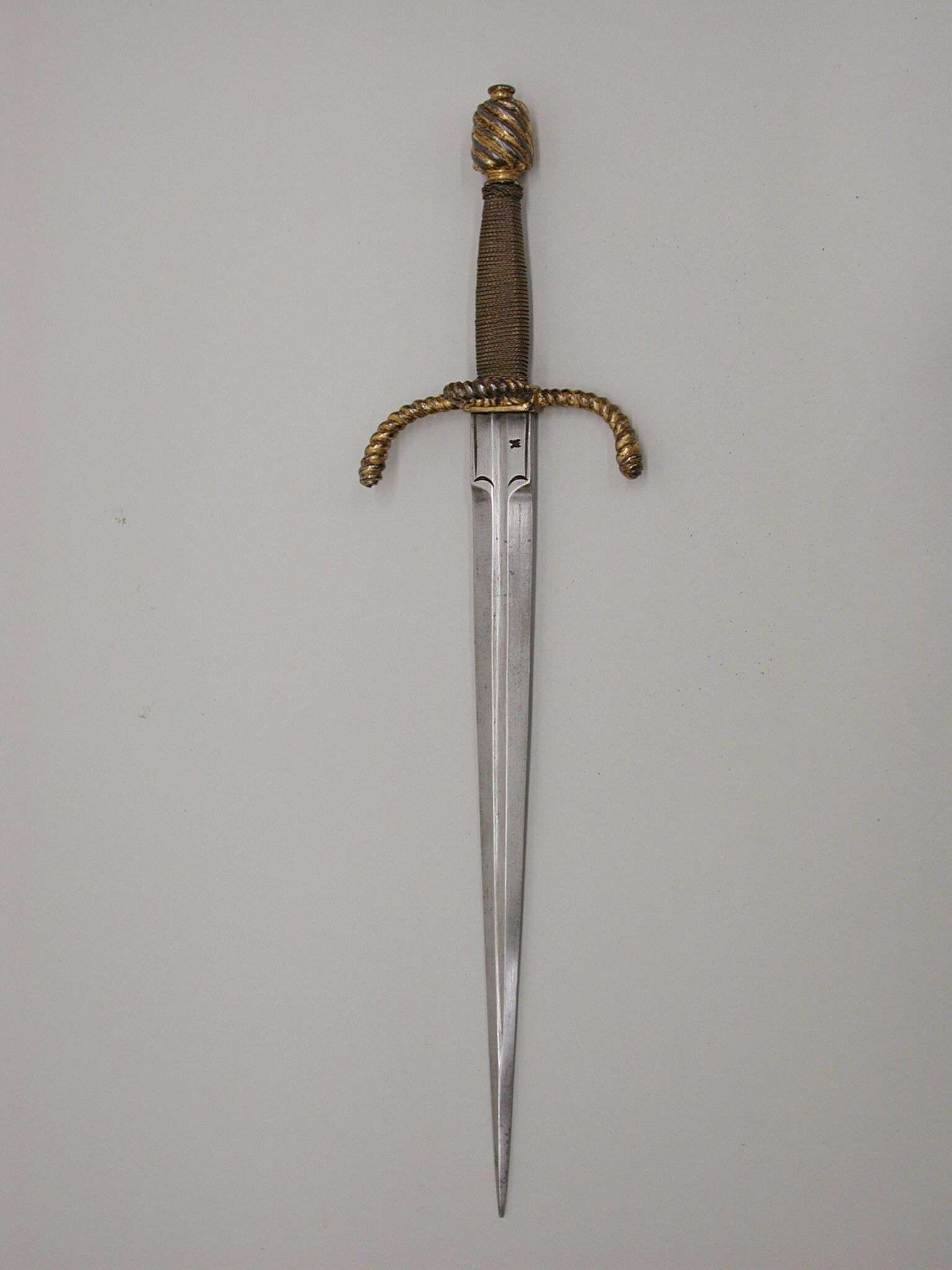
The Rapier and Parrying Dagger: A Study in Architectural Adversity
Within the hallowed archives of Katherine Fashion Lab, we rarely encounter an artifact that so purely embodies the concept of functional couture as the German rapier with its Spanish Toledo blade, accompanied by its parrying dagger. This is not a garment, but it is undeniably a construction of dress—a statement of identity, status, and lethal intent, tailored to the precise measurements of a gentleman’s hand and the unforgiving geometry of a duel. This standalone study dissects the piece not as a weapon, but as a masterclass in material contrast, ergonomic design, and the semiotics of personal defense in the late 16th century.
Material Dialogues: Steel, Gold, and the Tactile Grip
The immediate visual impact of this ensemble is a study in dichotomies. The rapier’s blade, forged in the legendary foundries of Toledo, is a ribbon of cold, grey steel—a testament to Spanish metallurgical supremacy. Its surface, when caught in the light, reveals subtle ripples of pattern welding, a whisper of the blade’s violent potential. In stark opposition, the hilt—the architectural heart of the piece—is a German interpretation of complex guard, a basket of interwoven steel bars, gilded with gold. This is not mere ornamentation; it is a deliberate visual strategy. The gold is a declaration of wealth, a shimmering armor for the hand that simultaneously signals the wearer’s elevated social station and his readiness to defend it.
Yet, the true genius of the design lies in the tactile elements. Beneath the gilded steel, the grip is a composite of wood, wrapped in copper wire, and finished with velvet. This is where the couture analogy becomes most potent. The copper wire, wound in a tight, spiral pattern, is not decorative. It is a textile engineering solution, providing a non-slip surface that absorbs sweat and ensures a firm, consistent hold even when the hand is slick with exertion. The velvet, likely a deep crimson or black, now faded with age, serves as a cushioning layer between the hard wood and the palm, preventing blisters and offering a soft, tactile contrast to the cold metal. It is a bespoke fitting, a glove-like interface between human flesh and lethal steel. In the language of high fashion, this is the difference between a ready-to-wear garment and a couture piece—the latter is built around the body, anticipating its every movement and pressure point.
The Parrying Dagger: A Counterpoint in Design
The companion parrying dagger, often referred to as a left-hand dagger, is not a secondary weapon but a co-equal protagonist in this narrative of defense. Its design is a direct response to the rapier’s length. Where the rapier is a tool of extension, the dagger is a tool of deflection. Its blade is shorter, broader, and often features a complex, swept hilt that mirrors the rapier’s guard but on a more compact scale. The key innovation is the broad, flat quillons—the crossguard—which are designed not just to protect the hand but to catch and trap the opponent’s blade.
In this specific ensemble, the dagger’s grip mirrors the rapier’s exactly: the same copper wire winding, the same velvet base. This is a critical detail. It ensures that the fighter’s muscle memory is consistent; the feel of one weapon is identical to the other. From a couture perspective, this is the creation of a collection, a cohesive line where every piece shares a common design language. The dagger is the perfect accessory, not an afterthought but an integral component of a unified system. The visual rhyme of the two hilts, one large and one small, creates a sense of balance and intentionality, a sartorial symmetry that speaks to a meticulously curated personal arsenal.
Ergonomics as Couture: The Tailored Defense
To truly analyze this piece, one must consider the ergonomic choreography it demands. The rapier is a thrusting weapon, requiring a specific hand position—the index finger often extended over the quillon for increased point control. The gilded guard is therefore not a simple cage; it is a sculpted architecture with loops and spaces designed to accommodate this finger, protecting it without restricting its movement. The balance point of the weapon, located just above the guard, is a result of the heavy hilt counteracting the long blade. This balance is the weapon’s fit—it must feel like an extension of the arm, not a separate tool. A poorly balanced rapier is akin to a suit with ill-fitting shoulders; it hampers movement and telegraphs intent.
The parrying dagger, held in the off-hand, is held in a forward, defensive position. Its design allows for rapid, short parries that redirect the opponent’s thrust. The velvet on its grip is crucial here; it provides a softer, more sensitive touch, allowing the fighter to feel the opponent’s blade through the steel, to sense the pressure and direction of the attack. This is the ultimate form of tactile communication, a silent dialogue between two fighters mediated by their couture. The materials are not passive; they are active participants in the duel, transmitting information and facilitating a response.
Conclusion: An Enduring Statement of Power
In conclusion, the rapier and parrying dagger from Katherine Fashion Lab’s collection is far more than a historical weapon. It is a masterpiece of applied design, where metallurgy, ergonomics, and material science converge to create an object of profound beauty and deadly function. The juxtaposition of Toledo steel and German gold, the pragmatic embrace of copper and velvet, and the meticulous mirroring of the two grips all speak to a level of craftsmanship that rivals any haute couture gown. It is a standalone study in how dress—in its most expansive definition—can be a tool of both self-expression and self-preservation.
This ensemble is a testament to an era where a gentleman’s worth was measured not only by his lineage but by his ability to project an image of controlled, elegant violence. The gold and velvet whisper of courtly refinement, while the steel and copper scream of readiness. It is a garment of war, tailored to perfection, and it remains a powerful, silent commentary on the inextricable link between how we adorn ourselves and who we aspire to be. The hand that wore this was a hand that understood that true style is not just about appearance, but about the confident, deliberate mastery of one’s own narrative.