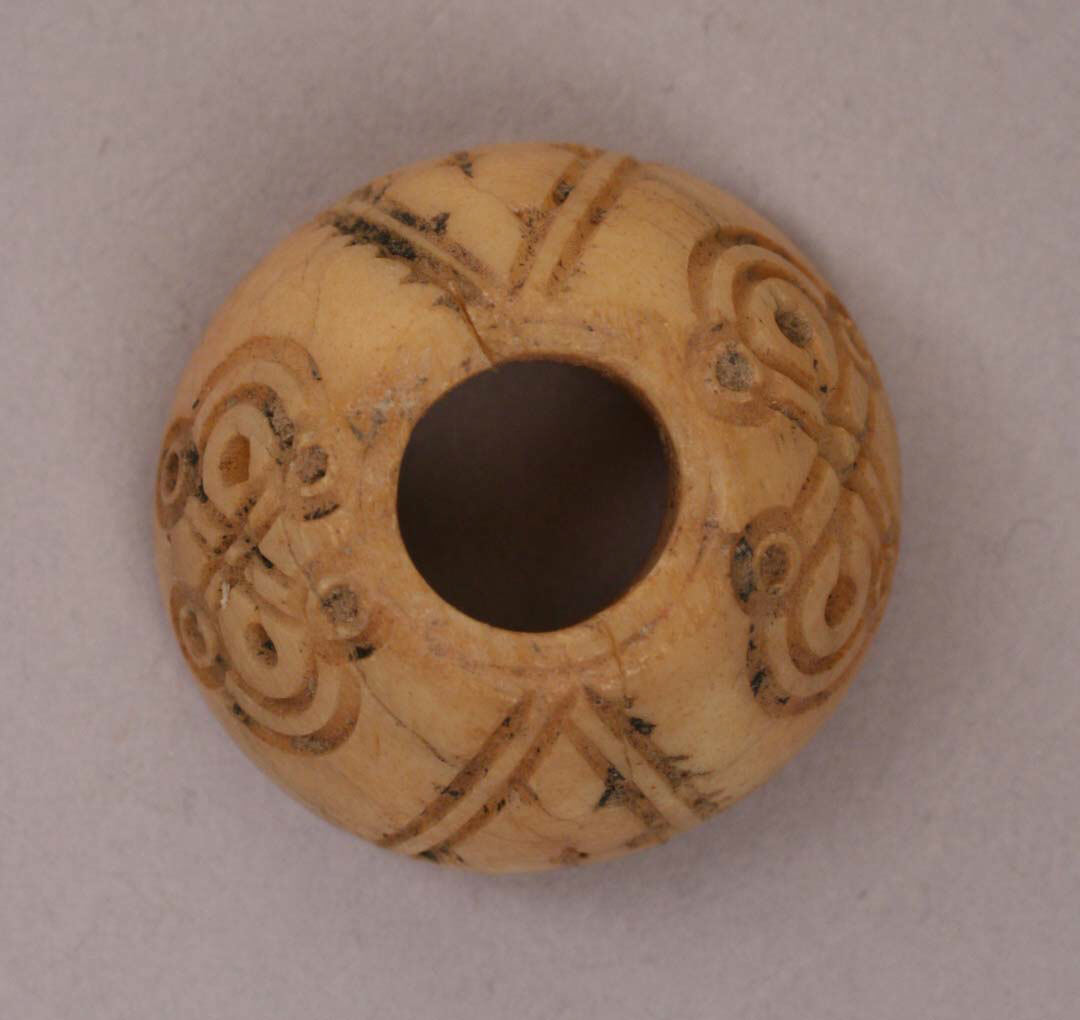
Executive Heritage Analysis: The Bone Spindle Whorl as a Paradigm of Feminine Power and Proto-Luxury Craft
In the rarefied echelons of contemporary luxury, where narrative authenticity is the ultimate currency, the artifacts of ancient civilizations offer more than mere aesthetic inspiration; they provide a foundational lexicon of power, creation, and spiritual resonance. For Katherine Fashion Lab, the strategic examination of a Bone Spindle Whorl—incised and inlaid with pigment—from an ancient civilization presents a compelling opportunity. This object, ostensibly a utilitarian tool, is in fact a profound repository of symbolic power and historical adornment. Its translation into a 2026 high-end luxury strategy demands a sophisticated understanding of its dual nature: as a mechanism of economic agency and as a talisman of cosmic order.
Materiality and Craft: The Alchemy of Bone and Pigment
The choice of bone as the primary medium is semantically rich. Unlike stone or metal, bone is a living material that has undergone a transformation from the organic to the eternal. In ancient cosmologies, bone represented the seat of the soul, the enduring structure of existence that survives the decay of flesh. By shaping this durable substance into a whorl, the artisan imbued the object with a permanence that transcended the transient nature of textile production. The incised patterns, often geometric or totemic, were not merely decorative; they were a form of proto-writing, encoding clan identities, protective invocations, or astronomical observations. The subsequent inlay of paint—often cinnabar, ochre, or azurite—activated these incisions, creating a chromatic contrast that would have shimmered in the flickering light of domestic hearths or ceremonial spaces. For a modern luxury house, this materiality signals a move away from sterile minimalism toward a tactile, narrative-driven opulence.
Symbolic Power and Spiritual Meaning: The Whorl as Microcosm
To the uninitiated, the spindle whorl is a simple weight. To the archaeologist and cultural semiotician, it is a microcosmic axis mundi. The act of spinning—drawing out fibers and twisting them into thread—was a profound metaphor for creation itself. The whorl’s rotation, its gyroscopic stability, mirrored the celestial spin of the heavens. In many ancient civilizations, from the Andean puchka to the Neolithic European whorls, this tool was intrinsically linked to goddesses of fate and destiny. The spinner did not merely make cloth; she wove the fabric of life, controlling the threads of birth, existence, and death. This imbues the object with a spiritual meaning rooted in agency—specifically, female agency. In a patriarchal historical record, the whorl stands as a testament to the economic and ritual power held by women. Textiles were often the primary currency of ancient economies, and the woman who controlled the spindle controlled wealth, alliance, and social narrative.
Furthermore, the incised pigment patterns often held apotropaic functions. They were designed to ward against evil spirits, ensuring that the cloth produced would carry protective properties for its wearer. This concept of embedded protection is a powerful narrative for modern luxury, where clients increasingly seek garments that feel like armor—not just physically, but psychologically and spiritually. The whorl, therefore, is not a passive artifact; it is an active agent of blessing and defense.
Historical Adornment: From Utilitarian Tool to Status Object
While the whorl was functional, its elaborate decoration elevates it into the realm of historical adornment. The investment of time and skill required to carve and inlay a tool that would be hidden during use suggests that its visibility was not the primary function. Rather, it was a private luxury—an object of personal pride and intimate significance. The whorl was often passed down through matrilineal lines, becoming a heirloom that carried the memory of ancestors. This challenges the modern luxury paradigm that equates status with external display. The ancient whorl suggests a sophisticated appreciation for interiority—a value system where the beauty of an object is a private conversation between the maker, the user, and the divine. This is the ultimate form of quiet luxury, predating the contemporary trend by millennia. For Katherine Fashion Lab, this reframes the concept of the "hidden detail" as not just a design trick, but a philosophical stance.
Strategic Application for 2026: The “Fate & Fiber” Collection
Translating this dense cultural matrix into a 2026 high-end luxury strategy requires a multi-layered approach that eschews superficial appropriation in favor of deep, structural homage. The strategy can be articulated across three verticals: Design Language, Material Provenance, and Ritualistic Engagement.
Design Language: The Geometry of Destiny
The incised geometric patterns of the whorl—concentric circles, spirals, and chevrons—should be abstracted and applied to garment construction, not just surface print. We propose developing a proprietary jacquard weave that replicates the tactile relief of the incisions. The color palette should draw from the mineral pigments used: bone-white, cinnabar red, and deep azurite blue. Crucially, the design language must incorporate the concept of motion. Just as the whorl spins, the garments should feature bias-cut panels or spiral seams that create a kinetic energy as the wearer moves, evoking the eternal rotation of the spindle. This moves the aesthetic from static decoration to dynamic symbolism.
Material Provenance: The New Bone Standard
Given ethical considerations, the use of actual bone is problematic in a modern luxury context. The 2026 strategy pivots to bio-fabricated alternatives and upcycled pre-consumer bone waste from the food industry, processed into a durable, ivory-like composite. This material would be used for signature hardware—buttons, toggles, and belt buckles—that serve as the modern equivalent of the whorl. Each piece of hardware would be individually incised with a unique geometric code, referencing the original artifact’s function as a marker of identity. This creates a collectible aspect, where the hardware becomes the heirloom element, detachable and transferable between garments, mirroring the whorl’s portability and legacy.
Ritualistic Engagement: The Spinner’s Circle
To activate the spiritual meaning, Katherine Fashion Lab will launch an exclusive client experience titled “The Spinner’s Circle.” This is not a standard trunk show; it is a curated workshop where clients are invited to spin a single thread using a replica of the ancient whorl, guided by textile historians. This thread is then woven into a discreet label inside their bespoke garment. This ritual transforms the purchase from a transaction into a rite of passage. The client becomes an active participant in the creation narrative, connecting her personal energy to the protective symbolism of the artifact. This experiential strategy addresses the 2026 luxury consumer’s desire for meaning, scarcity, and participation, positioning the garment not merely as clothing, but as a personal talisman of destiny.
Conclusion: Reclaiming the Feminine Axis
The bone spindle whorl is a masterclass in the fusion of function and metaphysics. It demonstrates that true luxury is not about the volume of material, but the density of meaning. By adopting this artifact as a strategic keystone, Katherine Fashion Lab can lead the 2026 market with a narrative that is both intellectually rigorous and emotionally resonant. The whorl offers a blueprint for a luxury that is quietly powerful, deeply protective, and eternally feminine. It is not a relic of the past, but a compass for a future where the act of creation is once again revered as the highest form of wealth.