The Sacred Silhouette: Deconstructing the Daoist Ritual Robe
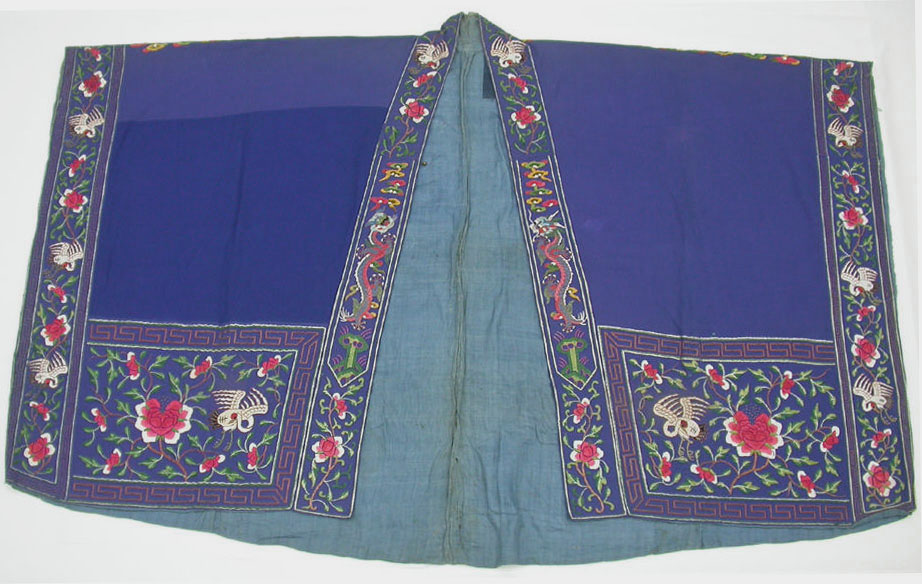
In the annals of fashion history, few garments carry the weight of cosmological significance as profoundly as the Daoist priest’s ritual robe, or *jiangyi*. At Katherine Fashion Lab, our standalone analysis of a late-Qing dynasty example—crafted from a lustrous silk ground and reinforced with a woolen interior—transcends mere aesthetic appreciation. This is not a garment of passive adornment; it is a wearable cosmological map, a liturgical instrument engineered for the transcendence of the mundane. The robe’s construction, iconography, and materiality offer a masterclass in how fashion operates as a system of encoded knowledge, long before the advent of the Western fashion system.
Material Dialectics: Silk’s Luminescence and Wool’s Earthly Anchor
The primary textile—a tabby-weave silk—serves as the luminous canvas upon which the celestial drama unfolds. Silk’s inherent refractive quality, its ability to catch and scatter light, is not accidental. In Daoist praxis, light is synonymous with *qi*, the vital life-force that animates the cosmos. The robe’s surface, therefore, is designed to shimmer during ritual performance, catching candlelight and incense smoke to create an aura of divine presence. This is a deliberate manipulation of material physics to achieve a metaphysical effect.
Conversely, the woolen lining presents a fascinating counterpoint. Wool, with its hygroscopic properties and thermal insulation, grounds the garment in the physical realm. It absorbs the priest’s perspiration and regulates body temperature during extended ceremonies, ensuring the wearer’s physical comfort does not disrupt spiritual focus. More subtly, wool’s matte, dense texture acts as an acoustic and tactile buffer, creating a sensory boundary between the priest’s body and the silk’s sacred exterior. This dialectic—luminous silk for the divine gaze, humble wool for the mortal body—articulates the Daoist principle of *yin* and *yang* in material form: the ethereal and the terrestrial coexisting in a single, functional object.
Iconographic Sovereignty: The Crane as Ascendant Messenger
The robe’s iconographic program is dominated by the red-crowned crane (*Grus japonensis*), embroidered in counted-thread silk floss and couched gold-wrapped threads. In Daoist iconography, the crane is not merely a bird; it is the mount of immortals, a psychopomp that ferries the soul between the earthly plane and the celestial realms. The cranes here are depicted in dynamic flight, wings fully extended, often paired with swirling clouds and the eight trigrams (*bagua*). Each crane’s placement is deliberate: a central crane on the back, aligned with the wearer’s spine, acts as the primary conduit for spiritual ascent. Smaller cranes encircle the shoulders and hem, creating a rotational energy field that visually propels the priest upward.
Critically, the cranes are not rendered in naturalistic, static poses. They are stylized, with exaggerated wing curvature and elongated tail feathers that merge into arabesques of cloud vapor. This is a conscious distortion of avian anatomy to serve a symbolic purpose: the bird is not flying; it is dissolving into the *dao*, the primordial void. The embroidery technique itself—utilizing split stitches for the body and Peking knots for the eyes—creates a tactile relief that invites both visual and haptic contemplation. The robe does not simply depict cranes; it embodies the act of ascension, making the priest a living, breathing avatar of the crane’s spiritual trajectory.
Structural Theology: The Robe as Architectural Cosmos
Beyond surface imagery, the robe’s cut and construction reveal a profound structural theology. The garment is cut in a cruciform shape, with wide, flowing sleeves that extend to the fingertips when the arms are outstretched. This silhouette is not a matter of stylistic whimsy; it is a direct reflection of the cosmos as conceived in early Daoist texts. The horizontal axis—from sleeve tip to sleeve tip—represents the earthly plane, the realm of human affairs. The vertical axis—from the collar to the hem—represents the celestial axis, the path of spiritual ascent. When the priest spreads his arms during the *bùxū* (pacing the void) ritual, he physically enacts the intersection of these two axes, becoming the central pillar that connects heaven and earth.
The robe’s front opening, secured by a simple fabric knot rather than metal buttons, is another point of significance. The absence of metal is a deliberate adherence to Daoist precepts against ostentation and the use of sharp, metallic objects near the body’s energy centers. The knot itself—often a “ruyi” (as-you-wish) knot, shaped like a scepter—is a talismanic closure, sealing the priest’s energy field against malevolent influences. The deep side slits, reaching to the waist, are not merely functional for movement; they allow the inner robe and the priest’s own body to become visible during ritual prostrations, symbolizing the vulnerability and openness required for divine communion.
Chromatic Hierarchy and the Politics of Color
The robe’s ground color—a deep, undyed ecru or a muted indigo—is equally instructive. Unlike the imperial yellow reserved for the emperor or the bright red of festive garments, the Daoist ritual robe often employs darker, earth-derived tones. This chromatic choice signals a rejection of worldly hierarchy in favor of a cosmological one. The ecru silk, unbleached and unadorned except for the embroidery, speaks to the Daoist ideal of *pu* (the uncarved block)—a state of primal simplicity that precedes worldly complexity. The embroidery, however, introduces gold and jewel tones, creating a tension between the humble ground and the resplendent motif. This tension is the essence of Daoist ritual dress: the priest is simultaneously a humble servant and a magnificent intermediary, a paradox resolved through the garment’s dual coding.
Furthermore, the placement of specific colors follows a strict logic. The cranes’ red crowns—a single, precise dot of crimson—are the only instances of pure, saturated red on the garment. Red, in Daoist color theory, is associated with the fire element and the heart, the seat of the spirit (*shen*). By isolating this color to the crane’s crown, the robe directs the viewer’s eye to the bird’s highest point, reinforcing the message of transcendence. The surrounding clouds are rendered in shades of blue and green, evoking water and wood elements—cooling, grounding forces that balance the fire of the cranes. This is not decorative color theory; it is applied alchemy, using chromatic relationships to harmonize the five elements within the wearer’s aura.
Conclusion: A Paradigm for Contemporary Couture
For the contemporary fashion scholar, this Daoist ritual robe offers a startlingly relevant paradigm. In an era where fashion is often reduced to surface-level signifiers and rapid consumption, this garment demands a slower, more contemplative reading. It demonstrates that true couture—whether in 18th-century Paris or 19th-century China—is fundamentally a system of deep coding, where every stitch, every fiber, and every hue carries semantic weight. The robe’s functionality is not limited to utility or beauty; it is a performative technology designed to alter the wearer’s ontological status.
The cranes, frozen in mid-flight, are not mere decoration. They are a promise—a visual incantation that the wearer, and by extension the community, can ascend beyond the mundane. Katherine Fashion Lab’s analysis concludes that this garment is a masterpiece of wearable philosophy, one that challenges our contemporary notions of what clothing can do. It is a reminder that the most profound fashion is not that which merely dresses the body, but that which seeks to elevate the soul, to negotiate the fragile boundary between the human and the divine. In this robe, the priest does not simply wear a garment; he wears the cosmos itself, and in doing so, he invites us to reconsider the transformative potential latent in every thread we choose to put on our own backs.