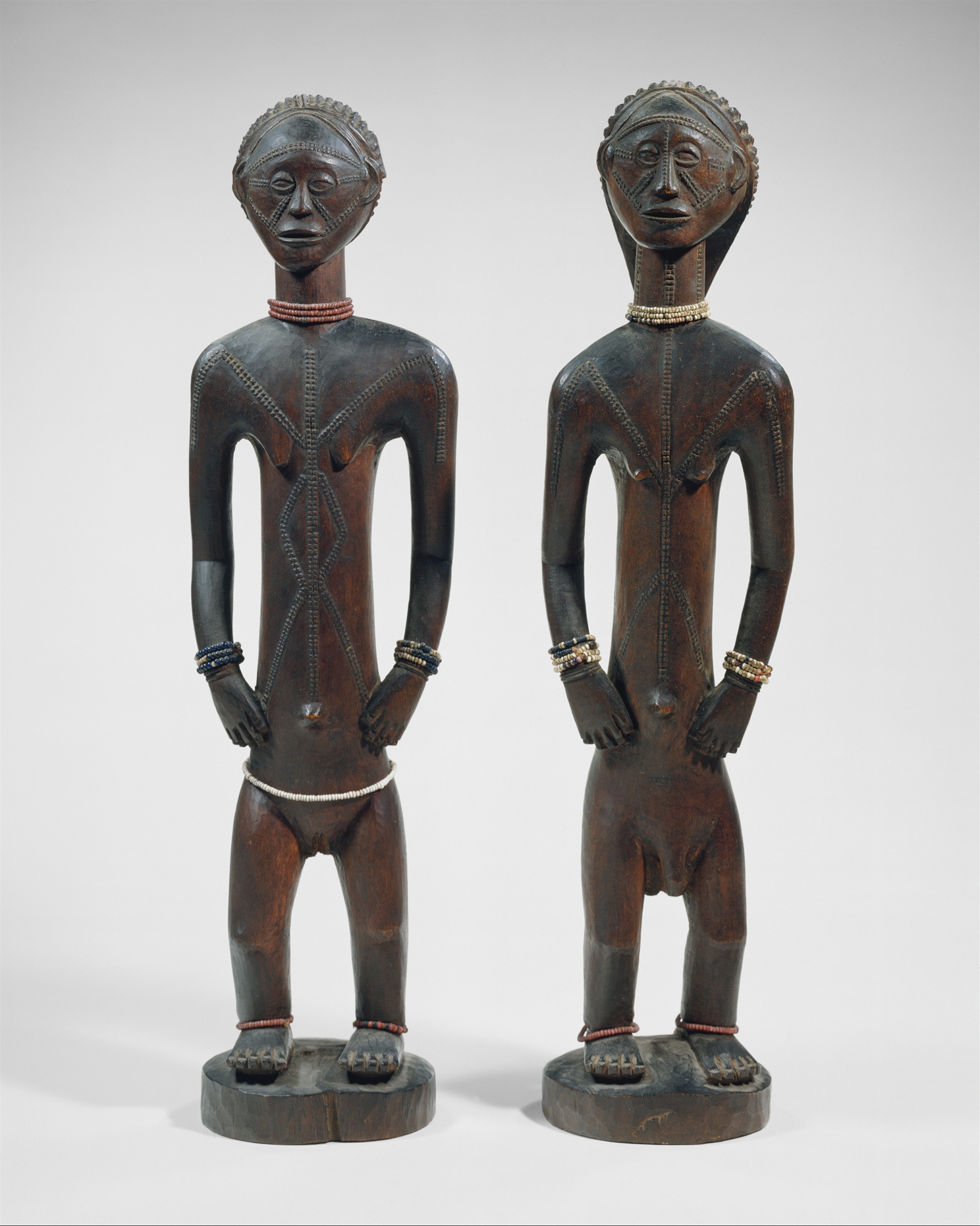
Standing Male and Female Figures: A Heritage Analysis for Katherine Fashion Lab
The paired standing figures from the Tabwa peoples of the Democratic Republic of the Congo represent a profound confluence of ancestral veneration, geometric abstraction, and social metaphysics. For Katherine Fashion Lab, these objects are not ethnographic curiosities but rather strategic repositories of design intelligence. This analysis deconstructs the symbolic power, historical adornment, and spiritual meaning of the figures, culminating in a 2026 high-end luxury strategy that translates their essence into wearable authority.
Symbolic Power: The Dialectics of the Pair
The Tabwa term butanda—referring to the rising of the new moon—encapsulates the figures' core symbolism. The male and female pair is not a binary opposition but a complementary unity reflecting cosmic and social order. The male figure often embodies lineage authority, holding implements of hunting or leadership, while the female figure signifies fertility and domestic continuity. However, their power lies in their co-presence: the figures are typically displayed together during initiations or chiefly investitures to model the ideal equilibrium of the community. The exaggerated, elongated torsos and flexed knees do not indicate anatomical error but rather a state of dynamic potential—the tension between the terrestrial and the ancestral realm. For a luxury house, this suggests that power is not monolithic; it is relational, requiring a dialogue between opposing forces—strength and nurture, lineage and innovation.
Historical Adornment: The Semiotics of Scarification and Beads
The surface of these figures is a cartography of identity. The intricate patterns of raised scarification—typically arranged in parallel chevrons and diamond motifs on the torso, arms, and face—are not decorative. They encode clan affiliations, achieved statuses, and protective charms. In Tabwa culture, the body was a canvas where social history was permanently inscribed, transforming flesh into a legible document. The beaded elements, often applied at the neck, waist, or ankles, introduce a contrasting texture. Beads were historically imported through Indian Ocean trade networks, making them objects of prestige and global connectivity. Their bright hues against the dark, polished wood symbolize the intersection of the internal (ancestral spirit) and the external (worldly wealth). This historical adornment strategy reveals a sophisticated understanding of layered communication: the wood speaks to permanence and nature, while the beads speak to commerce and ritual status.
Spiritual Meaning: Vessels of the Ancestral Gaze
Functionally, these figures served as mikisi—medicinal or protective charms activated by a ritual specialist. They were not idols but receptacles for ancestral spirits who could be petitioned for intervention in fertility, justice, or warfare. The figures' calm, downcast eyes are crucial: they do not confront the viewer but rather project an inward, omniscient focus. This posture suggests that true authority is introspective, not performative. The slight asymmetry in the figures' postures—a raised shoulder or a shifted hip—indicates a state of spiritual alertness, ready to receive divine instruction. For a modern audience, this translates into a concept of quiet luxury: power that does not shout but emanates from a centered, unshakeable core. The spiritual function of protection is also key. The figures were designed to shield the community from chaos; in a luxury context, this becomes a narrative of armor for the modern psyche—clothing and accessories that provide psychological resilience in volatile times.
2026 High-End Luxury Strategy: The "New Moon" Collection
Translating this heritage into a 2026 strategy requires a move beyond mere aesthetic appropriation toward conceptual transposition. Katherine Fashion Lab will position this analysis as the foundation for a capsule collection titled Butanda, named for the new moon.
Material and Textural Counterpoint
The primary design directive will be the juxtaposition of matte, dense surfaces (evoking polished wood) with high-luminosity, granular accents (evoking beads). For ready-to-wear, this manifests as structured, sculptural outerwear in dark, bonded wool or technical cashmere, cut with a severe, architectural line. The internal lining will feature a jacquard pattern derived directly from the Tabwa scarification motifs, visible only when the garment is in motion. This is a strategy of hidden revelation, rewarding the discerning client. For accessories, the figures' beading will be reimagined in high jewelry using black spinel and raw diamonds, set on matte blackened silver. The beads will not be strung but pavé-set in a raised, three-dimensional pattern, echoing the tactile relief of the original scarification. This creates a product that is simultaneously a nod to ritual body art and a contemporary statement of extreme craftsmanship.
Positioning and Narrative Architecture
The 2026 campaign will not use the word "tribal" or "ethnic." Instead, the narrative will center on relational authority and the geometry of resilience. The male and female figures will be referenced not as separate garments but as a system of pairings—a sharply tailored blazer and a fluid, columnar skirt; a severe necklace and a supple glove. The client is invited to compose their own "pair," recognizing that power is a dynamic balance. The brand will employ a limited-edition numbered release of 100 ensembles, each accompanied by a certificate that explains the specific Tabwa motif used, linking the owner to a lineage of protective symbolism. This is not luxury as excess, but luxury as curated meaning.
Retail Experience and Client Engagement
Katherine Fashion Lab will offer private appointments where the client experiences the physical figures through a high-resolution, 3D interactive scan. This digital encounter precedes the physical try-on, creating a moment of contemplative purchase. The retail environment will be dimly lit, with spotlights on the garments' geometric patterns, mimicking the effect of moonlight on the original figures. The strategic goal is to position the brand as a cultural translator—not a collector of objects, but a weaver of narratives that empower the contemporary individual with ancestral gravitas. By 2026, the market will favor brands that offer substantive heritage and psychological depth; the Butanda collection is designed to be the definitive answer to that demand.
Conclusion: From Object to Operating System
The Tabwa standing figures offer more than a visual vocabulary; they provide an operating system for power—one based on balance, inscription, and protective introspection. For Katherine Fashion Lab, the strategic imperative is to honor this system through rigorous material research and conceptual discipline. The 2026 strategy is not about reviving the past but about engineering a future aesthetic that carries the same weight of authority, the same precision of adornment, and the same spiritual calm. The figures stand as silent sentinels; the new collection must make their wisdom wearable.